South Fork Shenandoah River
Fly fishing in Virginia · Intermediate · Best seasons: Spring, Summer, Fall
Target Species
Smallmouth Bass, Sunfish, Catfish
About This Water
Scenic Shenandoah Valley river with excellent smallmouth bass. Float fishing paradise.
Fishing Recommendations
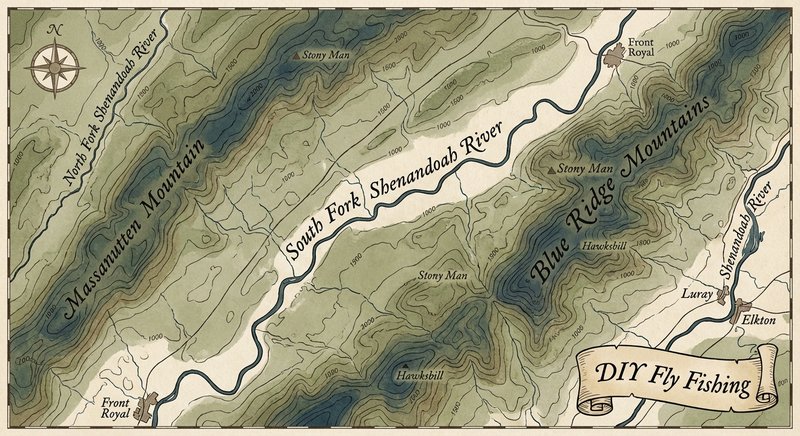
Welcome to the South Fork of the Shenandoah River, one of the premier smallmouth bass destinations in the Eastern United States. Flowing between the Blue Ridge Mountains to the east and the Massanutten Mountain range to the west, this river offers not just incredible fishing, but some of the most scenic views in the Mid-Atlantic.
As your guide, here is the lowdown on how to tackle this legendary water.
🎣 Location Overview
The South Fork is formed by the confluence of the North and South Rivers at Port Republic and flows north for about 100 miles to meet the North Fork at Front Royal.
What makes it special is its pool-and-riffle structure. Unlike the rocky, high-gradient mountain streams nearby, the South Fork is a broader, slower-moving limestone-influenced river. The water is generally alkaline, which leads to high insect biomass and healthy fish growth rates. Anglers love it because it is incredibly "fishable"—it’s easy to wade in many sections, but even better to float in a raft or drift boat to access the deeper ledges where the trophies hide.
🐟 Target Species & Behavior
Smallmouth Bass (The Star)
The "Bronzeback" is the king here. They are aggressive, hard-fighting, and highly visual hunters.
- Behavior: They hold in current breaks, behind large boulders, and along submerged limestone ledges.
- Feeding: They transition from aquatic insects (hellgrammites/mayflies) in the spring to crayfish and baitfish (shiners and chubs) as the summer progresses.
Sunfish (Redbreast & Bluegill)
The South Fork has a massive population of Redbreast Sunfish.
- Behavior: They are found in the slower "backwater" eddies and tight against wood debris/fallen trees.
- Feeding: They are opportunistic, hitting small poppers and nymphs with reckless abandon.
Channel & Flathead Catfish
While not the traditional fly target, they are abundant.
- Behavior: They sit in the deepest holes and under cut banks during the day.
- Feeding: If you want one on a fly, you’ll need heavy sink-tip lines and large, dark streamers (black or olive) bounced slowly off the bottom.
📅 Best Times to Fish
Spring (April - June)
- Window: Late April through June is the "Prime Time."
- Conditions: As water temps hit 55-60°F, fish become very active pre-spawn. This is when you'll find the largest fish in shallower water.
- Note: Avoid fishing directly over spawning beds (circular cleared nests) in May to protect the future of the fishery.
Summer (July - August)
- Window: Early morning and late evening.
- Conditions: The "Topwater Window." When the sun is high, fish move to deeper oxygenated water near riffles. Mid-day can be tough unless you use "low and slow" techniques.
Fall (September - October)
- Window: All day.
- Conditions: As water temps drop, Smallmouth go on a feeding binge to bulk up for winter. This is the best time for "numbers" and aggressive streamer strikes.
🪰 Recommended Flies & Techniques
Top Fly Patterns
- Topwater: Murdoch’s Wiggle Minnow (in silver/white), BoogleBugs (in "Electric Yellow" or "Chartreuse"), and Clouser Deep Minnows (Chartreuse/White).
- Sub-Surface: CK Hellgrammite (Black) — this is arguably the most important fly on the river.
- Crayfish: Near Nuff Crayfish or Clawman in olive or rusty orange.
Techniques
- The "Shenandoah Swing": Cast a streamer (like a Woolly Bugger or Clouser) slightly upstream, let it sink, and pulse it as it swings through the current at the head of a pool.
- The Popping Game: In summer, cast a hard-body popper tight to the bank. Let the rings dissipate before giving it a subtle "chug." Smallmouth often hit on the pause.
- Nymphing for Bass: Using a heavy hellgrammite pattern under a strike indicator through deep riffles is deadly when the fish aren't looking up.
💡 Pro Tips & Local Knowledge
- Focus on the Ledges: The South Fork is full of limestone ledges that run perpendicular to the current. Fish the "downstream" side of these ledges; bass sit in the soft water right behind the rock wall waiting for food to wash over.
- Match the Hellgrammite: If you see "Hellgrammite casings" on the rocks, put on a black, articulated fly. It is the "steak and potatoes" of the river.
- Color Transitions: In clear water, use natural colors (olive, brown, white). If the river gets "stained" (tea-colored) after a rain, switch to solid black or fluorescent chartreuse.
- Shifting Flows: Check the Front Royal or Luray USGS gauges. If the river is rising rapidly, stay home. If it’s "falling and clearing," the fishing will be lights-out.
⚠️ Important Information
Access
- Public Boat Ramps: The Virginia DWR maintains excellent ramps. Key stretches include Innskeep to Foster’s Landing and Bentonville to Overall.
- Wading: Access is available at Shenandoah River State Park and various bridge crossings, but be mindful of private property—in Virginia, the riverbed can be privately owned.
Regulations
- License: A valid Virginia Freshwater Fishing License is required.
- Regulations: Special "Slot Limits" often apply to Smallmouth Bass (e.g., all fish between 11–14 inches must be released). Check the latest DWR regulations as they can change by section.
Special Considerations
- Hydration & Sun: The Shenandoah valley gets incredibly hot and humid in July. Bring more water than you think you need.
- River Traffic: On summer weekends, the river can be crowded with "tubers." To have the water to yourself, launch at sunrise and be off the water by 11:00 AM.
Bug Hatches & Matching Flies
| Hatch | Type | Peak months | Time of day | Hook sizes | Matching flies |
|---|---|---|---|---|---|
| White Miller Ephoron leukon | mayfly | August, September | Evening | #12-14 | White Wulff #12-14, White Miller Paradox #12-14, Snowshoe Emerger #14 |
| Spotted Sedge Hydropsyche | caddis | May, June, July | Evening | #14-18 | Elk Hair Caddis (Tan) #14-16, Hydropsyche Larva #14-16, Pupa Sparkle Emerger #16 |
| Trico Tricorythodes | mayfly | July, August, September | Morning | #20-24 | Trico Spinner #20-22, RS2 (Black) #20-22 |
| Blue-Winged Olive Baetis | mayfly | April, October, November | Afternoon | #18-22 | Parachute BWO #18-20, Pheasant Tail #18-20 |
| Japanese Beetle Popillia japonica | terrestrial | July, August | All Day | #12-14 | Foam Beetle #12-14, Coffee's Sparkle Beetle #12 |
| Hex Hexagenia limbata | mayfly | June, July | Late Evening/Dusk | #6-8 | Hexagenia Dry #6-8, Hex Nymph #6-10 |
| Damselfly Calopteryx maculata | terrestrial | June, July, August | Afternoon | #10-12 | Braided Butt Damsel #10-12, Marabou Damsel Nymph #12 |
| Black Ant Formicidae | terrestrial | August, September | Afternoon | #14-18 | Chernobyl Ant #10-14, Black Foam Ant #16-18 |