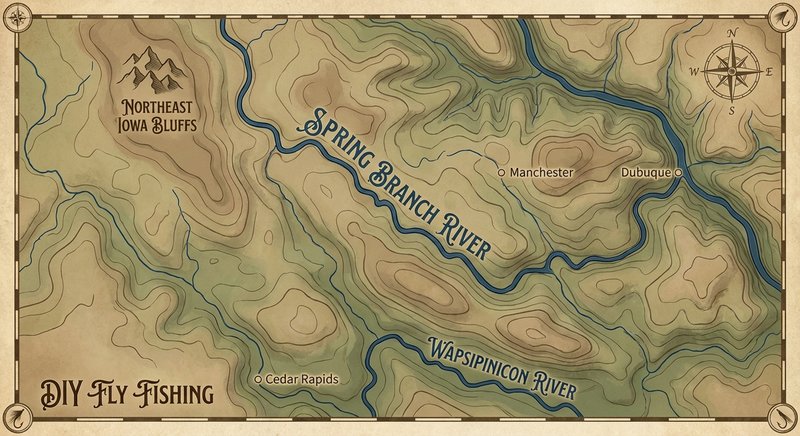
Spring Branch
Fly fishing in Iowa · beginner · Best seasons: spring, fall
Target Species
Rainbow Trout
About This Water
Delaware County spring creek with stocked trout. Easy access community fishing.
Fishing Recommendations
Welcome to one of the true gems of the Driftless Area. As your guide, I can tell you that Spring Branch Creek near Manchester, Iowa, is not your average Midwestern stream. It is a classic limestone spring creek that demands respect, tactical precision, and a bit of stealth.
Because it originates from a massive cold-water spring (and sits adjacent to a fish hatchery), the water temperature remains remarkably stable year-round, creating a fertile environment for some of the healthiest trout in the state.
🎣 Location Overview
Spring Branch is located just southeast of Manchester in Delaware County. What makes this water special is its high biomass. The limestone-rich water is a factory for aquatic insects and crustaceans.
The stream is characterized by crystal-clear water, deep undercut banks, and thick beds of aquatic vegetation (elodea and watercress). Unlike the rocky, tumbling streams of the West, Spring Branch is a "quiet" water. It is technical, smooth-surfaced, and requires a methodical approach. Anglers love it because it offers a "big fish" potential in a very intimate setting, but be warned: the fish here are highly educated.
🐟 Target Species & Behavior
- Rainbow Trout: These are the primary residents. While the creek receives stockings, the cold, stable water allows for significant "holdover" fish that become wild in their behavior. They are notoriously spooky.
- Brown Trout: You will also encounter wild Brown Trout here. They tend to dominate the undercut banks and deeper holes near overhead cover.
Behavior: Because the water is so clear, these fish see everything. They often hold in the "lanes" between weed beds. During a hatch, they will move into the shallow riffles or sit just inches below the surface in slow glides. When not rising, they are focused heavily on the bottom, gorging on scuds and sowbugs.
📅 Best Times to Fish
- Optimal Seasons:
- Spring (April – June): This is the prime window for hatches. The valley awakens, and the Blue-Winged Olives (BWO) and Caddis start moving.
- Fall (September – November): My personal favorite. The crowds thin out, the Browns are aggressive pre-spawn, and the BWO hatches return with a vengeance.
- Best Time of Day:
- Cloudy Days: This is the "secret sauce" for Spring Branch. Overcast skies cut the glare and make the fish much less skittish.
- Early Morning/Late Evening: During the heat of summer or bright sunny days, the "magic hour" before sunset is when the big fish move out of the shadows.
🪰 Recommended Flies & Techniques
Top Fly Patterns
- The "Pink Squirrel": A Driftless staple. Use a size 14-18. It mimics a variety of nymphs and scuds and is a consistent producer here.
- Scuds and Sowbugs: In sizes 16-20 (Grey, Olive, or Tan). These are the bread and butter of a Spring Branch trout's diet.
- Blue-Winged Olive (BWO): Sizes 18-22. Essential for those drizzly spring and fall afternoons.
- Elk Hair Caddis: Sizes 16-18. Great for "skittering" across the surface in the evenings.
- Hippie Stomper: A fantastic terrestrial/attractor for summer months.
Effective Techniques
- Nymphing: Use a "Tactical Nymphing" approach. Because the water is slow, a heavy strike indicator can splash and spook fish. Use a small "pinch-on" foam indicator or a New Zealand wool indicator.
- The "Dry-Dropper": A high-visibility dry fly with a small scud tied 18-24 inches below it is the most effective way to cover water without spooking fish.
- Streamers: Don't overlook a small Woolly Bugger (Black or Olive) swung deep into the undercut banks, especially after a rain when the water has a slight tint.
💡 Pro Tips & Local Knowledge
- Stay Out of the Water: The biggest mistake I see is people wading right into the middle of the stream. On Spring Branch, fish from the bank as much as possible. Your shadow and the pressure waves from wading will shut down a pool before you even cast.
- Long Leaders are Key: Use a 9-foot to 12-foot leader tapered down to 6X or even 7X tippet. These fish are extremely leader-shy due to the clarity and slow current.
- Observe First: Spend 5-10 minutes just watching a pool before you cast. Look for the subtle "sip" of a rising trout or the flash of a flank underwater.
- The Hatchery Reach: The section closest to the Manchester Fish Hatchery often holds the highest density of fish, but they are also the most pressured. If you want a more "wild" experience, hike further downstream.
⚠️ Important Information
- Access: Much of the fishable water is located within the Spring Branch Creek Wildlife Management Area. There is excellent public access and well-maintained parking lots near the hatchery.
- Regulations:
- Artificial Lures Only: You cannot use bait (worms, corn, etc.) on this stretch of water.
- Trout Fee: You must have a valid Iowa Fishing License and have paid the Trout Fee.
- Brown Trout Limit: There is a 14-inch minimum length limit on Brown Trout; all others must be released immediately if under that size (check current DNR signs at the trailhead for the most up-to-date specific bag limits).
- Special Considerations: The banks can be very muddy and slippery. While you don't always need to wade, good traction boots are a must. Also, please respect the "Leave No Trace" principles to keep this fragile spring creek pristine.
Tight lines, and enjoy the technical challenge of the Branch!
Bug Hatches & Matching Flies
| Hatch | Type | Peak months | Time of day | Hook sizes | Matching flies |
|---|---|---|---|---|---|
| Blue-Winged Olive (BWO) Baetis spp. | mayfly | March, April, September, October | Late Morning/Afternoon | #18-22 | RS2 #18-22, Parachute BWO #18-22 |
| Scuds Gammarus pseudolimnaeus | crustacean | Year-round | All Day | #14-18 | Ray Charles #14-18, Pink Scud #16-18 |
| Trico Tricorythodes spp. | mayfly | July, August, September | Early Morning | #20-24 | Trico Spinner #20-24, Drowned Trico #20-22 |
| Sulfurs Ephemerella invaria | mayfly | May, June | Evening | #14-16 | Sulfur Parachute #14-16, Sulfur Emerger #14-16 |
| Little Brown Sedge (Caddis) Glossosoma spp. | caddis | May, June | Evening | #16-18 | Elk Hair Caddis #16-18, Pupa/Soft Hackle #16-18 |
| Cressbugs (Sowbugs) Asellus intermedius | crustacean | Year-round | All Day | #14-18 | Sowbug #14-18, Tailwater Sowbug #16-18 |
| Chironomids (Midges) Chironomidae | midge | January, February, March | Late Morning/Afternoon | #18-24 | Zebra Midge #18-22, Griffith's Gnat #20-24 |
| Terrestrials (Ants/Beetles) Formicidae / Coleoptera | terrestrial | July, August, September | Midday/Afternoon | #12-18 | Cinnamon Ant #16-18, Foam Beetle #14-16 |
| Crane Fly Tipulidae | midge | August, September | Morning/Evening | #10-14 | Daddy Long Legs #10-12, Crane Fly Larva #10-12 |