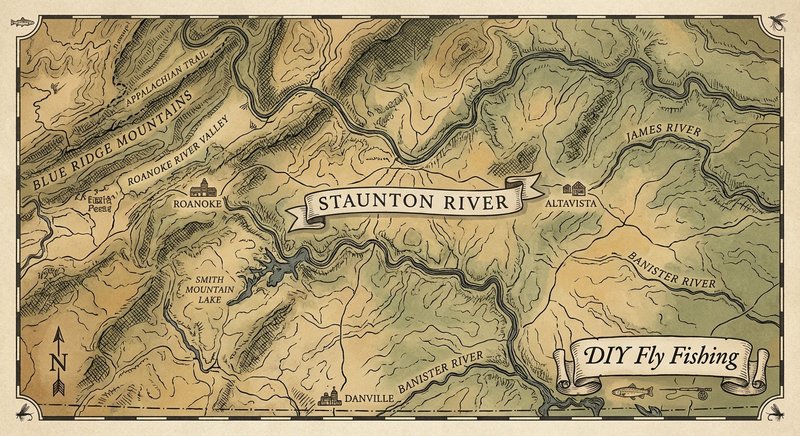
Staunton River
Fly fishing in Virginia · Intermediate · Best seasons: Spring, Summer, Fall
Target Species
Smallmouth Bass, Largemouth Bass, Striped Bass
About This Water
South-central Virginia river with excellent smallmouth and largemouth bass. Diverse fishery.
Fishing Recommendations
Welcome to one of the hidden gems of the Mid-Atlantic. As your guide, I can tell you that the Staunton River (the local name for the reach of the Roanoke River between Leesville Dam and Kerr Reservoir) offers some of the most diverse and exciting warm-water fly fishing in Virginia.
Whether you are chasing the legendary spring Striped Bass run or technical summer Smallmouth, this river demands respect and rewards the prepared angler.
🎣 Location Overview
The Staunton River is a designated State Scenic River, and for good reason. It transitions from a rocky, upland-style river with Class I-II rapids and shoals into a deeper, slower coastal-plain-style river.
What makes it special is its connectivity. Because it feeds into Kerr Reservoir (Buggs Island Lake), it serves as a massive nursery and a migratory corridor. The water is generally tea-colored but can clear up nicely during dry spells. Anglers love it because it feels "wilder" than the James or the New River—you’ll see more bald eagles and ospreys than people on many stretches.
🐟 Target Species & Behavior
Striped Bass (Landlocked)
- Behavior: These are "landlocked" stripers that migrate up from Kerr Reservoir to spawn in the rocky shoals near Brookneal. They are aggressive, powerful, and travel in schools.
- Hold: During the run, look for them in deep "staging" pools during the day and moving into shallower fast-moving shoals to spawn/feed at low light.
- Diet: Primarily Gizzard Shad and Threadfin Shad.
Smallmouth Bass
- Behavior: The "working man’s" fish of the Staunton. They are incredibly hardy and punch way above their weight class in the river's current.
- Hold: Look for "edges"—the seam where fast water meets slow water, the downstream side of large boulders, and undercut banks.
- Diet: Crayfish, Hellgrammites (Dobsonfly larvae), and Minnows.
Largemouth Bass
- Behavior: More sedentary than the Smallmouth.
- Hold: Focus on the "slacker" water. Log jams, lily pad edges in the lower stretches, and deep, slow eddies.
- Diet: Frogs, bluegill, and larger baitfish.
📅 Best Times to Fish
- Spring (April – May): The Prime Window. This is the Striped Bass migration. Mid-April to Mother’s Day is usually the peak. Water temps between 58°F and 65°F trigger the most activity.
- Summer (June – August): Best for Smallmouth Bass. As the water warms, the metabolism of the bass skyrockets. This is prime time for topwater action.
- Fall (September – early November): The "feeding frenzy." As temperatures drop, fish move to deeper pools but feed aggressively to bulk up for winter. This is your best chance at a trophy-sized Smallmouth.
- Time of Day: During the summer, the "magic hour" is the first two hours of light and the last hour of dusk for topwater. For Stripers in the spring, overcast days are often more productive than bright, sunny ones.
🪰 Recommended Flies & Techniques
For Striped Bass
- Flies:
- Clouser Minnow (Size 1/0 to 3/0) in Chartreuse/White or Grey/White. This is the gold standard.
- Half and Half (A cross between a Deceiver and a Clouser).
- Game Changers in white for realistic shad imitation.
- Technique: Use a 7-9wt rod with a 250-350 grain sinking tip line. You must get the fly down to the fish in the current. Cast across and slightly upstream, let it sink, and use erratic, hard strips.
For Smallmouth & Largemouth
- Flies:
- Topwater: BoogleBugs (Poppers), Murdich Minnows (sub-surface), and Stealth Bombers.
- Sub-surface: Nearnuff Crayfish, Game Changers, and Woolly Buggers (Olive or Black).
- Nymphs: Hellgrammite imitations (Pat’s Rubber Legs in dark colors).
- Technique: For Smallies, "swing" your streamers through the riffles like you would for trout, or "pop-and-pause" poppers near shoreline structure.
💡 Pro Tips & Local Knowledge
- The Brookneal Focus: If you are after Stripers, the town of Brookneal is your headquarters. The "Catfish Hotel" and the shoals near the public boat landing are legendary.
- Flows are Everything: The Staunton is influenced by releases from the Leesville Dam. Check the USGS gauges at Brookneal. If the river is spiking/muddy, the fishing will be tough. Ideally, you want a steady or slowly dropping flow.
- The "Figure Eight": When Striper fishing, don't pull your fly out of the water too fast at the end of a retrieve. These fish often follow the fly right to the boat or bank.
- Go Big on Leaders: For Stripers, don't mess around with 5x trout tippet. Use a stout 20lb fluorocarbon leader. Smallmouth are less line-shy here than in spring creeks; 10lb-12lb (1x-0x) is standard.
⚠️ Important Information
Access Points
- Leesville Dam: High-gradient, very rocky. Best for wading during low flow.
- Altavista (Dalton’s Landing): Good Smallmouth water.
- Brookneal: The epicenter for the Striper run.
- Long Island: Great mid-river access for kayaks.
- Staunton River State Park: Where the river meets the lake; best for Largemouth and late-season Stripers.
Regulations & Permits
- A Virginia Freshwater Fishing License is required.
- Striper Slot Limits: Virginia has very specific "no-take" slots and seasons for Striped Bass on the Staunton to protect spawning females. Check the current VDWR (Virginia Department of Wildlife Resources) regulations before keeping any fish. Most fly anglers practice 100% catch and release here.
Safety
- Wading: The rocks in the Staunton are notoriously slippery. Felt soles or studs are highly recommended.
- Navigation: This is a "boney" river. If you are in a drift boat or a motorboat, be extremely careful of submerged rock ledges. Kayaks and rafts are the preferred vessels for most of the river.
Tight lines, and enjoy the pull of a Staunton River "bronze back" or "silver bullet!"
Bug Hatches & Matching Flies
| Hatch | Type | Peak months | Time of day | Hook sizes | Matching flies |
|---|---|---|---|---|---|
| White Miller Ephoron leukon | mayfly | August, September | Evening/Night | #12-14 | White Wulff #12-14, Ephoron Spinner #14, White Miller Emerger #12-14 |
| Tan Caddis Hydropsyche | caddis | April, May, June, September | Evening | #14-18 | Elk Hair Caddis (Tan) #14-16, Pupa-Le-Do #14-18, Soft Hackle Hare's Ear #14-16 |
| Hellgrammite Corydalus cornutus | stonefly | June, July, August | All Day | #2-8 | Murray's Hellgrammite #4-8, Bitch Creek Nymph #6-10, Adult Dobsonfly #2-6 |
| Blue-Winged Olive Baetis | mayfly | March, April, October, November | Afternoon | #18-22 | BWO Sparkle Dun #18-22, Pheasant Tail Nymph #18-22, RS2 #20-22 |
| Trico Tricorythodes | mayfly | July, August, September | Morning | #20-24 | Trico Spinner #22-24, Griffith's Gnat #20-22, Trico Nymph #22 |
| Common Damselfly Calopteryx maculata | terrestrial | June, July, August | Midday | #10-12 | Adult Damselfly (Blue) #10-12, Marabou Damselfly Nymph #12, Damsel Bugger #10 |
| Hex Hexagenia rigida | mayfly | June, July | Evening/Dusk | #6-10 | Hexagenia Dry #6-8, Hex Nymph #8, Yellow Humpy #10 |
| Terrestrial Ants and Beetles Formicidae/Coleoptera | terrestrial | July, August, September | All Day | #10-16 | Chernobyl Ant #8-12, Foam Beetle #12-16, Fur Ant #14-16 |