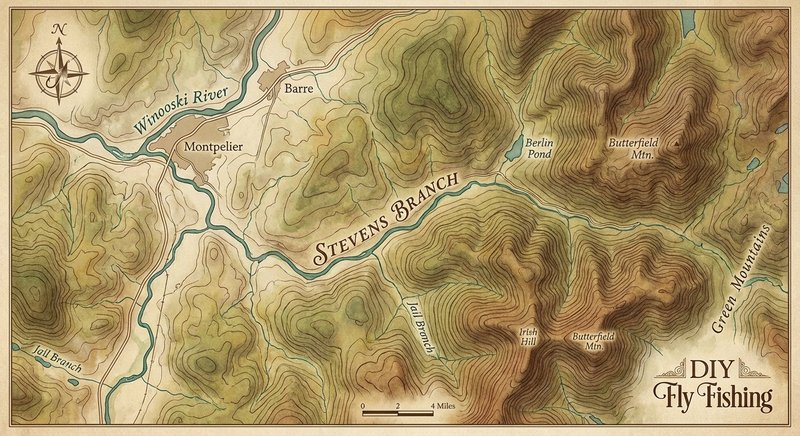
Stevens Branch
Fly fishing in Vermont · Beginner · Best seasons: Spring, Summer, Fall
Target Species
Brown Trout, Rainbow Trout
About This Water
Central Vermont tributary to the Winooski. Good brown trout fishing near Barre.
Fishing Recommendations
As an expert guide who has spent significant time traversing the freestone waters of the Green Mountain State, I can tell you that the Stevens Branch is one of Vermont’s most underrated "sleeper" fisheries.
Flowing through the heart of Washington County—specifically the Barre and Montpelier area—it is a major tributary to the Winooski River. While it often takes a backseat to the big water of the Winooski or the scenic beauty of the Mad River, the Stevens Branch offers exceptional pocket water, surprising numbers of wild fish, and a unique urban-meets-nature fishing experience.
🎣 Location Overview
The Stevens Branch is a classic Vermont freestone stream that drains a significant portion of the central plateau. What makes it special is its resilience and diversity. It transitions from a small, high-gradient mountain stream in its upper reaches to a medium-sized river as it moves through Barre and into Montpelier.
Anglers love it because it is "workable" water. It’s not so large that you need a drift boat, yet it’s large enough to reward technical casting. The substrate is largely granite cobble and ledge rock, creating an abundance of "pocket water"—small, oxygenated holding spots behind boulders that are a fly fisherman's dream. Because it flows through developed areas, it is often overlooked by "scenic" tourists, meaning less pressure for those willing to fish under a bridge or behind a local business.
🐟 Target Species & Behavior
The Stevens Branch is primarily a Brown and Rainbow Trout fishery.
- Brown Trout: These are the kings of the Stevens. You’ll find wild, buttery-yellow browns in the deeper undercut banks and beneath the shadows of old stone walls. They are wary and tend to hold in the "darker" water—under overhanging branches or in the deeper tail-outs of pools during low light.
- Rainbow Trout: Found more frequently in the faster, bubblier "white water" and riffles. They are opportunistic feeders and will often strike aggressively at nymphs and dry flies in the oxygenated runs.
- Behavior: During the spring, fish are found in the slower seams to conserve energy. As the water warms in summer, they move into the fastest, most oxygenated water available.
📅 Best Times to Fish
Seasons
- Spring (Late April – June): This is the prime window. Once the snowmelt (runoff) subsides and the water hits 50°F, the fish become extremely active. This coincides with the major Hendrickson and Quill Gordon hatches.
- Summer (July – August): Water levels can get low and temperatures can rise. Focus on the early mornings (6 AM – 10 AM) or the "last light" evening sessions. If the water exceeds 68°F, give the trout a break and head to higher elevations.
- Fall (September – October): A spectacular time. The Brown Trout become aggressive as they prepare for the spawn. Streamer fishing is at its peak during this time.
Prime Windows
- The "Evening Rise": In June and July, the hour before sunset is legendary on the Stevens for caddis and Blue Winged Olive activity.
🪰 Recommended Flies & Techniques
Top Fly Patterns
- Nymphs:
- Pheasant Tail (14-18): A staple for mimicking the abundant Mayfly nymphs.
- Pat’s Rubber Legs (8-12): Essential for high-water spring fishing (mimics Stoneflies).
- Zebra Midge (18-22): Crucial for picky fish in the slower pools near Montpelier.
- Dry Flies:
- Elk Hair Caddis (14-16): The "go-to" searcher pattern for the Stevens.
- Parachute Adams (14-20): Works during almost any hatch.
- Stimulators (10-12): Great for the faster pocket water in the upper sections.
- Streamers:
- Woolly Bugger (Black or Olive): Dead-drifted or swung through deep holes.
Techniques
- Tight-Line (Euro) Nymphing: This is arguably the most effective way to fish the Stevens Branch. Because of the rocky bottom and varied currents, a traditional indicator often creates too much drag. A tight-line rig allows you to probe the deep pockets behind boulders effectively.
- Dry-Dropper: In the summer, a size 12 Stimulator with a size 16 Pheasant Tail dropper is a lethal combination for covering water quickly.
💡 Pro Tips & Local Knowledge
- The "Urban Secret": Don't be afraid to fish the stretches right through the city of Barre. Some of the largest holdover Brown Trout in the system live in the deep, oxygenated holes created by man-made structures and bridge abutments.
- Focus on the "Confluence": The area where the Stevens Branch meets the Winooski in Montpelier is a "fish highway." Large trout from the Winooski often move into the Stevens to seek thermal refuge or to follow baitfish.
- Shadow Management: Because the river is relatively narrow in spots, your shadow can spook fish easily. Always fish "up-stream" and stay low when approaching the banks.
⚠️ Important Information
- Access: Access is generally good due to the river’s proximity to Route 302 and Route 14. There are several pull-offs and public parks. However, always respect private property signage, especially in the more rural stretches above Barre.
- Regulations: The Stevens Branch falls under Vermont General Trout Fishing Regulations.
- Season: Generally 2nd Saturday in April to Oct 31st.
- Catch & Release: While some sections allow harvest, I highly recommend practicing catch and release to preserve the wild trout populations in this hardworking stream.
- Permits: A valid Vermont Fishing License is required. You can purchase these easily online via the Vermont Fish & Wildlife website.
- Wading Safety: The rocks in the Stevens can be incredibly slick (covered in "didymo" or rock snot in some years). Felt-soled boots or studs are highly recommended.
Guide’s Final Word: The Stevens Branch isn't the "prettiest" river in Vermont in the traditional sense, but for the angler who values high fish counts and technical pocket water over mountain vistas, it is a gold mine. Tight lines!
Bug Hatches & Matching Flies
| Hatch | Type | Peak months | Time of day | Hook sizes | Matching flies |
|---|---|---|---|---|---|
| Blue-Winged Olive (BWO) Baetis spp. | mayfly | April, May, September, October | Mid-day/Afternoon | #18-22 | RS2 #18-22, Parachute Adams #18-22, Pheasant Tail #18-20 |
| Hendrickson Ephemerella subvaria | mayfly | May | Afternoon | #12-14 | Hendrickson Sparkle Dun #12-14, Red Quill #14, Hare's Ear #12-14 |
| Grannom Caddis Brachycentrus occidentalis | caddis | May | Morning/Evening | #14-16 | Elk Hair Caddis (Olive) #14-16, Deep Sparkle Pupa #14-16, Holy Grail #14-16 |
| March Brown Maccaffertium vicarium | mayfly | May, June | Afternoon | #10-12 | March Brown Spinner #10-12, Gold Ribbed Hare's Ear #10-12 |
| Sulphur Ephemerella invaria | mayfly | June | Evening | #14-18 | Sulphur Parachute #14-18, Sulphur Emerger #16-18 |
| Light Cahill Stenacron interpunctatum | mayfly | June, July | Evening | #12-14 | Light Cahill #12-14, Cahill Wet Fly #12-14 |
| Golden Stonefly Acronuria abnormis | stonefly | June, July | Morning/Evening | #8-12 | Pat's Rubber Leg #8-12, Stimulator (Orange/Yellow) #8-12 |
| Spotted Sedge Hydropsyche spp. | caddis | June, July, August | Evening | #14-18 | Tan Elk Hair Caddis #14-18, LaFontaine's Emergent Pupa #14-16 |
| Terrestrials Formicidae / Coleoptera | terrestrial | July, August, September | Daytime | #12-18 | Black Foam Ant #16-18, Chernobyl Ant #10-12, Joan Wulff’s Hoppers #12-14 |
| Zebra Midge Chironomidae | midge | March, April, November | Anytime | #18-24 | Zebra Midge #18-22, Griffith's Gnat #18-22 |