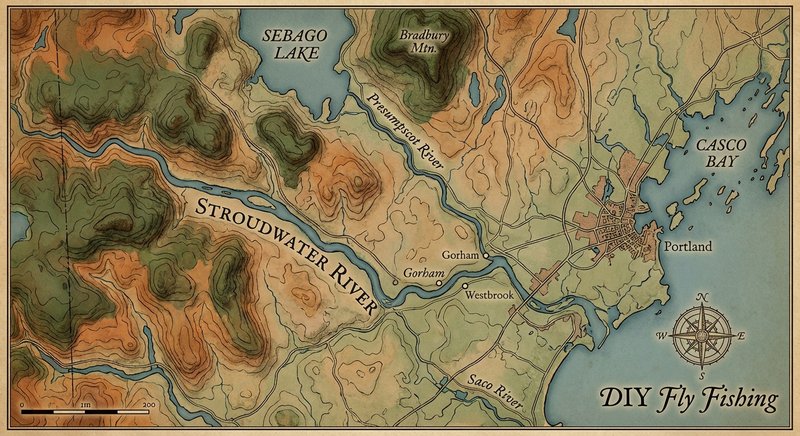
Stroudwater River
Fly fishing in Maine · Intermediate · Best seasons: Spring, Fall
Target Species
Sea-Run Brown Trout, Brook Trout
About This Water
Greater Portland area stream with sea-run brown trout. Urban fishing opportunity.
Fishing Recommendations
The Stroudwater River is one of Maine’s "hidden in plain sight" gems. Flowing through the heart of the Greater Portland area, it offers a surprisingly wild experience for an urban/suburban stream. It is a small, coastal river characterized by intimate pools, tight canopy cover, and a unique tidal influence that brings in the legendary sea-run brown trout.
Here is your comprehensive guide to fly fishing the Stroudwater River.
🎣 Location Overview
The Stroudwater is a small, tea-colored coastal stream that originates in Buxton and flows through Westbrook and Portland before emptying into the Fore River estuary. What makes it special is the juxtaposition of its location and its inhabitants; you can be fishing for wild-behaving sea-run browns while hearing the distant hum of the Portland International Jetport.
The water is generally slow-moving with a silt and gravel bottom. It is heavily forested along its banks, meaning casting is technical and "bow-and-arrow" casts are often more useful than a double-haul. The lower reaches are brackish and tidal, while the upper sections feel like a classic Maine brook trout stream.
🐟 Target Species & Behavior
- Sea-Run Brown Trout: These are the "ghosts" of the Stroudwater. These fish spend time in the salt of Casco Bay to feed and return to the river to spawn or find thermal refuge. They are notoriously spooky, incredibly strong, and often take on a silvery, chrome appearance.
- Brook Trout: You will find both stocked and some wild "salter" brook trout. They are generally smaller (6–10 inches) but are vibrant and aggressive feeders.
- Behavior: In this small water, trout are extremely sensitive to vibration and overhead movement. They hold in deep undercut banks, beneath fallen logs (deadfall), and in the dark shadows of the overhanging canopy. During the incoming tide, sea-run fish will push up into the lower pools.
📅 Best Times to Fish
- Spring (Late April – June): This is the prime window. As the water warms, the "smolt run" occurs, and sea-run browns follow baitfish inland. Look for the "Hendrickson" hatch in May.
- Fall (September – October): Brown trout become aggressive as they prepare to spawn. The cooler temperatures bring fish back up from the deeper, cooler estuary waters.
- Time of Day: Early morning (dawn) and late evening (dusk) are paramount here. Because the water is shallow and clear in spots, low-light conditions are your best friend.
- The Tidal Factor: In the lower sections (below Congress Street), the incoming tide is often the most productive, as it pushes fresh water and baitfish into the river system.
🪰 Recommended Flies & Techniques
Top Fly Patterns
- Streamers: This is a "meat and potatoes" river for browns.
- Black or Olive Woolly Buggers (Size 8-12)
- Muddler Minnows (to mimic mummichogs/sculpins)
- Grey Ghosts (A Maine classic for landlocked and sea-run fish)
- Nymphs: When the water is low or the fish are finicky.
- Pheasant Tails (Size 14-18)
- Prince Nymphs (Size 12-14)
- Dry Flies: For the spring hatches or summer evenings.
- Elk Hair Caddis (Size 14-16)
- Adams (Size 16)
- Terrestrials: Black ants and beetles in late summer.
Techniques & Presentation
- Stealth Nymphing: Use a high-sticking method with minimal fly line on the water. Indicators should be small and subtle (or use a "dry-dropper" rig).
- The "Twitch" Streamer Retrieve: Cast your streamer tight to the opposite undercut bank. Instead of long strips, use short, erratic twitches to mimic a wounded minnow.
- Dapping: In the tightest sections near the Stroudwater River Trail, you may not even cast. Simply poke your rod through the brush and drop the fly into the pocket water.
💡 Pro Tips & Local Knowledge
- Think Like a Predator: The biggest browns in this river stay hidden during the day. If you want a trophy, fish during a light rain or on a heavily overcast day. This breaks up the surface glare and makes the fish feel secure enough to leave their woody debris.
- Wading Caution: The bottom can be very silty and "mucky" in the lower sections. Be careful not to get stuck, and try to avoid wading as much as possible to keep from sending plumes of silt downstream, which will alert every fish to your presence.
- Shadow Management: Always keep the sun in front of you if possible. If your shadow falls across a pool on the Stroudwater, the fishing in that pool is effectively over for the next 30 minutes.
⚠️ Important Information
- Access:
- The Stroudwater River Trail: Excellent access from Congress Street (near the Portland West End) and from outer Congress near the Westbrook line.
- Hinckley Park: Provides access to the upper reaches.
- Regulations: The Stroudwater has specific regulations that can change. Generally, it falls under General Law for South Zone, but parts are Catch and Release or have specific bag limits for trout.
- Always check the current Maine IFW Open Water Fishing Laws before heading out.
- Keep it Cold: This is a fragile fishery. In mid-summer, the water temperatures can rise to dangerous levels for trout (above 68°F). If the water is warm, please give the fish a break and wait for the fall.
- Tick Safety: The brush along the Stroudwater is prime habitat for deer ticks. Wear long pants and use repellent.
Bug Hatches & Matching Flies
| Hatch | Type | Peak months | Time of day | Hook sizes | Matching flies |
|---|---|---|---|---|---|
| Blue Winged Olive Baetis | mayfly | April, May, September, October | Mid-day | #18-22 | RS2 #20-22, Parachute Adams #18-22, BWO Sparkle Dun #18-20 |
| Hendrickson Ephemerella subvaria | mayfly | May | Afternoon | #12-14 | Red Quill #12-14, Pheasant Tail #12-14, Hendrickson Emerger #14 |
| Grannom Caddis Brachycentrus | caddis | May | Morning/Afternoon | #14-16 | Peacock Caddis #14-16, Deep Sparkle Pupa #14-16, Elk Hair Caddis (Black/Olive) #14-16 |
| Sulphurs Ephemerella dorothea | mayfly | June, July | Evening | #16-18 | Sulphur Parachute #16-18, Sulphur Emerger #16-18, Hare's Ear #16-18 |
| Light Cahill Stenacron interpunctatum | mayfly | June, July | Evening | #12-14 | Light Cahill #12-14, Gold Ribbed Hare's Ear #12-14 |
| Trico Tricorythodes | mayfly | July, August, September | Early Morning | #22-26 | Trico Spinner #22-24, Zebra Midge #22 |
| Terrestrials Formicidae / Coleoptera | terrestrial | July, August, September | All Day | #12-18 | Black Foam Ant #14-18, Crowe Beetle #12-16, Cricket #10-12 |
| Tan Caddis Hydropsyche | caddis | June, July, August | Evening | #14-16 | Elk Hair Caddis (Tan) #14-16, Hydropsyche Larva #14-16, LaFontaine's Emergent Sparkle Pupa #14-16 |