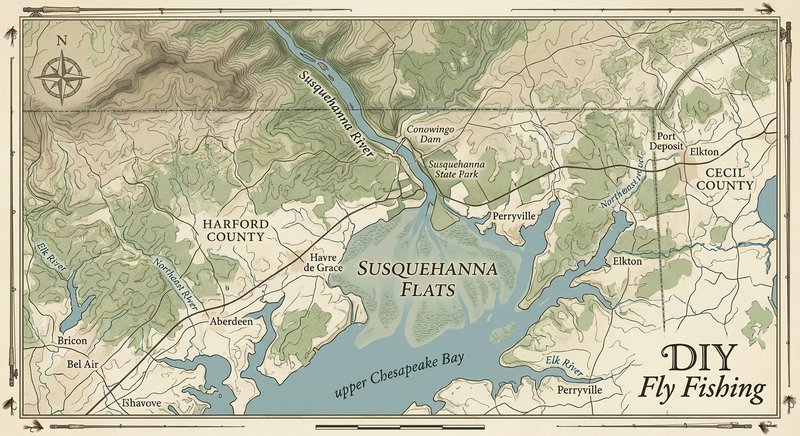
Susquehanna Flats
Fly fishing in Maryland · Intermediate · Best seasons: Spring, Summer, Fall
Target Species
Striped Bass, Largemouth Bass, White Perch
About This Water
Upper Chesapeake Bay with excellent bass fishing. Famous striped bass spawning area.
Fishing Recommendations
Welcome to one of the most legendary fly fishing destinations on the East Coast. As a guide, I consider the Susquehanna Flats to be a "bucket list" location for any serious salt or brackish water angler.
This is a massive, shallow-water delta where the Susquehanna River meets the Chesapeake Bay. It is a world of grass, tides, and some of the largest Striped Bass you will ever see in three feet of water.
🎣 Location Overview
The "Flats" comprise roughly 50 square miles of submerged aquatic vegetation (SAV) and sandy shoals. What makes this area special is its freshwater-dominant environment. Because of the massive outflow from the Susquehanna River, the water is often fresh enough to host Largemouth Bass alongside saltwater Striped Bass.
Anglers love it because it offers "sight fishing" opportunities that feel more like the Florida Keys than the Mid-Atlantic. In the spring, the water can be gin-clear, allowing you to see 40-inch Striped Bass cruising the sandbars. It is a high-stakes, high-reward fishery where the wind and the tide dictate everything.
🐟 Target Species & Behavior
Striped Bass (Rockfish)
The undisputed king of the Flats. In the Spring, migratory monsters (30–50+ inches) move onto the flats to feed on herring and shad before or after spawning. They are predatory and territorial. In Summer and Fall, "resident" fish (18–28 inches) take over, hiding in the grass and blitzing on silversides and menhaden.
Largemouth Bass
The Flats host a world-class Largemouth fishery. These fish live deep inside the massive milfoil and hydrilla beds. They are typically thicker and stronger than pond bass because they have to fight tidal currents. They feed heavily on bluegill, crawfish, and small perch.
White Perch
Often ignored until you hook one on a 4-weight, these are the "panfish of the bay." They school in the thousands along the edges of channels and over hard-bottom sections. They are aggressive feeders and provide non-stop action when the bigger species are finicky.
📅 Best Times to Fish
- Spring (April – mid-May): This is the "Trophy Season." The focus is entirely on large migratory Striped Bass. It is strictly catch-and-release during this window (check MD DNR for specific dates).
- Summer (June – August): Best for Largemouth Bass and resident Stripers. You must fish the "low light" windows. Be on the water at 5:00 AM. Once the sun gets high and the jet skis come out, the bite shuts down.
- Fall (September – November): The "Fall Blitz." As temperatures drop, fish feed heavily for winter. Look for diving birds and surface activity.
- The Golden Rule: The Tide. You want moving water. An incoming tide brings cooler, clearer bay water onto the flats; an outgoing tide pulls baitfish out of the grass. Avoid "slack tide" (the hour when the water stops moving).
🪰 Recommended Flies & Techniques
Top Patterns
- For Striped Bass:
- Clouser Minnow: (Chartreuse/White or Grey/White) - The gold standard.
- Bob’s Banger: Large foam poppers for explosive topwater strikes.
- Lefty’s Deceiver: In 2/0 to 4/0 for mimicking adult Menhaden.
- For Largemouth:
- Dahlberg Diver: Excellent for fishing over the edges of grass.
- Hollow Fleyes: Tied weedless to get into the thick vegetation.
- For White Perch:
- Size 8–10 Woolly Buggers or tiny Clousers in pink/white.
Techniques
- The "Susky Strip": These fish like speed. Use a two-handed strip (rod under arm) to keep the fly moving fast. If a Striper is following, do not stop—speed up.
- Intermediate Lines: For the Flats, a slow-sinking intermediate line is more versatile than a floating line, as it cuts through the wind and keeps your fly just above the grass.
- Topwater: Use a heavy fluorocarbon leader (20–30lb) to turn over big poppers.
💡 Pro Tips & Local Knowledge
- The Wind is Your Enemy: The Flats are shallow and wide open. A sustained wind from the South can "muddy up" the water in an hour. If the visibility is less than 12 inches, the fly fishing will be grueling. Always check the turbidity reports.
- Find the "Drains": As the tide goes out, look for small "rivers" or depressions in the grass beds. Baitfish are forced out of these channels, and predators sit at the mouth of the drain like a conveyor belt of food.
- Stealth Matters: Even though these are big fish, they are incredibly "spooky" in 3 feet of water. If you have a trolling motor, use it on low. If you have a push pole, use it. A slamming locker lid can clear a flat.
- The "Stumps": There is a famous area near the mouth of the Northeast River known as the "Stump Field." It holds massive Largemouth, but it is a propeller graveyard. Navigate with extreme caution.
⚠️ Important Information
Access
- Havre de Grace (Tydings Park): Best for accessing the western side of the Flats.
- North East Community Park: Best for accessing the eastern side and the "Stump" fields.
- Elk Neck State Park (Rogues Harbor): Great central access.
Regulations & Permits
- You must have a Maryland Chesapeake Bay & Coastal Sport Fishing License.
- Striped Bass Regulations change annually and seasonally. Maryland frequently closes the season or implements "no-targeting" windows to protect spawning fish. Always check the Maryland DNR website before launching.
Safety
- The Susquehanna Flats can go from glass-calm to 3-foot whitecaps in minutes.
- Watch your depth sounder. It is very easy to get grounded on a sandbar during an outgoing tide, leaving you stranded for 6 hours until the water returns.
Guide’s Final Word: Respect the Flats. When you hook a 40-inch Striper in water so shallow you can see its dorsal fin, you’ll understand why we call this place the "Promised Land" of the Chesapeake. Tight lines!
Bug Hatches & Matching Flies
| Hatch | Type | Peak months | Time of day | Hook sizes | Matching flies |
|---|---|---|---|---|---|
| White Fly Ephoron leukon | mayfly | August, September | Evening | #12-14 | White Wulff #12-14, Ephoron Nymph #12-14, White Poly Spinner #12-14 |
| Giant Willow Fly Hexagenia limbata | mayfly | June, July | Evening/Night | #4-8 | Hexagenia Spinner #6-8, Burrowing Mayfly Nymph #4-8, Yellow Humpy #8 |
| Tan Caddis Hydropsyche | caddis | May, June, September | Evening | #14-18 | Elk Hair Caddis (Tan) #14-16, LaFontaine's Deep Sparkle Pupa #14-18, Hydropsyche Larva #14-16 |
| Tricos Tricorythodes | mayfly | July, August, September | Morning | #20-24 | Trico Spinner #20-24, Trico Dun #22, RS2 (Black) #20-24 |
| Midges Chironomidae | midge | March, April, October, November | All Day | #18-24 | Zebra Midge #18-22, Griffith's Gnat #18-20, Top Secret Midge #20-24 |
| Blue-Winged Olive Baetis | mayfly | April, May, October | Afternoon | #18-22 | BWO Sparkle Dun #18-20, Pheasant Tail Nymph #18-22, BWO Emerger #18-22 |
| Light Cahill Stenacron interpunctatum | mayfly | May, June | Evening | #12-16 | Light Cahill #12-14, Gold Ribbed Hare's Ear #12-16, Cream Usual #14 |
| Terrestrials (Ants/Beetles) Formicidae / Coleoptera | terrestrial | July, August | Afternoon | #12-18 | Chernobyl Ant #12-14, Black Foam Beetle #14-16, Cinnamon Flying Ant #16-18 |