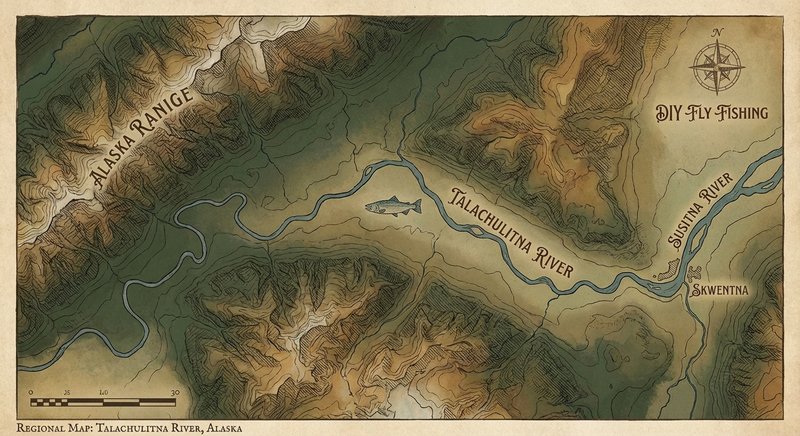
Talachulitna River
Fly fishing in Alaska · Intermediate · Best seasons: Summer, Fall
Target Species
Rainbow Trout, Silver Salmon, King Salmon
About This Water
Clear water tributary of the Skwentna. Excellent rainbow trout and salmon fishing.
Fishing Recommendations
Welcome to "The Tal." As a guide who has spent many seasons navigating the wild waters of Southcentral Alaska, I can tell you that the Talachulitna River is the gold standard for a remote, fly-in angling experience. It was Alaska’s first designated "Float Fishery" and remains a "Wild and Scenic River," ensuring its rugged beauty remains untouched.
Here is your professional guide to fishing the Talachulitna.
🎣 Location Overview
The "Tal" is located roughly 80 air miles northwest of Anchorage in the Susitna River drainage. It is a classic Alaskan freestone river, characterized by crystal-clear water, gravel bars, and a diverse structure ranging from tight braids in the upper reaches to a dramatic, boulder-strewn canyon in the lower section.
What makes it special is the variety and intimacy. Unlike the massive glacial rivers of the state, the Tal is "human-scaled." You can read the water easily, wade most sections comfortably, and see the fish you are targeting. It offers some of the best leopard-spotted Rainbow Trout fishing in the world, set against the backdrop of the Alaska Range.
🐟 Target Species & Behavior
Rainbow Trout
The Tal is famous for its "Leopard" Rainbows—vividly spotted, hard-fighting wild fish.
- Behavior: Early season, they are aggressive insect hunters. Once the salmon arrive, they become "egg-vacuums," following the spawning salmon upstream and holding immediately behind active redds (nests).
- Feeding: They transition from stoneflies and sculpins in June to salmon eggs in July/August, and finally to decaying salmon flesh in September.
King Salmon (Chinook)
- Behavior: These are the giants of the river. They enter the system in June. They hold in deep, slow-moving pools and "holes" to rest during their upstream migration.
- Feeding: They aren't feeding to survive at this stage, but they strike out of aggression and instinct.
Silver Salmon (Coho)
- Behavior: Known as the "acrobats," Silvers enter the Tal in August. They prefer "froggy" water—slow sloughs, backwaters, and the soft edges of main currents.
- Feeding: Extremely aggressive. They will chase streamers and even topwater "wog" patterns.
📅 Best Times to Fish
Summer (June - July)
- June: Prime time for King Salmon. The water is usually high from snowmelt.
- July: The "Grand Slam" month. You’ll find the end of the Kings, the arrival of Pinks and Chums, and excellent Rainbow fishing.
- Conditions: Long daylight hours (20+ hours). Fishing is good all day, but early "morning" (3 AM - 7 AM) can be magical for Kings.
Fall (August - September)
- August: The peak for Silver Salmon and the beginning of the "Egg Feed" for Rainbows.
- September: The "Trophy Rainbow" window. As salmon die off, the biggest trout in the system gorge on flesh and eggs to prepare for winter.
- Conditions: Cooler temps, shorter days, and potential for rain. This is when the fish are at their fattest.
🪰 Recommended Flies & Techniques
For Rainbow Trout
- The "Egg" (Beads): 6mm and 8mm plastic beads in "Mottled Roe," "Orange Peel," or "Peach." Technique: Dead-drift under an indicator, mimicking a stray egg rolling down the gravel.
- Mice: Mr. Hankey or White-Bellied Mice. Technique: Skated across the surface near cut banks. This is heart-stopping topwater action.
- Streamers: Sculpzilla, Dali Lama (Black/White or Olive). Technique: Swinging through deep runs or stripping near wood debris.
For Silver Salmon
- Pink/Purple Streamers: Hareball Leeches, Pink Dolly Varden.
- Topwater: The "Pink Salmon Wog." Technique: Strip it fast across the surface to trigger a wake-oriented strike.
For King Salmon
- Large Intruders: Blue/Black or Pink/Orange patterns with heavy lead eyes. Technique: Deep swinging using a Skagit line and T-14 or T-17 sink tips.
💡 Pro Tips & Local Knowledge
- The Canyon Section: The lower Tal flows through a canyon. This area holds some of the largest Rainbows, but it requires careful navigation. If you are floating, do not take the canyon lightly—it has technical whitewater (Class III).
- Match the Salmon: If you see bright red Sockeye or Chum salmon on nests, fish a small, pale bead. If the salmon are fresh and just starting to spawn, use a brighter, more translucent bead.
- The "Flesh" Factor: By mid-September, switch from beads to "Flesh Flies" (dirty white/beige rabbit strips). The trout stop looking for eggs and start looking for chunks of decaying salmon.
- Stay Mobile: The Tal is a river of movement. If a hole isn't producing after 20 minutes, move. The fish move with the tide and the salmon runs.
⚠️ Important Information
Access
- Fly-in Only: There are no roads. Most anglers fly via floatplane from Anchorage or Willow.
- Float Trips: Most common way to fish the Tal is a 5–7 day float trip (approx. 40 miles) starting at Beluga Lake and ending at the confluence with the Skwentna River.
Regulations & Permits
- Licensing: You need a standard Alaska Sport Fishing License. If targeting Kings, you must have a King Salmon Stamp.
- Rainbow Trout: The Talachulitna is Catch and Release only for Rainbow Trout. Use barbless hooks to protect the fishery.
- Salmon Limits: Regulations can change mid-season based on fish counts (Emergency Orders). Always check the Alaska Department of Fish & Game (ADF&G) website for the "West Cook Inlet" management area before heading out.
Special Considerations
- Bears: This is high-density Brown Bear and Black Bear country. Carry bear spray, keep a clean camp, and never fish alone.
- Gear: A 6-weight rod is perfect for Trout/Silvers. A 9-weight is necessary for Kings. Bring high-quality Gore-Tex waders; you will be in them all day.
Tight lines on the Tal—there truly isn't another river like it!
Bug Hatches & Matching Flies
| Hatch | Type | Peak months | Time of day | Hook sizes | Matching flies |
|---|---|---|---|---|---|
| Blue Winged Olive Baetis spp. | mayfly | May, September | Midday/Afternoon | #16-22 | BWO Sparkle Dun #18-20, RS2 #18-22, Pheasant Tail #16-20 |
| Golden Stonefly Hesperoperla pacifica | stonefly | June, July | Midday | #6-10 | Rogue River Stone #8-10, Pat's Rubber Legs #6-10, Golden Stimulator #8-12 |
| Spotted Sedge Hydropsyche spp. | caddis | July, August | Evening | #12-16 | Elk Hair Caddis #14-16, LaFontaine's Deep Sparkle Pupa #14-16, Holy Grail #14-16 |
| Little Yellow Stonefly Isoperla spp. | stonefly | July | Afternoon/Evening | #14-16 | Yellow Stimulator #14-16, Little Yellow Sally Nymph #14-16, Yeager's Neversink Sally #14-16 |
| Pale Morning Dun Ephemerella spp. | mayfly | July | Morning/Afternoon | #14-18 | PMD Sparkle Dun #16-18, Mercury Pheasant Tail #16-18, PMD Quigley Hackle Stacker #14-16 |
| Chironomid Chironomidae | midge | May, June, September | All Day | #18-24 | Zebra Midge #18-22, Griffith's Gnat #20-22, Smoke Jumper #20-22 |
| Giant Black Stonefly Pteronarcys californica | stonefly | June | Midday | #2-6 | Chubby Chernobyl #4-8, Girdle Bug #4-8 |
| Crane Fly Tipulidae | terrestrial | August, September | Afternoon | #8-12 | Daddy Long Legs #8-10, Crane Fly Larva #10-12 |