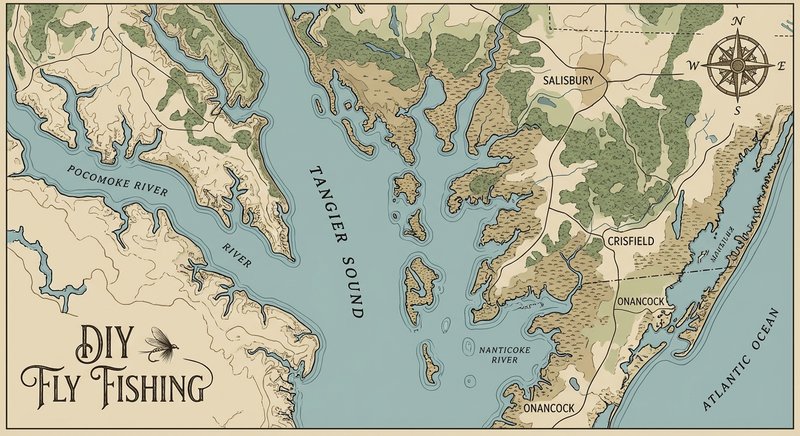
Tangier Sound
Fly fishing in Maryland · Intermediate · Best seasons: Spring, Summer, Fall
Target Species
Striped Bass, Speckled Trout, Red Drum
About This Water
Lower Chesapeake Bay with excellent striped bass. Also speckled trout and red drum.
Fishing Recommendations
Welcome to the "Everglades of the North." As a guide who has spent countless days poling these flats, I can tell you that Tangier Sound is one of the most unique and rewarding saltwater fly fishing destinations on the Atlantic coast. Located in the lower Chesapeake Bay, it offers a labyrinth of marsh islands, submerged aquatic vegetation (SAV), and tidal guts that feel more like the remote backcountry of Florida than the Mid-Atlantic.
Here is your comprehensive guide to fly fishing Tangier Sound.
🎣 Location Overview
Tangier Sound is a vast body of water bordered by the Eastern Shore of Maryland and a chain of iconic islands including Smith, South Marsh, and Bloodsworth Islands.
What makes it special is the shallow water habitat. Unlike the deep channels of the main Chesapeake, the Sound is characterized by sprawling "grass flats" (primarily eelgrass and widgeon grass). This vegetation filters the water, often providing the best clarity in the entire Bay. It is a nursery for blue crabs and grass shrimp, creating a rich protein shake that attracts predators. Anglers love it because it offers legitimate sight-fishing opportunities—a rarity in the Mid-Atlantic—where you can target fish in 2 to 4 feet of water.
🐟 Target Species & Behavior
Speckled Trout (Spotted Seatrout)
The "Speck" is the undisputed king of the Tangier flats. They are ambush predators that hold on the edges of grass beds or in "potholes" (sandy depressions in the grass).
- Behavior: They are extremely light-sensitive and spooky. They prefer clear, moving water.
- Feeding: They focus on grass shrimp and small "silversides" or "rain minnows."
Striped Bass (Rockfish)
While the monsters are in the deep Atlantic, the Sound is home to "schoolie" stripers (18–28 inches) that live in the marshes year-round.
- Behavior: They love structure. You’ll find them tucked against "sod banks" (eroding marsh edges), under docks, or at the mouths of "guts" (tidal creeks) where the tide flushes bait out.
- Feeding: Opportunistic. They will smash topwater poppers, but their staple is the juvenile Atlantic Menhaden (bunker).
Red Drum (Redfish)
"Puppy" reds (15–25 inches) have become increasingly common in the Sound over the last decade.
- Behavior: They act much like their Southern cousins, "tailing" in the shallowest water during high tide to root for crabs.
- Feeding: Highly focused on the bottom. If they are there, they are looking for crabs and mud minnows.
📅 Best Times to Fish
- Spring (May – June): This is the prime window for Speckled Trout as they migrate into the Sound. As the water hits 60°F, the bite turns on.
- Summer (July – August): Best for Puppy Drum. However, the heat can make mid-day fishing tough. Pro Tip: Fish the "low light" hours (dawn and dusk) to avoid the heat and find active fish.
- Fall (September – early November): Locally known as "Rocktober." This is the best time for Striped Bass as they gorge themselves for winter. The trout also make a final push before heading south.
- The Tides: Never fish "slack" water. An incoming tide brings cooler, clearer water onto the flats (great for Trout). An outgoing tide flushes bait out of the marshes (prime for Stripers at creek mouths).
🪰 Recommended Flies & Techniques
Top Fly Patterns
- Clouser Deep Minnow: (Chartreuse/White or Tan/White). Size 2 to 1/0. The "official" fly of the Chesapeake. Use it for everything.
- Kwan Fly / Spoon Fly: For Red Drum. These mimic small crabs or shrimp and ride hook-up to avoid snagging grass.
- Bob's Banger or Gurgler: For topwater action. Nothing beats a Striper or Speckled Trout smashing a surface fly in 2 feet of water.
- Half & Half: A cross between a Lefty’s Deceiver and a Clouser. Great for larger Stripers.
Techniques & Presentation
- The "Twitch-and-Pause": When fishing for Specks over grass, use an intermediate sinking line. Strip the fly twice, then let it sit for two seconds. Most hits occur on the pause.
- Stealth is Key: The water is shallow. Long casts (50+ feet) are often necessary to avoid spooking fish with the boat or kayak.
- Rod Setup: An 8-weight saltwater fly rod is the "utility player" here. It has enough backbone to punch through the wind but is sensitive enough for Specks.
💡 Pro Tips & Local Knowledge
- Follow the Birds: If you see terns or gulls diving, there is bait being pushed to the surface. It’s usually schoolie Stripers. Get there fast, but cut your motor early and drift in.
- The "Gut" Strategy: On a falling tide, find a small creek (gut) draining a marsh. Position yourself down-tide and cast right into the mouth. Stripers sit there like trout in a stream, waiting for the conveyor belt of food.
- Wade Fishing: If you have a kayak or small skiff, don't be afraid to hop out. Many of the flats around Jane’s Island have firm sandy bottoms. Wading allows for the ultimate stealthy approach for Specks.
- The Wind: The Sound is shallow and open. A 15-knot wind can turn the water into a "washing machine" and mud it up. Always check the wind forecast; if it's blowing over 12 knots, look for "lee" shores behind the islands to find clear water.
⚠️ Important Information
Access
- Crisfield, MD: Known as the "Seafood Capital of the World," this is your primary jumping-off point. There are excellent ramps at Somers Cove Marina and Jane’s Island State Park.
- Deal Island: A bit further north, providing access to the "Lower Tangier" marshes.
Regulations & Permits
- You need a Maryland Bay & Coastal Sport Fishing License.
- Striped Bass regulations change frequently in Maryland (closed seasons, size limits). Always check the MD DNR website before heading out.
- Speckled Trout have a minimum size (usually 14") and a daily creel limit.
Special Considerations
- Stinging Nettles: In July and August, the water is full of sea nettles (jellyfish). If you are wading, wear long pants or "skin" guards.
- Bugs: The "marsh flies" and mosquitoes on the islands are legendary and brutal. Bring high-quality bug spray (DEET or Picaridin) if the wind is calm.
- Navigation: The Sound is full of "chew-up-your-prop" shallows. Stick to marked channels until you are intimately familiar with the flats, and always carry a GPS/Chartplotter.
Tight lines, and enjoy the solitude of the Tangier marshes!
Bug Hatches & Matching Flies
| Hatch | Type | Peak months | Time of day | Hook sizes | Matching flies |
|---|---|---|---|---|---|
| Salt Marsh Midge Chironomidae | midge | April, May, September | Evening/Night | #18-22 | Zebra Midge #18-20, Griffith's Gnat #20-22 |
| Black Carpenter Ant Camponotus pennsylvanicus | terrestrial | June, July | Afternoon | #12-16 | Black Foam Ant #14-16, Chernobyl Ant #12 |
| Coastal Grasshopper Melanoplus spp. | terrestrial | August, September | Mid-day | #8-12 | Dave's Hopper #10-12, Rainy's Grand Hopper #8-10 |
| Greenhead Fly Tabanus nigrovittatus | midge | July, August | Daytime | #10-14 | Deer Hair Fly #12, Wet Black Gnat #14 |
| Saltmarsh Mosquito Aedes sollicitans | midge | June, July, August | Dawn/Dusk | #20-24 | Mosquito #20-22 |
| Japanese Beetle Popillia japonica | terrestrial | June, July | Daytime | #12-14 | Foam Beetle #12-14, Coffee's Sparkle Beetle #14 |
| Marsh Beetle Scirtidae | terrestrial | May, June | Evening | #16-18 | Micro Foam Beetle #18 |
| Spotted Lanternfly Lycorma delicatula | terrestrial | August, September, October | Daytime | #8-12 | Lanternfly Foam Pattern #8-10, Pink/Red Attractor Foam #10 |