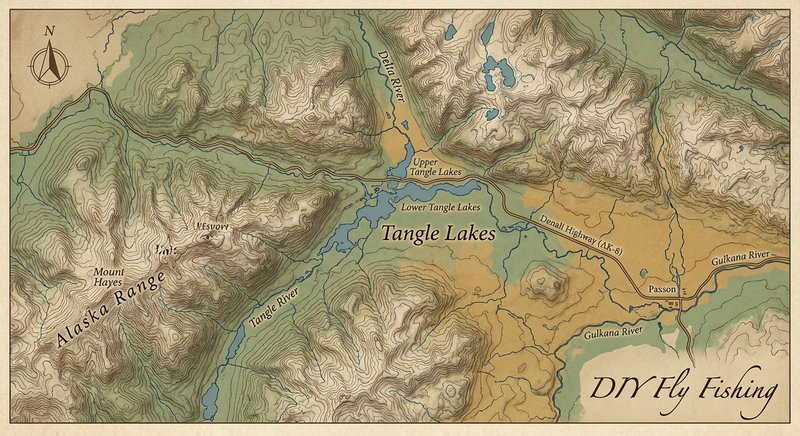
Tangle Lakes
Fly fishing in Alaska · Beginner · Best seasons: Summer
Target Species
Lake Trout, Arctic Grayling, Burbot
About This Water
Interior Alaska lake system with lake trout and grayling. Accessible via Denali Highway.
Fishing Recommendations
The Tangle Lakes system, located along the Denali Highway in Interior Alaska, is a world-class high-alpine fishery. As a guide, I consider this one of the most scenic and productive roadside-accessible fisheries in the state. It is a series of long, narrow lakes connected by the Tangle River, forming the headwaters of the Delta River.
Here is your comprehensive guide to fly fishing the Tangle Lakes.
🎣 Location Overview
The Tangle Lakes are situated at an elevation of about 3,000 feet in a vast tundra landscape nestled against the Alaska Range. What makes this area special is the interconnectivity. You have a "chain" of lakes (Upper, Round, Shallow, and Lower) linked by short, gravel-bottomed river stretches.
The water is remarkably clear for Alaska, often having a slight "tea" tint but generally offering excellent visibility. Anglers love it because it offers a "choose your own adventure" style of fishing: you can wade the river sections for non-stop Grayling action or paddle the lakes to hunt for predatory Lake Trout.
🐟 Target Species & Behavior
Arctic Grayling
The "sailfish of the north" is the primary draw here. The Tangle Lakes system is one of the most prolific Grayling fisheries in the world.
- Behavior: They are highly opportunistic and bold. They hold in the moving water of the Tangle River stretches and near the inlets/outlets of the lakes.
- Feeding: They focus on aquatic insects (caddis, mayflies, midges) and terrestrial insects blown off the tundra (ants, beetles).
Lake Trout
These are the apex predators of the lakes. While many are in the 2–5 lb range, "Lakers" here can reach significantly larger sizes.
- Behavior: In early summer, they cruise the shallow shorelines and "shelves" where the water drops off. As the water warms in late July, they retreat to the deeper basins of Round and Upper Tangle Lake.
- Feeding: They primarily target smaller Grayling, Whitefish, and sculpins.
Burbot
Often called "freshwater lingcod," these are unique, eel-like predators.
- Behavior: They are bottom-dwellers and nocturnal. They are rarely caught on dry flies but will occasionally take a heavily weighted streamer stripped slowly through deep, dark holes or near lake bottoms.
📅 Best Times to Fish
- Optimal Months: Mid-June through August.
- June: Best for Lake Trout in the shallows and the most aggressive Grayling feeding post-spawn.
- July: Peak insect hatch season (Caddis and Mayflies).
- August: Great for terrestrial patterns and "Match the Hatch" scenarios.
- Best Time of Day: In the land of the Midnight Sun, "time of day" is relative. However, the evening hours (8 PM – Midnight) often see the most intense surface activity for Grayling.
- Prime Window: Early July is the "sweet spot" when the weather is stable, the mosquitoes are manageable (relatively speaking), and the fish are keyed into surface dries.
🪰 Recommended Flies & Techniques
For Arctic Grayling (Dry Fly & Nymphing)
Grayling are famous for their willingness to rise, making this a dry-fly paradise.
- Dry Flies: Elk Hair Caddis (size 12-16), Parachute Adams (14-18), Black Gnats, and Mosquito patterns.
- Nymphs: Gold-Ribbed Hare’s Ear, Pheasant Tail (14-16), and Prince Nymphs.
- Technique: Use a 4-weight or 5-weight rod. In the river sections, use a standard dead-drift. On the lakes, a "twitch-and-pause" retrieve with a dry fly can trigger aggressive strikes.
For Lake Trout (Streamers)
- Patterns: White or Olive Zonkers, Woolly Buggers (Black or Olive), and Large Clouser Minnows (White/Chartreuse).
- Technique: Use a 7-weight rod with a sink-tip line. Focus on the "drop-offs"—the spots where the light turquoise water turns dark blue. Strip the streamer aggressively to mimic a fleeing baitfish.
For Burbot (Heavy Streamers)
- Patterns: Large, heavy lead-eyed streamers in purple, black, or red.
- Technique: You must get the fly to the bottom. Use a full sinking line and a "slow-bounce" retrieve along the lake floor in deep holes.
💡 Pro Tips & Local Knowledge
- The "Inter-Lake" Stretches: The best Grayling fishing is almost always in the 100-yard stretches of moving water where one lake empties into the next.
- Bring a Canoe: While you can fish near the campgrounds, the best fishing is accessed by paddling away from the road. A canoe or kayak allows you to reach the "Lower Tangles," which see far less pressure.
- Wind is the Enemy: The tundra is wide open. If the wind picks up, the dry fly action on the lakes will die. Switch to a small weighted nymph under a dry fly (dropper rig) to stay in the game.
- The "Grayling Wave": Grayling often travel in schools. If you catch one, stay put—there are likely twenty more within a 30-foot radius.
⚠️ Important Information
- Access: Located via the Denali Highway. Note: This is a gravel road. Check your rental car agreement, as many do not allow driving here. High clearance is recommended but not always necessary.
- Regulations: The Tangle Lakes are managed by the Alaska Department of Fish and Game (ADF&G).
- Bag Limits: Grayling limits are often restrictive (usually 2 per day, only one over 12 inches) to preserve the trophy quality. Always check the current year’s "Interior Southcentral" regulation booklet.
- Licensing: You must have a valid Alaska sport fishing license.
- Safety: This is Grizzly Bear country. While the bears here are often shy, you should always carry bear spray and keep a "clean camp."
- Weather: Even in July, a cold front can drop temperatures to near freezing. Bring high-quality rain gear and layers (merino wool or fleece).
Guide’s Final Word: Don't overcomplicate your fly choice for Grayling. If they aren't rising to a Caddis, they'll almost certainly hit a Prince Nymph. Save your energy for the Lake Trout—landing a 10lb Laker on a fly rod in the middle of the tundra is an experience you'll never forget.
Bug Hatches & Matching Flies
| Hatch | Type | Peak months | Time of day | Hook sizes | Matching flies |
|---|---|---|---|---|---|
| Chironomid (Midge) Family Chironomidae | midge | June, July, August | All Day | #18-24 | Zebra Midge #18-22, Griffith's Gnat #20-22, Traun River Emerger #18-20 |
| Mosquito Family Culicidae | terrestrial | June, July | All Day | #12-16 | Standard Mosquito #12-16, Grizzly Hackle #14-16 |
| Blue Winged Olive (BWO) Baetis tricaudatus | mayfly | June, September | Late Morning/Afternoon | #16-20 | RS2 #18-20, Parachute Adams #16-20, BWO Sparkle Dun #18-20 |
| Little Yellow Stonefly (Yellow Sally) Isoperla spp. | stonefly | July, August | Afternoon/Evening | #14-16 | Yellow Sally #14-16, Kaufmann's Stone #14-16 |
| Spotted Sedge Hydropsyche | caddis | July, August | Evening | #14-18 | Elk Hair Caddis #14-18, LaFontaine's Deep Sparkle Pupa #14-16 |
| Grannom Caddis Brachycentrus | caddis | June | Afternoon | #12-16 | Peacock Caddis #14-16, Holy Grail #14-16 |
| Dark Gray Wing Mayfly Cinygmula spp. | mayfly | June, July | Afternoon | #14-16 | Hare's Ear Nymph #14-16, Dark Parachute Adams #14-16 |
| Black Carpenter Ant Camponotus herculeanus | terrestrial | July, August | Afternoon | #12-16 | Black Foam Ant #14-16, Chernobyl Ant #12-14 |