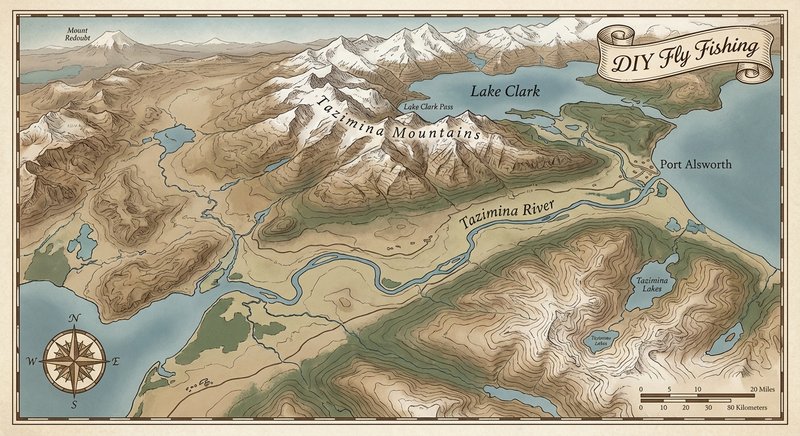
Tazimina River
Fly fishing in Alaska · Intermediate · Best seasons: Summer, Fall
Target Species
Rainbow Trout, Sockeye Salmon, Arctic Grayling
About This Water
Lake Clark area stream with excellent rainbow trout fishing. Scenic mountain backdrop.
Fishing Recommendations
Welcome to the Tazimina River, one of the true gems of the Bristol Bay watershed and Lake Clark National Park. As a guide, I consider the "Taz" to be the quintessential Alaskan fly-out destination. It offers a rare combination of crystal-clear water, stunning scenery (including two massive waterfalls), and a concentrated population of "Leopard" Rainbows.
Here is your comprehensive guide to fishing the Tazimina.
🎣 Location Overview
The Tazimina River is located in the heart of the Bristol Bay region, flowing between Upper and Lower Tazimina Lakes and eventually dumping into the Newhalen River/Lake Iliamna system.
What makes this river special is its clarity. While many Alaskan rivers can turn silty or "tea-colored," the Tazimina remains exceptionally clear, making it a world-class destination for sight-fishing. The river is famous for its two spectacular waterfalls; the Lower Falls acts as a natural barrier for salmon, concentrating the biomass of Sockeye and the Rainbows that follow them into the lower few miles of the river. It is a relatively small, intimate river that is easily waded, offering a mix of classic riffles, deep turquoise pools, and technical pocket water.
🐟 Target Species & Behavior
Rainbow Trout
The Tazimina is home to the famous Alaskan "Leopard" Rainbow—dark-spotted, vividly colored, and incredibly strong.
- Behavior: In early summer, they are opportunistic, feeding on insects and salmon smolt. By August, they become "egg-obsessed," sitting directly behind spawning Sockeye to intercept stray eggs.
- Hold: Look for them in the "seams" just downstream of spawning beds or in deep undercut banks during the bright sun.
Sockeye Salmon
The Tazimina sees a massive influx of Sockeye (Red) Salmon starting in July.
- Behavior: Once they enter the river, they stop feeding and focus on spawning. However, they are highly territorial.
- Hold: They pack into the shallow gravel bars and "stack" in the deeper runs before moving onto the reds.
Arctic Grayling
The "Lady of the Stream" is abundant here, particularly in the upper reaches and the slower tailouts.
- Behavior: Grayling are the primary dry-fly target. They will rise for almost any well-presented insect and are often found in the softer water away from the main salmon current.
📅 Best Times to Fish
Summer (July – Early August)
- Focus: Sockeye Salmon and "Smolt Out-migration."
- Conditions: Long Alaskan days (up to 20 hours of light).
- Peak Window: Mid-July is the height of the Sockeye run. You will see "rivers of red" as the salmon push upstream.
Fall (Mid-August – September)
- Focus: Trophy Rainbow Trout (The Egg Drop).
- Conditions: Cooler temps, changing tundra colors, and the "Flesh" season.
- Peak Window: Late August through mid-September is the prime window for Rainbows. As salmon begin to die after spawning, trout switch from eating eggs to eating decaying salmon flesh.
🪰 Recommended Flies & Techniques
For Rainbow Trout
- Beads (The Gold Standard): 6mm and 8mm plastic beads in "Mottled Orange," "Light Roe," and "Peach." Dead-drifting a bead under an indicator is the most effective way to catch Tazimina trout.
- Flesh Flies: "Dirty Socks" or "Bunny Flesh" in white, ginger, and washed-out pink.
- Streamers: Black or Olive Sculpzilla, Dali Lamas, or white Zonkers to mimic salmon smolt.
For Arctic Grayling
- Dry Flies: Size 12-16 Elk Hair Caddis, Royal Wulff, or Parachute Adams.
- Nymphs: Gold Ribbed Hare’s Ear or Pheasant Tails.
For Sockeye Salmon
- Technique: The "Alaska Fly-Flip" or "Flossing."
- Flies: Sparse Sockeye Specials or Coho Bully in neon green, pink, or orange. Sockeye rarely "strike" a fly; you are looking for a drift that puts the leader into their mouth.
💡 Pro Tips & Local Knowledge
- The "Gravel Push": When targeting Rainbows in August, don't fish the deep holes. Fish the shallow gravel right behind the spawning Sockeye. If you see a group of bright red salmon kicking up gravel, there are almost certainly 5 to 10 trout sitting 3–6 feet behind them.
- Sight Fishing Stealth: Because the water is so clear, the fish can see you as easily as you see them. Avoid wearing bright colors, stay low on the bank, and try to avoid casting your shadow over the fish.
- The Lower Falls: The pool directly below the Lower Falls is a "holding pen" for fish waiting to find spawning ground. It can be incredibly productive but requires a bit of a hike to access.
- Bead Selection: Match the "hatch." Early in the spawn, use small, bright orange beads. As the season progresses and eggs sit in the water longer, switch to larger, paler, "washed-out" colors.
⚠️ Important Information
Access
The Tazimina is a remote fly-out destination. Most anglers access it via floatplane from Port Alsworth or lodges around Lake Iliamna. There are no roads here.
Regulations & Permits
- License: You must have a valid Alaska Sport Fishing License.
- Trout: The Tazimina is generally Catch and Release for Rainbow Trout to preserve the world-class genetics of the Bristol Bay "Leopard" Trout.
- Gear: Single-point barbless hooks are highly recommended (and often required in certain Bristol Bay drainages).
Safety: The "Real" Locals
This is Brown Bear (Grizzly) country. The salmon run attracts high concentrations of bears.
- Always carry bear spray and know how to use it.
- Make noise when walking through tall grass or brush.
- Never leave your backpack or lunch unattended on the bank.
Guide’s Final Word: The Tazimina is one of the few places where you can stand in knee-deep water so clear it looks like air, watching a 25-inch Rainbow Trout inhale your bead. Treat the fish with respect, keep them in the water for photos, and enjoy the silence of the Alaskan wilderness.
Bug Hatches & Matching Flies
| Hatch | Type | Peak months | Time of day | Hook sizes | Matching flies |
|---|---|---|---|---|---|
| Blue Winged Olive Baetis spp. | mayfly | May, September | Afternoon | #16-20 | BWO Sparkle Dun #16-18, RS2 #18-20, Pheasant Tail #16-18 |
| American Grannom Brachycentrus occidentalis | caddis | June | Afternoon/Evening | #12-16 | Peacock Caddis #14-16, Deep Sparkle Pupa #14-16, Holy Grail #14-16 |
| Giant Salmonfly Pteronarcys californica | stonefly | June, July | All Day | #4-8 | Pat's Rubber Leg #6-8, Chubby Chernobyl #6-10, Rogue River Stone #6-8 |
| Pale Morning Dun Ephemerella excrucians | mayfly | July, August | Late Morning/Afternoon | #14-16 | PMD Parachute #14-16, Split Case PMD #16, Last Chance Emerger #14-16 |
| Spotted Sedge Hydropsyche spp. | caddis | July, August | Evening | #12-16 | Elk Hair Caddis (Tan) #12-16, LaFontaine's Emergent Pupa #14-16, Caddis Larva (Green) #12-14 |
| Chironomid Family Chironomidae | midge | May, June, September | Morning | #18-24 | Zebra Midge #18-22, Griffith's Gnat #20-22, Black Midge Pupa #18-20 |
| Golden Stonefly Hesperoperla pacifica | stonefly | July | Afternoon | #8-12 | Golden Stone Nymph #10-12, Stimulator (Yellow) #8-12, Bully's Golden Stone #8-10 |
| October Caddis Dicosmoecus atripes | caddis | September, October | Afternoon | #8-12 | Orange Stimulator #8-10, October Caddis Pupa #10-12, Morrish's October Caddis #8-10 |
| Flying Black Ant Formicidae | terrestrial | August | Afternoon | #14-18 | Black Foam Ant #14-16, Parachute Ant #16-18 |