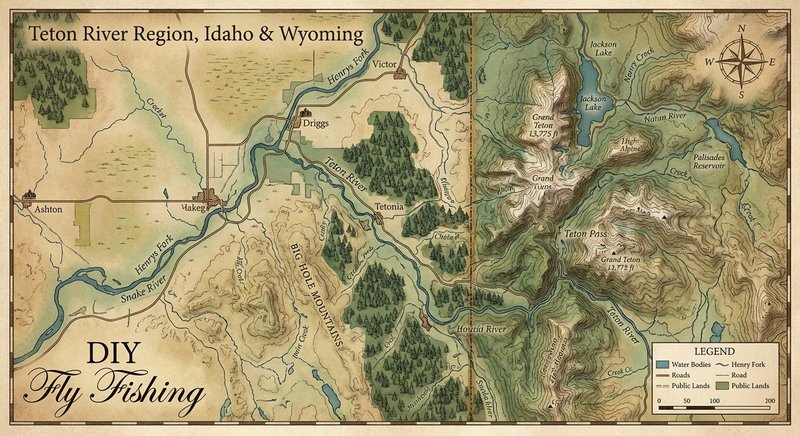
Teton River
Fly fishing in Idaho · Beginner · Best seasons: Summer, Fall
Target Species
Cutthroat Trout, Rainbow Trout
About This Water
A smaller river with excellent dry fly fishing. Native cutthroat and stocked rainbows in scenic Teton Valley.
Fishing Recommendations
The Teton River in Idaho is one of the most scenic and rewarding fly fishing destinations in the American West. Flowing through the high-altitude Teton Valley with the jagged peaks of the Grand Tetons as a backdrop, it offers a "choose your own adventure" experience, ranging from slow, meandering spring-creek-style water to rugged, boulder-strewn canyons.
🎣 Location Overview
The Teton is a tale of two rivers.
- The Upper Valley (The Valley Section): Located between Victor and Driggs, this section is a slow-moving, serpentine meadow stream. It is famous for its glassy glides, deep undercut banks, and massive weed beds. It requires stealth and technical presentation but rewards anglers with incredible dry fly sight-fishing.
- The Canyon Section: Below the Bitch Creek confluence, the river drops into a steep, remote canyon. Here, the character shifts to a classic freestone river with pocket water, riffles, and large boulders.
What makes it special is the density of Native Yellowstone Cutthroat Trout and the fact that, unlike the nearby South Fork or Henry’s Fork, the Teton feels more intimate and accessible.
🐟 Target Species & Behavior
- Yellowstone Cutthroat Trout: The crown jewel of the Teton. They are known for being surface-oriented and willing to rise to a well-presented dry fly. They often hold tight to undercut banks or at the tail-outs of deep pools.
- Rainbow Trout: Found throughout the system, but more prevalent as you move toward the canyon. They are harder fighters than the Cutthroat and tend to hold in faster, oxygenated riffles.
- Cutt-bow Hybrids: You’ll find plenty of these, combining the beauty of the Cutthroat with the aerial acrobatics of a Rainbow.
Feeding Behavior: In the valley, fish are "lookers." They have plenty of time to inspect a fly in the slow current. In the canyon, they are "reactors," smashing terrestrials and attractors in the pocket water.
📅 Best Times to Fish
Summer (Late June – August)
- The Window: Once the spring runoff subsides (usually late June), the Teton explodes.
- Conditions: July is the peak for hatches (PMDs and Yellow Sallies). Late July and August are legendary for Terrestrial season.
- Time of Day: Early morning for tricos; mid-morning to afternoon for main hatches and hoppers.
Fall (September – October)
- The Window: This is many guides' favorite time. The crowds vanish, and the fish get aggressive before winter.
- Conditions: Overcast days trigger massive Blue Winged Olive (BWO) hatches.
- Time of Day: 11:00 AM to 4:00 PM is the sweet spot. Brown trout (though less common) become more active and territorial.
🪰 Recommended Flies & Techniques
Dry Flies (The Teton’s Bread & Butter)
- PMDs: Sparkle Dun (size 16-18), Tilt Wing PMD.
- Terrestrials: Chubby Chernobyl (Gold, Tan, Purple - size 8-12), Dave’s Hopper, Moorish Hopper, and Cinnamon Ants.
- Stoneflies: Golden Stones and Yellow Sallies (size 14-16).
- Fall: Parachute Adams, RS2, and Baetis Sparkle Dun (size 18-22).
Nymphing
- Patterns: Zebra Midges (Red/Black), Pat’s Rubber Legs (Tan/Brown), and Perdigons for the faster canyon water.
- Technique: Use a "Dry-Dropper" rig in the valley to avoid spooking fish with a heavy plastic indicator.
Streamers
- Patterns: Wooly Buggers (Olive/Black), Gold-beaded Sculpzilla.
- Technique: In the Canyon, "pounding the banks" from a drift boat is highly effective.
💡 Pro Tips & Local Knowledge
- The "Teton Twitch": When fishing hoppers in the valley, give the fly a very subtle "twitch" just as it passes an undercut bank. This often triggers a strike from a wary Cutthroat that was on the fence.
- Long Leaders are Mandatory: In the slow meadow sections, use a 12-foot 5X leader. The water is crystal clear, and the fish are extremely leader-shy.
- The "Bates to Cache" Float: This is the classic valley float. It’s a half-day or full-day depending on how much you row. It offers the best "National Geographic" views of the mountains.
- Mind the Moose: The Teton Valley is prime moose habitat. Be extremely careful when wading through willows or around bends; they are often standing in the river and can be aggressive.
⚠️ Important Information
- Access:
- Valley: Excellent boat ramps at South Leigh, Cache Bridge, and Bates Bridge.
- Canyon: Access is much more difficult. Harrop’s Bridge is the main entry/exit. Be prepared for a long day if floating the canyon.
- Regulations: The Teton has specific rules regarding bait and harvest to protect the native Cutthroat. It is predominantly Catch and Release for Cutthroat. Always check the current Idaho Fish and Game (IDFG) regulations before heading out.
- Wading vs. Floating: The valley is best fished from a drift boat or raft because the mud bottom makes wading difficult. The canyon is better for nimble rafts or hardy wade-anglers.
- Permits: An Idaho fishing license is required. These can be purchased online or at fly shops in Driggs or Victor.
Guide’s Final Word: “Respect the Cutthroat. They are a treasure of the West. Keep them in the water, take your photo quickly, and watch them swim away to fight another day.”
Bug Hatches & Matching Flies
| Hatch | Type | Peak months | Time of day | Hook sizes | Matching flies |
|---|---|---|---|---|---|
| Blue-Winged Olive (BWO) Baetis tricaudatus | mayfly | April, May, September, October | Late Morning/Afternoon | #18-22 | RS2 #20-22, Parachute Adams #18-20, BWO Sparkle Dun #18-22 |
| Brown Drake Ephemera simulans | mayfly | June, July | Evening | #10-12 | Brown Drake Cripple #10-12, Brown Drake Spinner #10-12, Hare's Ear Nymph #10-12 |
| Pale Morning Dun (PMD) Ephemerella excrucians | mayfly | June, July, August | Morning/Early Afternoon | #16-18 | Last Chance Cripple #16-18, PMD Parachute #16-18, Pheasant Tail #16-18 |
| Golden Stonefly Hesperoperla pacifica | stonefly | June, July | All Day | #8-12 | Chubby Chernobyl (Gold) #8-12, Pat's Rubber Leg #8-12, Water Walker #10 |
| Yellow Sally Isoperla spp. | stonefly | June, July, August | Late Afternoon/Evening | #14-16 | Yellow Stimulator #14-16, Iron Sally #14-16, Little Yellow Sloan #16 |
| Salmonfly Pteronarcys californica | stonefly | June | All Day | #4-8 | Fluttering Salmonfly #4-6, Bitch Creek Nymph #6-8, Sofa Pillow #6-8 |
| Trico Tricorythodes spp. | mayfly | August, September | Early Morning | #20-24 | Trico Spinner #20-24, Zebra Midge #20-22 |
| Grasshopper Orthoptera | terrestrial | July, August, September | Late Morning/Afternoon | #8-14 | Morrish Hopper #10-12, Rainy's Grand Hopper #8-12, Dave's Hopper #12-14 |
| Caddis Hydropsyche / Brachycentrus | caddis | May, June, July, August | Evening | #14-18 | Elk Hair Caddis #14-18, LaFontaine's Deep Sparkle Pupa #16, Peacock Caddis #16-18 |
| Midge Chironomidae | midge | February, March, April | Late Morning/Afternoon | #18-24 | Griffith's Gnat #18-22, Zebra Midge #18-24, Morgan's Midge #20-22 |