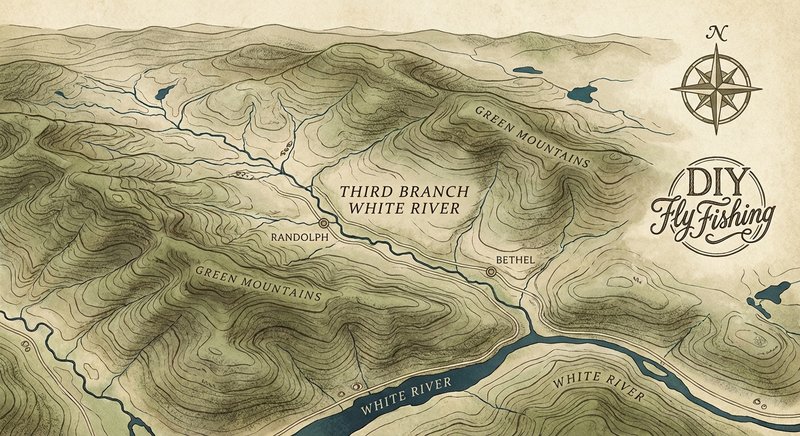
Third Branch White River
Fly fishing in Vermont · Beginner · Best seasons: Spring, Summer, Fall
Target Species
Rainbow Trout, Brown Trout
About This Water
Central Vermont stream with wild trout populations. Scenic fishing through pastoral valley.
Fishing Recommendations
The Third Branch of the White River is one of Vermont’s most charming and productive freestone streams. While the "Main Stem" of the White River gets much of the glory, the Third Branch—which flows through the towns of Braintree, Randolph, and Bethel—offers a more intimate, technical, and rewarding experience for the wading angler.
As your guide, here is the deep-dive intel you need to successfully fish the Third Branch.
🎣 Location Overview
The Third Branch is a classic New England freestone river. It is characterized by its crystal-clear water, varied substrate ranging from fine gravel to massive granite boulders, and a "pocket water" nature that keeps anglers on their toes.
What makes it special is its accessibility and diversity. Because it parallels Route 12 for much of its length, you can easily hop from one type of water to another—shifting from deep, slow-moving "Loch Ness" pools to fast, oxygenated riffles in a matter of minutes. It feels more "wild" than the main stem, with tighter canopies in the upper reaches that provide excellent cover for fish and a cooler microclimate for the angler.
🐟 Target Species & Behavior
The Third Branch is primarily a Rainbow and Brown Trout fishery.
- Rainbow Trout: These are often the "energetic" residents of the river. You’ll find them in the fast, highly oxygenated water—specifically in the "heads" of the pools where the riffle enters. They are opportunistic feeders and will often rise to a dry fly even when no hatch is present.
- Brown Trout: The "kings" of the deeper pools. The Third Branch holds some surprisingly large, buttery Browns, especially in the undercut banks and deep wood debris near Randolph. They are more nocturnal and cautious; to catch the big ones, you’ll need to focus on low-light periods or deep nymphing.
- Feeding Habits: In the spring, they focus on heavy aquatic insect activity (nymphs). By mid-summer, they become "structure-oriented," hiding from the sun and waiting for terrestrials (grasshoppers/ants) to fall off the high banks.
📅 Best Times to Fish
- Spring (Late April – June): This is the prime window. Once the "mud season" runoff subsides (usually by mid-May), the Hendrickson and March Brown hatches begin. This is the best time for dry fly action.
- Summer (July – August): Water levels drop and temperatures rise. Critical Note: During hot spells, fish early in the morning (dawn to 10:00 AM). If the water temperature hits 70°F, stop fishing to protect the trout. Look for "cold water refuges" where smaller mountain brooks enter the Third Branch.
- Fall (September – October): My personal favorite. The Brown trout become aggressive as they prepare for spawning. The foliage is world-class, and the fish are eager to bulk up before winter. Streamer fishing is deadliest now.
🪰 Recommended Flies & Techniques
Dry Flies
- Hendrickson (Size 12-14): Late May essential.
- Elk Hair Caddis (Size 14-18): The "go-to" search pattern for the Third Branch. Tan or Olive.
- Royal Wulff: High visibility for the fast pocket water in the Braintree section.
- Terrestrials: Black Ants (size 16-18) and Foam Hoppers (size 10-12) during August.
Nymphs
- Pheasant Tail (Size 14-18): Imitates almost everything in this river.
- Pat’s Rubber Legs (Size 8-12): Essential for high water or targeting larger Browns in deep holes.
- Perdigons: In the fast riffles, use heavy tungsten Perdigons to get deep quickly.
Streamers
- Woolly Bugger (Black or Olive): Size 6-10. Swing these through the deep bends.
- Muddler Minnow: Excellent for imitating the sculpins and dace native to the White River system.
💡 Pro Tips & Local Knowledge
- The "Randolph to Bethel" Stretch: This is the most productive water. Focus on the areas where the river moves away from the road slightly; these spots see less pressure and hold more wild fish.
- Stealth is Key: Because the water is often gin-clear, the fish are "spooky." Avoid wearing bright colors. Approach a pool from downstream and stay low. A long leader (9ft to 12ft) ending in 5X or 6X fluorocarbon tippet will significantly increase your hook-up rate.
- High-Sticking the Pockets: Don't just fish the big pools. The Third Branch is full of "buckets"—small depressions behind rocks. Use a "Euro-nymphing" style or a short-line high-stick technique to drift nymphs through these pockets.
- The "After-Work" Rise: In June, there is often a massive caddis hatch right at dusk. Even if the river looks dead at 5:00 PM, wait until the sun dips below the ridge.
⚠️ Important Information
- Access: Much of the river is bordered by private land. Vermont has a tradition of open access for fishing, but always look for "Posted" signs. If it’s not posted, you can generally fish it, but always be respectful of hayfields and livestock.
- Regulations: The Third Branch generally follows Vermont General Trout Stream Regulations (Open 2nd Saturday in April to Oct 31). However, always check the Vermont Fish & Wildlife Law Digest as rules regarding "Catch and Release" sections can change.
- Wading Safety: The rocks in the Third Branch are notorious for being slippery (covered in "didymo" or rock snot in some sections). Felt soles or studs are highly recommended.
- License: You must have a valid Vermont Fishing License, which can be purchased online or at local general stores in Randolph or Bethel.
Guide’s Final Word: The Third Branch is a river that rewards patience and observation. Spend five minutes watching a pool before you cast; you’ll often see the subtle "wink" of a trout’s flank as it feeds, telling you exactly where to aim. Tight lines!
Bug Hatches & Matching Flies
| Hatch | Type | Peak months | Time of day | Hook sizes | Matching flies |
|---|---|---|---|---|---|
| Blue Winged Olive (BWO) Baetis | mayfly | April, May, September, October | Mid-day/Afternoon | #18-22 | BWO Sparkle Dun #18-22, RS2 #20-22, Pheasant Tail #18-20 |
| Hendrickson Ephemerella subvariabilis | mayfly | May | Afternoon | #12-14 | Red Quill #12-14, Hendrickson Nymph #12-14, Hare's Ear #12-14 |
| March Brown Maccaffertium vicarium | mayfly | May, June | Afternoon | #10-12 | March Brown Dry #10-12, Gold Ribbed Hare's Ear #10-12 |
| Sulphur Ephemerella invaria / dorothea | mayfly | June, July | Evening | #14-18 | Sulphur Parachute #14-18, CDC Sulphur Emerger #16-18, Pheasant Tail #14-18 |
| Tan Caddis Hydropsyche | caddis | May, June, July, August | All day/Evening | #14-18 | Elk Hair Caddis #14-18, LaFontaine's Deep Sparkle Pupa #14-16, Holy Grail #14-16 |
| Slate Drake Isonychia bicolor | mayfly | June, July, August, September | Afternoon/Evening | #10-14 | Isonychia Parachute #12-14, Zug Bug #10-12, Prince Nymph #10-14 |
| Light Cahill Stenacron interpunctatum | mayfly | June, July | Evening | #12-14 | Light Cahill Dry #12-14, Cream Variant #14 |
| Giant Stonefly Pteronarcys dorsata | stonefly | May, June | Night/Early Morning | #4-8 | Pats Rubber Legs #6-10, Black Stonefly Nymph #4-8 |
| Eastern Carpenter Ant Camponotus pennsylvanicus | terrestrial | July, August | All day | #12-16 | Black Foam Ant #14-16, Chernobyl Ant #12-14 |