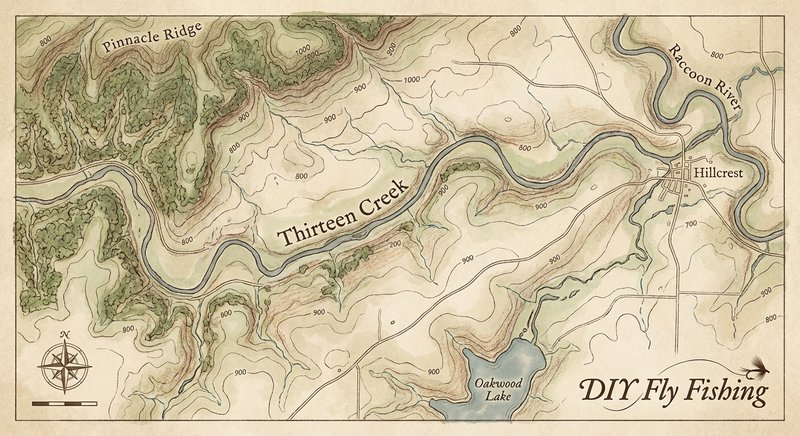
Thirteen Creek
Fly fishing in Iowa · intermediate · Best seasons: spring, summer, fall
Target Species
Brown Trout
About This Water
Howard County stream with wild trout. Remote fishing in northeastern Iowa.
Fishing Recommendations
Thirteen Creek, located in the rolling limestone hills of Winneshiek County near Decorah, is one of the "hidden gems" of Iowa’s Driftless Area. While many anglers flock to the high-profile waters of North Bear or Waterloo Creek, Thirteen Creek offers a more intimate, technical, and rewarding experience for those who value stealth and wild fish over easy access.
Here is your professional guide to fly fishing Thirteen Creek.
🎣 Location Overview
Thirteen Creek is a classic Driftless spring creek—small, cold, and highly productive. It is a tributary to the Upper Iowa River system, characterized by its narrow width, deep undercut banks, and alternating sections of meadow runs and timbered canopy.
What makes Thirteen Creek special is its wildness. Unlike streams that rely heavily on weekly stocking, Thirteen Creek supports a robust population of wild, naturally reproducing Brown Trout. The water stays cold year-round thanks to limestone springs, providing a thermal refuge even during the heat of an Iowa July. Anglers love it because it requires "the short game"—technical casting, belly-crawls through tall grass, and precise fly placement.
🐟 Target Species & Behavior
The primary resident here is the Wild Brown Trout. You may occasionally find a stray Rainbow trout near the confluence with larger systems, but this is a Brown Trout fishery through and through.
- Behavior: These fish are notoriously spooky. Because the stream is narrow, they are highly sensitive to vibration on the bank and shadows on the water.
- Holding Patterns: Look for them tight against "cut banks" (where the water has eroded a cave under the sod), behind submerged logs, and in the deep "buckets" at the tail-outs of riffles.
- Feeding: They are opportunistic but selective. They focus heavily on aquatic invertebrates (scuds and sowbugs) year-round but become aggressive surface feeders during terrestrial season.
📅 Best Times to Fish
Optimal Seasons
- Spring (April – May): This is prime time. The "Mother’s Day Caddis" hatch and Blue Winged Olives (BWO) bring fish to the surface. Water levels are usually optimal.
- Summer (June – August): The most exciting time for terrestrial lovers. As the Iowa corn and prairie grasses grow tall, grasshoppers, ants, and beetles become the main course.
- Fall (September – October): Pre-spawn. The Brown Trout turn aggressive and dawn their most vibrant colors. Large streamers can move big fish during this window.
Best Times of Day
- Low Light: Early morning (before 9:00 AM) and the "magic hour" before sunset are most productive. Brown trout are light-sensitive and feel most secure feeding in the shadows.
- Overcast Days: A cloudy, drizzly day is a gift on Thirteen Creek. It masks your profile and often triggers a BWO hatch.
🪰 Recommended Flies & Techniques
Top Fly Patterns
- Nymphs:
- The Pink Squirrel (Size 14-18): The quintessential Driftless fly. Works year-round.
- Scuds/Sowbugs (Gray or Olive, Size 16-20): These are the "bread and butter" of Thirteen Creek.
- Pheasant Tail Nymph: Classic profile for matching various mayfly larvae.
- Dry Flies:
- Elk Hair Caddis (Size 14-16): Great for riffles.
- Hi-Vis Ant or Beetle (Size 16-18): Essential for summer "stealth" fishing.
- Chubby Chernobyl (Small): Use as a lead fly in a "dry-dropper" rig.
- Streamers:
- Black or Olive Woolly Bugger (Size 10-12): Small and dark is better here than big and flashy.
Effective Techniques
- The "Iowa Crawl": Stay 5-10 feet back from the bank. If you can see the fish, they have likely already seen you. Kneel in the grass to lower your profile.
- Dry-Dropper: Use a buoyant dry fly with a small weighted nymph (like a Zebra Midge or Scud) 18 inches below it. This allows you to cover two zones without the splash of a plastic indicator.
- Bow-and-Arrow Cast: In the timbered sections, you won't have room for a backcast. Master this flick-shot to get your fly under overhanging branches.
💡 Pro Tips & Local Knowledge
- Watch the Grass: In the meadow sections, the grass hangs over the water. Trout will often sit directly under those grass blades waiting for an insect to fall. Drop your fly inches from the bank—if you're in the middle of the stream, you're missing the fish.
- Tippet Stealth: Use 6X fluorocarbon tippet. The water is often crystal clear, and wild Browns are leader-shy.
- Avoid the "Big Splash": Use a lighter rod (2-weight to 4-weight). A heavy 5-weight line hitting the water can sound like a boulder to a trout in a creek this small.
- Move Upstream: Always fish upstream. Driftless trout face into the current; if you approach from behind, you have a much better chance of staying undetected.
⚠️ Important Information
Access
- Thirteen Creek flows through a mix of private land and public fishing easements.
- Look for the Green Signs: The Iowa DNR marks public access points with green "Angler Access" signs. Respect these boundaries and stay within the fence lines.
Regulations & Permits
- Iowa Fishing License: Required for all anglers 16 and older.
- Trout Fee: You must pay the Iowa Trout Fee in addition to your base fishing license to fish these waters.
- Limits: Most Iowa trout streams have a 5-fish daily limit, but check the latest DNR regulations for Thirteen Creek specifically, as some stretches may have "Artificial Lure Only" or length-limit restrictions.
Special Considerations
- Weather: Iowa weather changes fast. Flash floods can turn Thirteen Creek "chocolate milk" in an hour. If the water is rising and murky, head to the springs or wait for it to settle.
- Terrain: Be prepared for mud and tall vegetation. Long pants are recommended even in summer to protect against wild parsnip and stinging nettles.
Bug Hatches & Matching Flies
| Hatch | Type | Peak months | Time of day | Hook sizes | Matching flies |
|---|---|---|---|---|---|
| Blue-winged Olive Baetis tricaudatus | mayfly | April, October | Late Morning/Afternoon | #18-22 | RS2 #20-22, Parachute Adams #18-22, Pheasant Tail Nymph #18-20 |
| Grannom Caddis Brachycentrus | caddis | April, May | Afternoon/Evening | #14-16 | Elk Hair Caddis #14-16, Deep Sparkle Pupa #14-16, Holy Grail #14-16 |
| Sulfur / Pale Morning Dun Ephemerella invaria | mayfly | May, June | Evening | #14-18 | Sulfur Parachute #14-18, Sulfur Cripple #16-18, Pheasant Tail #16-18 |
| Trico Tricorythodes | mayfly | July, August, September | Morning | #20-24 | Trico Spinner #20-24, Sunken Trico Spinner #22-24, Trico Parachute #20-22 |
| Spotted Sedge Hydropsyche | caddis | June, July, August | Evening | #14-18 | Tan Elk Hair Caddis #14-18, LaFontaine Sparkle Pupa #16-18 |
| Light Cahill Stenacron | mayfly | June, July | Evening/Dusk | #12-14 | Light Cahill #12-14, Gold Ribbed Hare's Ear #12-14 |
| Zebra Midge Chironomidae | midge | January, February, March, December | All Day | #18-24 | Zebra Midge #18-22, Griffith's Gnat #18-22, Mercury Midge #20-22 |
| Terrestrials (Ants/Beetles/Hoppers) Formicidae / Coleoptera / Orthoptera | terrestrial | July, August, September | Mid-day/Afternoon | #10-18 | Dave's Hopper #10-14, Black Foam Ant #14-18, Coffee's Sparkle Beetle #14-16 |