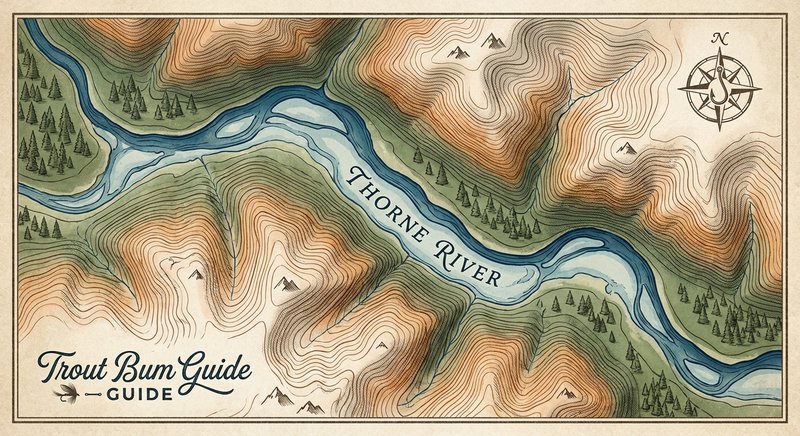
Thorne River
Fly fishing in Alaska · Intermediate · Best seasons: Spring, Fall
Target Species
Steelhead, Cutthroat Trout, Dolly Varden
About This Water
Prince of Wales Island stream with excellent steelhead runs. Accessible by logging roads.
Fishing Recommendations
Welcome to the Thorne River, a crown jewel of Prince of Wales Island (POW) in Southeast Alaska. As a guide, I consider the Thorne to be one of the most quintessential "low and slow" Tongass rainforest rivers. It is a system characterized by tea-colored tannin water, massive fallen old-growth timber, and a wildness that is increasingly hard to find.
Here is your comprehensive guide to fly fishing the Thorne River.
🎣 Location Overview
Located on the eastern side of Prince of Wales Island, the Thorne River is the largest watershed on the island. It is a classic "blackwater" system—the dark, acidic water comes from the surrounding muskegs and peat bogs.
What makes the Thorne special is its diversity of habitat. From the tidal flats at the mouth to the "Falls" area and the upper reaches near Thorne Lake, the river offers a mix of deep, mysterious pools, long gravel runs, and chaotic logjams. Anglers love it because it is one of the most productive systems in the region that remains accessible by the island’s road system, yet it retains a rugged, remote feel.
🐟 Target Species & Behavior
Steelhead
The Thorne hosts a legendary run of wild spring Steelhead. These are "island-style" fish—typically smaller than those in the Skeena or Olympic Peninsula (averaging 6–10 lbs), but they are incredibly aggressive and chrome-bright. They hold in the classic "walking speed" water, often tucked very tight to wood structure.
Cutthroat Trout
The Thorne is a world-class Cutthroat fishery. You’ll find both resident fish and sea-run "Bluebacks." They are opportunistic predators. In the spring, they focus on salmon fry; in the fall, they transition to salmon eggs and flesh. They love the "edges"—seams where fast water meets slow water, and deep undercuts.
Dolly Varden
Dollies follow the food. In the spring, they are sleek and silver, migrating from the sea to chase out-migrating salmon fry. In the fall, they turn brilliant orange and red as they spawn and gorge on salmon eggs. They are often found in the tail-outs of pools or directly behind spawning salmon.
📅 Best Times to Fish
Spring (Late March – May)
- Prime Window: Mid-April to early May.
- The Draw: This is the peak for Steelhead. It also coincides with the salmon fry emergence, which brings the Cutthroat and Dolly Varden into a feeding frenzy.
- Conditions: Expect rain and cool temperatures. Water levels can rise and fall rapidly.
Fall (August – October)
- Prime Window: September.
- The Draw: The return of Coho (Silver) and Pink salmon. While you may not be targeting salmon, the Dolly Varden and Cutthroat fishing is at its peak as they feast on eggs.
- Conditions: The "Rainy Season" begins. Higher water often moves fish up from the estuary into the river reaches.
Time of Day
On the Thorne, light levels matter less than the tide. For the lower river, the incoming tide pushes fresh fish into the system. For the upper river, "low light" (early morning/late evening) is best for resident Cutthroat.
🪰 Recommended Flies & Techniques
Steelhead (Spring)
- Flies: Egg-Sucking Leeches (black/pink), Intruder-style flies in blue/black or orange/white, and the "Thorne River Special" (a variation of a Comet).
- Technique: High-stick nymphing with heavy beads or swinging flies with a light sink tip. Because of the wood, you must be precise.
Cutthroat & Dolly Varden (Spring - Fry Pattern)
- Flies: Epoxy Fry, rolled Muddler Minnows, and small silver streamers.
- Technique: "The Fry Strip." Cast across the current and use erratic, short strips to mimic a struggling salmon fry.
Cutthroat & Dolly Varden (Fall - Egg/Flesh)
- Flies: 8mm or 10mm beads (mottled orange, "dead" egg white), and Ginger/White Bunny Leech (flesh fly).
- Technique: Dead-drift nymphing under an indicator. You must put the fly right on the bottom to find the Dollies.
💡 Pro Tips & Local Knowledge
- Fear the Wood, Fish the Wood: The Thorne is full of "snags." However, the fish live inside the logjams. If you aren't losing a few flies, you aren't fishing where the fish are. Use 12–15lb Maxima Ultragreen for Steelhead to give you a chance to pull them away from the logs.
- The "Falls" Area: The area near the Thorne River Falls is a natural bottleneck. It’s a great place to locate fish, but it can get crowded. Hike a half-mile upstream or downstream from the main access points to find solitude.
- Tannin Visibility: Don't let the dark water fool you. Even if it looks "black," it is often very clear. Fish can see you easily. Wear earthy tones and move stealthily along the banks.
- The Graveyard Stretch: The lower Thorne near the bridge has deep slow water. It looks "froggy," but big sea-run Cutthroat often cruise these flats during the tide change.
⚠️ Important Information
- Access: The Thorne is accessible via the FH-43 (Thorne Bay Road). There are several pull-outs and a developed campground. A drift boat or raft is helpful for the middle sections, but most of the river is very walkable/wadeable.
- Regulations: Alaska Department of Fish & Game (ADF&G) regulations for Prince of Wales are strict.
- Steelhead: Generally Catch & Release only.
- Bait: Usually prohibited in the summer/fall to protect wild stocks (check current "Southeast" regs).
- Licensing: You need an Alaska fishing license and a Steelhead King Salmon Stamp if you are targeting Steelhead.
- Safety (Bears): This is high-density Black Bear country. They are generally not aggressive, but they are focused on salmon. Carry bear spray, make noise, and never leave your catch or backpack unattended.
- Cell Service: Extremely limited to non-existent once you leave the Thorne Bay town area. Download your maps for offline use.
Guide’s Final Word: The Thorne isn't a river where you'll catch 50 fish a day easily. It’s a river that rewards the patient angler who can read dark water and isn't afraid to lose a fly to a submerged cedar log. Tight lines!
Bug Hatches & Matching Flies
| Hatch | Type | Peak months | Time of day | Hook sizes | Matching flies |
|---|---|---|---|---|---|
| Blue Winged Olive Baetis | mayfly | May, September, October | Afternoon | #16-20 | Parachute Adams #16-20, RS2 #18-20, Pheasant Tail Nymph #16-18 |
| Golden Stonefly Hesperoperla pacifica | stonefly | June, July | Morning/Evening | #6-10 | Golden Bird's Nest #8-10, Stimulator (Yellow/Gold) #8-12, Pat's Rubber Leg #6-10 |
| Chironomids Chironomidae | midge | April, May, June | All Day | #18-24 | Zebra Midge #18-22, Griffith's Gnat #20-22, Ice Midge #20 |
| Spotted Sedge Hydropsyche | caddis | July, August | Evening | #12-16 | Elk Hair Caddis #14-16, LaFontaine's Deep Sparkle Pupa #14-16, Holy Grail Caddis #14-16 |
| Early Black Stonefly Capniidae | stonefly | March, April | Afternoon | #14-18 | Black Copper John #16-18, Black Stimulator #16, Little Black Stone Nymph #14-18 |
| Green Sedge Rhyacophila | caddis | June, July, August | All Day | #10-14 | Caddis Green Weenie #12-14, Green Deep Sparkle Pupa #12-14, Peacock Caddis #14 |
| March Brown Rhithrogena morrisoni | mayfly | May | Afternoon | #12-14 | March Brown Dry #12-14, Hare's Ear Nymph #12-14, March Brown Wet #12-14 |
| October Caddis Dicosmoecus | caddis | September, October | Afternoon/Evening | #8-12 | Orange Stimulator #8-10, October Caddis Pupa #8-12, Morrish October Caddis #10 |
| Terrestrial Ants and Beetles Formicidae / Coleoptera | terrestrial | July, August | Afternoon | #12-16 | Black Foam Ant #14-16, Chernobyl Ant #10-12, Fat Albert #12 |