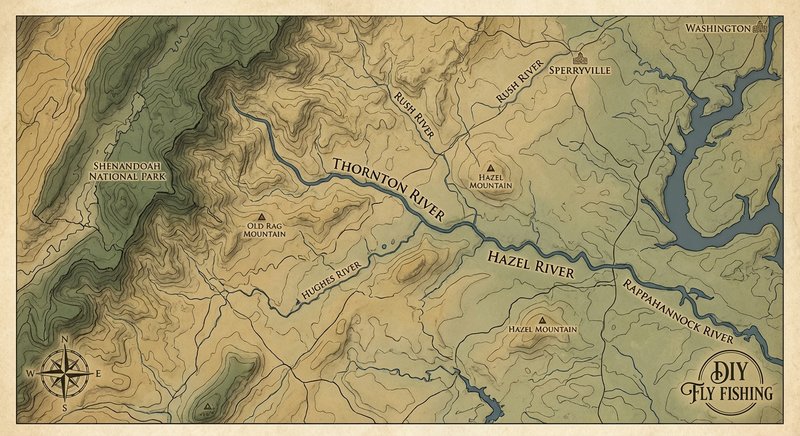
Thornton River
Fly fishing in Virginia · Beginner · Best seasons: Spring, Summer, Fall
Target Species
Brook Trout, Brown Trout
About This Water
Rappahannock County stream with wild trout. Access near Sperryville.
Fishing Recommendations
As a guide who has spent years navigating the blue-ribbon streams of the Blue Ridge, I can tell you that the Thornton River is one of Virginia’s true gems. Located in Rappahannock County, primarily within and just outside Shenandoah National Park (SNP), it offers a classic "mountain freestone" experience. It is rugged, intimate, and rewards the angler who values stealth and precision over long casts.
Here is your professional guide to fishing the Thornton River.
🎣 Location Overview
The Thornton River is a quintessential Appalachian freestone stream. It is divided effectively into two personalities: the North Fork and the South Fork.
- The Upper Sections (Inside SNP): This is native Brook Trout territory. The water is crystal clear, tumbling over granite boulders into deep, emerald-green plunge pools. It is high-gradient and heavily forested.
- The Lower Sections (Below the Park boundary): As the river leaves the park, it levels out slightly and becomes a "Special Regulation" area. Here, the water stays cool enough to support wild Brown Trout and holds stocked fish as well.
What makes it special is the solitude. While the nearby Rapidan gets the fame, the Thornton offers similar quality fishing with half the foot traffic.
🐟 Target Species & Behavior
Native Brook Trout (Salvelinus fontinalis)
Found primarily in the higher elevations (North Fork). These fish are "opportunistic feeders" because mountain streams are nutrient-poor. They aren't usually picky about fly patterns, but they are incredibly "spooky." If they see your shadow or your fly line splashing, the pool is done for an hour.
Wild & Stocked Brown Trout (Salmo trutta)
Found in the lower sections and the Special Reg area. Browns are more calculated than Brookies. They hold in "lie" spots—under undercut banks, behind large submerged logs, or in the deep shadows of overhanging rhododendrons. They feed heavily on crawfish, sculpins, and larger aquatic insects.
📅 Best Times to Fish
Spring (March – June): The Prime Window
This is the golden era for the Thornton. Water levels are up from snowmelt and spring rains.
- Prime Window: Late April to May. This coincides with the major hatches (Quill Gordons, March Browns, and Sulphurs).
- Time of Day: 10:00 AM – 4:00 PM when the water warms slightly.
Summer (July – August): The Stealth Season
Water levels drop and become "gin-clear."
- Prime Window: Early morning (dawn till 10 AM).
- Condition: Look for "Terrestrial" action. Ants, beetles, and grasshoppers are the main course. Note: If water temps exceed 68°F, stop fishing to protect the trout.
Fall (September – November): The Spawn & Color
The Brookies take on brilliant orange hues.
- Prime Window: October.
- Condition: Brook trout become aggressive as they prepare to spawn. Browns also become more active as water temps drop. Be careful not to step on "redds" (spawning nests) in late November.
🪰 Recommended Flies & Techniques
Top Fly Patterns
- Dry Flies:
- Mr. Rapidan (Size 14-16): The local legend. It mimics everything and is easy to see.
- Royal Wulff (Size 16): A classic attractor for Brookies.
- Elk Hair Caddis (Size 14-18): Essential for evening rises.
- Parachute Adams: The ultimate "searching" pattern.
- Nymphs:
- Pheasant Tail (Size 16-20): Mimics the natural mayfly nymphs.
- Hare’s Ear: Works well in the deeper plunge pools.
- Terrestrials:
- Black Foam Ants (Size 18): Lethal in July and August.
- Streamers:
- Black Ghost or Wooly Bugger (Size 10-12): For the Brown trout in the lower sections.
Techniques
- The "Bow and Arrow" Cast: Much of the Thornton is overgrown with mountain laurel. You will often need to use this cast to get into tight spots.
- High Sticking: In the plunge pools, keep as much fly line off the water as possible to avoid "drag." Let the fly tumble naturally over the lip of the pool.
- Dry-Dropper: A popular local rig. Tie a Mr. Rapidan on top and a small Zebra Midge or Pheasant Tail 18 inches below it.
💡 Pro Tips & Local Knowledge
- Sneak Upstream: Always fish moving upstream. Trout face into the current; if you approach from behind, you stay out of their line of sight.
- The "One Cast" Rule: In the small pools of the North Fork, your first cast is your best chance. If you miss, move to the next pool.
- Focus on the "Tail-outs": In the evening, fish move from the deep heads of the pools to the shallow "tail-outs" (where the water leaves the pool) to feed on emerging bugs.
- Park at Hull School Trail: For the North Fork, access via the Hull School Trail off Skyline Drive provides a steep but rewarding hike down into some of the best Brookie water in the state.
⚠️ Important Information
Access
- Skyline Drive: Access the upper reaches from the Thornton Gap entrance.
- Route 211: There are several pull-offs along Highway 211 outside the park near Sperryville. Look for the "Virginia Trout Stocked Water" signs.
Regulations & Permits
- Inside the Park (SNP): A valid Virginia Freshwater Fishing License is required. Only single-point, barbless hooks are allowed. No organic bait (artificial lures only).
- Special Regulation Area: Check the VDGIF (Virginia Department of Game and Inland Fisheries) website for specific creel limits on the lower Thornton, as they change periodically.
- Catch and Release: While not always required by law, I highly recommend C&R for all native Brook Trout to preserve the fishery.
Safety
- Bears: This is black bear country. They are generally shy, but keep your food secured.
- Footing: The rocks in the Thornton are notorious for "slick-as-ice" algae. Wear felt-soled boots or studded rubber boots.
Bug Hatches & Matching Flies
| Hatch | Type | Peak months | Time of day | Hook sizes | Matching flies |
|---|---|---|---|---|---|
| Quill Gordon Epeorus pleuralis | mayfly | March, April | Midday | #12-14 | Quill Gordon #12-14, Hare's Ear #12-14 |
| Blue Quill Paraleptophlebia adoptiva | mayfly | March, April | Late Morning | #16-18 | Blue Quill #16-18, Pheasant Tail #16-18 |
| March Brown Maccaffertium vicarium | mayfly | April, May | Afternoon | #10-14 | March Brown American #12-14, Gold Ribbed Hare's Ear #10-12 |
| Sulphur Ephemerella invaria/dorothea | mayfly | May, June | Evening | #14-18 | Sulphur Parachute #14-18, Sulphur Emerger #16-18 |
| Little Yellow Stonefly (Yellow Sally) Isoperla spp. | stonefly | May, June, July | Late Afternoon/Evening | #14-16 | Yellow Sally #14-16, Little Yellow Stone Nymph #14-16 |
| Light Cahill Stenacron interpunctatum | mayfly | June, July | Evening | #12-14 | Light Cahill #12-14, Cream Variant #14 |
| Cinnamon Caddis Hydropsyche spp. | caddis | May, June, September | Evening | #14-16 | Elk Hair Caddis (Tan/Brown) #14-16, LaFontaine's Deep Sparkle Pupa #14-16 |
| Blue Winged Olive Baetis spp. | mayfly | March, October, November | Midday | #18-22 | BWO Parachute #18-22, RS2 #20-22 |
| Terrestrials (Ants and Beetles) Formicidae / Coleoptera | terrestrial | July, August, September | All Day | #14-18 | Black Foam Beetle #14-16, Cinnamon Ant #16-18 |