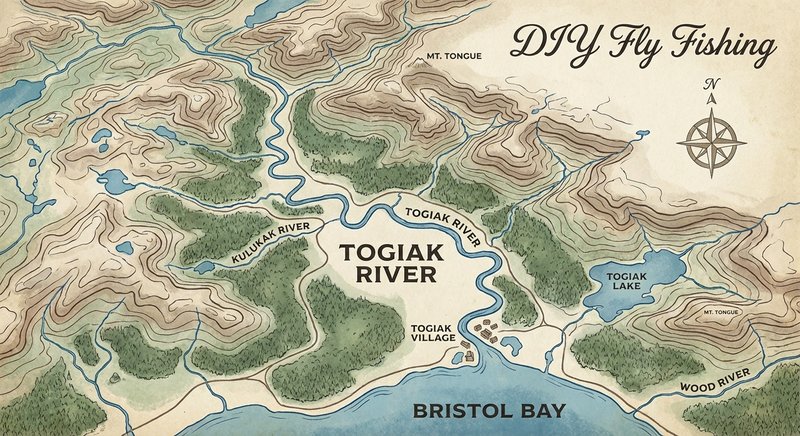
Togiak River
Fly fishing in Alaska · Advanced · Best seasons: Summer, Fall
Target Species
Rainbow Trout, Arctic Char, Silver Salmon
About This Water
Trophy rainbow trout in remote southwestern Alaska. Catch-and-release fishing paradise.
Fishing Recommendations
The Togiak River is a true crown jewel of Southwest Alaska. Located within the Togiak National Wildlife Refuge, it is often overshadowed by the larger rivers of the Bristol Bay region (like the Naknek or Kvichak), but for the discerning fly angler, that is its greatest strength. It is a river of staggering biomass, breathtaking scenery (with the Ahklun Mountains as a backdrop), and world-class fishing for "The Big Three": Rainbows, Char, and Silvers.
🎣 Location Overview
The Togiak flows approximately 60 miles from Togiak Lake to Togiak Bay. Unlike the high-gradient, rocky rivers of the interior, the Togiak is characterized by its "classic" Alaskan coastal river feel. It features a mix of wide, gravel-bottomed flats, deep cut banks, and braided channels.
What makes the Togiak special is its remoteness and biological diversity. Because it is managed within a National Wildlife Refuge, the pressure is lower than in the "Alagnak corridor." The river is famous for its incredible runs of all five species of Pacific Salmon, which serve as the engine for the entire ecosystem. When the salmon arrive, the resident Rainbows and Dolly Varden/Arctic Char gorge themselves, leading to some of the fattest, hardest-fighting fish in the state.
🐟 Target Species & Behavior
Rainbow Trout
The Togiak Rainbows are legendary for their girth. These are "leopard" rainbows—heavily spotted and vibrant.
- Behavior: Early in the summer, they are aggressive predators chasing smolt and sculpins. As soon as the salmon start spawning (late July/August), they become "egg-obsessed," holding directly behind active salmon redds.
- Holding Water: Look for "the seam" behind spawning salmon, deep undercut banks, and wood debris (sweep-ers).
Arctic Char / Dolly Varden
Often found in massive schools, these fish follow the salmon migration from the salt.
- Behavior: They are opportunistic scavengers. They will hold in the softer water and tail-outs of runs, waiting for eggs or flesh to drift down.
- Feed: Primarily salmon eggs, salmon flesh (later in the season), and small baitfish.
Silver Salmon (Coho)
The Togiak is arguably one of the best Silver Salmon rivers in the world.
- Behavior: Silvers are known for their aggression and willingness to take a fly on the surface. They hold in "froggy" water—slow-moving sloughs, backwaters, and the edges of the main current.
- Feed: While they stop eating to spawn, their predatory instinct remains high. They strike out of aggression and territoriality.
📅 Best Times to Fish
- July (Peak Rainbow/Char): This is the time for "the swing." You can catch Rainbows on streamers and even mouse patterns. Sockeye and King salmon are entering the river, providing the initial nutrient boost.
- August (The Egg Drop): The "prime time" for Rainbows and Char. Pink and Chum salmon are spawning. Fishing 8mm or 10mm beads is the name of the game.
- Late August – Mid-September (Silver Season): This is the window for Coho. The river fills with chrome-bright Silvers fresh from the Bering Sea.
- Best Time of Day: In the Alaskan summer, the "golden hour" lasts for hours. However, for Silvers, the early morning before the sun hits the water is best for topwater action. For Trout, mid-day is perfectly fine as long as there are spawning salmon present.
🪰 Recommended Flies & Techniques
For Rainbows & Char
- Beads (Indispensable): 8mm and 10mm beads in "Mottled Roe," "Orange Clear," and "Peach." Matching the specific stage of the salmon spawn is critical.
- Streamers: Sculpzilla (olive/white), Dali Lama (black/white), and Bunny Leech.
- Mice: Mr. Hankey or the Morrish Mouse. Pro Tip: Fish these tight to the banks under overhanging willows.
- Technique: Nymphing beads under an indicator is most productive. Ensure your weight (split shot) is enough to get the bead bouncing along the gravel.
For Silver Salmon
- Topwater: Pink or Purple Pink Pany or Wog. Skating these across the surface of slow sloughs will trigger explosive strikes.
- Sub-surface: Flash Trap, Hareball Leech (Pink/Purple), and the Clouser Minnow.
- Technique: The "strip-strip-pause" retrieve is deadly for Silvers.
💡 Pro Tips & Local Knowledge
- The "Egg Flip": When fishing for trout, look for "cleaned" gravel—this indicates a salmon redd. If you see a large female salmon kicking up gravel, fish 10–15 feet directly behind her. Your bead should mimic an egg that just got kicked out of the nest.
- Backwater Silvers: Don't spend all day in the main current for Silvers. Look for "dead water" sloughs that look almost like a pond. Often, the largest concentrations of Coho are stacked in water that looks too still to fish.
- The "Mouse" Factor: Togiak rainbows are famously aggressive toward mammals. Even if there isn't a hatch, a mouse pattern skated across a deep woody hole can produce the largest trout of your life.
- Bear Awareness: This is high-density Brown Bear country. They are there for the same salmon you are. Always carry bear spray, make noise when walking through willows, and never leave fish on a stringer.
⚠️ Important Information
Access
- Remote Only: There is no road access to the Togiak. You must fly into the village of Togiak via Dillingham and then take a jet boat upriver, or book with one of the few established lodges (like Togiak River Lodge or Togiak River Fishing Adventures).
- Float Trips: Multi-day float trips from Togiak Lake down to the village are popular but require significant wilderness experience and logistics.
Regulations & Permits
- Refuge Permits: Ensure your guide has the proper Togiak National Wildlife Refuge permits.
- License: You need a standard Alaska Sport Fishing License. If you intend to keep a King Salmon (if the season is open), you need a King Stamp.
- Barbless Hooks: It is highly recommended (and often required by lodges/best practices) to use single, barbless hooks to protect the fishery.
Gear Recommendations
- Rods: 6-weight for Trout/Char; 8-weight for Silvers.
- Lines: Weight-forward floating lines are the standard. Bring a sink-tip for Silvers in deeper holes.
- Clothing: Layering is key. Even in August, a 40-degree rainy morning can turn into a 65-degree sunny afternoon. High-quality Gore-Tex waders and jackets are non-negotiable.
Bug Hatches & Matching Flies
| Hatch | Type | Peak months | Time of day | Hook sizes | Matching flies |
|---|---|---|---|---|---|
| Blue Winged Olive Baetis | mayfly | May, September, October | Midday | #16-22 | BWO Sparkle Dun #18-20, Pheasant Tail #16-20, RS2 #18-22 |
| Chironomid Chironomidae | midge | May, June, September | All Day | #18-24 | Zebra Midge #18-22, Griffith's Gnat #20-22, Black Beauty #20-24 |
| Golden Stonefly Hesperoperla pacifica | stonefly | June, July | Afternoon | #6-10 | Pat's Rubber Legs #6-10, Rogue River Stone #8-10, 20-Incher Stone #8-12 |
| Spotted Sedge Hydropsyche | caddis | July, August | Evening | #12-16 | Elk Hair Caddis #14-16, LaFontaine's Deep Sparkle Pupa #14-16, Goddard Caddis #12-14 |
| Pale Morning Dun Ephemerella | mayfly | July | Late Morning | #14-18 | PMD Sparkle Dun #16-18, Mercer's Poxy Back PMD #16-18, Split Case PMD #16-18 |
| Grannom Caddis Brachycentrus | caddis | June | Afternoon | #12-16 | Holy Grail #14-16, Peacock Caddis #14-16, Z-Wing Caddis #14-16 |
| Giant Salmonfly Pteronarcys californica | stonefly | June | Afternoon | #4-8 | Kaufmann's Stone #4-8, Chubby Chernobyl #6-10, Bitch Creek Nymph #6-8 |
| Mosquito Aedes | terrestrial | June, July | All Day | #12-16 | Mosquito #12-16, Humpy #14-16, Black Gnat #16-18 |