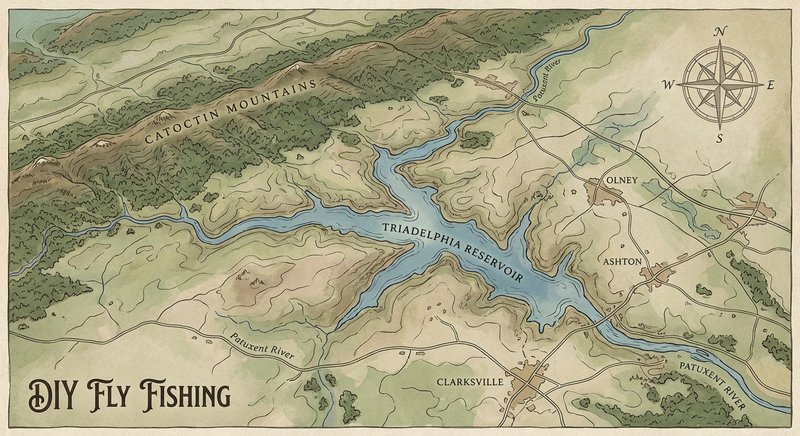
Triadelphia Reservoir
Fly fishing in Maryland · Beginner · Best seasons: Spring, Summer, Fall
Target Species
Largemouth Bass, Crappie, Catfish
About This Water
Howard County reservoir with bass and panfish. Scenic Patuxent watershed.
Fishing Recommendations
Welcome to one of Maryland’s hidden gems for stillwater fly fishing. As your guide, I’m excited to walk you through the nuances of Triadelphia Reservoir. Located on the Patuxent River bordering Montgomery and Howard Counties, "Tri" offers a serene, scenic alternative to the more crowded Potomac River.
Because this is a WSSC-managed reservoir with strictly regulated motor use, it is a paradise for fly anglers in kayaks, canoes, or small boats who value quiet water and "big fish" potential.
🎣 Location Overview
Triadelphia Reservoir is a 1,370-acre impoundment that serves as a primary water source for the D.C. suburbs. What makes it special is the lack of heavy boat traffic and the sheer amount of submerged structure.
The water is characterized by deep old river channels, steep drop-offs, and expansive flats filled with "stump fields"—remnants of trees cleared when the valley was flooded. The shoreline is heavily wooded, providing excellent "deadfall" (downed trees) that serves as prime habitat. While the water clarity can vary depending on rainfall (it can get "stained" or muddy after big storms), it generally offers enough visibility for effective sight casting in the shallows during the spring.
🐟 Target Species & Behavior
Largemouth Bass
The king of the reservoir. These fish are structure-oriented. In the spring, they move to the shallow back-ends of coves to spawn. In the heat of summer, they retreat to the edges of the old Patuxent river channel or hold deep under fallen timber. They primary feed on Gizzard Shad, Bluegill, and Crawfish.
Crappie (Black and White)
Triadelphia holds a massive population of "slabs." They are schooling fish. In the spring, you’ll find them in 4–8 feet of water near submerged brush. Once the water warms, they move to deeper structures (15+ feet), making them harder to target with a fly rod unless you use sinking lines.
Catfish (Channel and Bullhead)
While rarely targeted by fly anglers, they are a blast on a 7-weight rod. They cruise the silty flats near the inlets (where the Patuxent enters the reservoir) and will aggressively take a streamer stripped slowly across the bottom, especially in low-light conditions.
📅 Best Times to Fish
- Spring (April – June): Prime Time. This is when the bass and crappie are in the shallows. Look for water temperatures hitting 55°F for crappie and 60°F+ for bass.
- Summer (July – August): Focus on the "Golden Hours"—the first 90 minutes of light and the last hour before sunset. During the day, fish go deep to find oxygen and cooler temps.
- Fall (September – November): As temperatures drop, bass go on a feeding binge to prepare for winter. They will follow baitfish (shad) into the shallower coves again.
- Optimal Conditions: Overcast days are superior here. The fish feel more secure moving away from deep cover, and topwater action will last all day.
🪰 Recommended Flies & Techniques
For Largemouth Bass
- Topwater: BoogleBugs or Umpqua Swimming Frogs (Size 2-4). Work these tightly against downed logs.
- Subsurface: Gamechangers or Clouser Minnows in white/chartreuse to mimic Gizzard Shad.
- Crayfish Patterns: Near Nuff Craws or heavy Woolly Buggers (Black or Olive) hopped along rocky points.
For Crappie
- Patterns: Micro-jig flies, Chartreuse Marabou Minnows, or Small Bead-head Woolly Buggers (Size 8-12).
- Technique: Use a slow, rhythmic strip. If you catch one, stay there—there are likely fifty more in a ten-yard radius.
For Catfish
- Patterns: Backstabbers or heavy Dungeon streamers in dark colors (black/purple).
- Technique: You must get the fly to the bottom. Use a sink-tip line and "crawl" the fly along the mud flats near the upper end of the reservoir.
💡 Pro Tips & Local Knowledge
- The "Green Bridge" Area: The area around the MD Route 97 bridge is a local favorite. It offers a mix of deep bridge pilings and nearby shallow flats.
- Watch the Water Level: WSSC fluctuates the water levels for water management. If the water is low, focus on the rocky points and the main river channel edges. If the water is high, the fish will be deep inside the "willow " and "buttonbush" shorelines—you’ll need accurate casting to get your fly into the pockets.
- The "Shad Bust": In late summer and fall, watch for schools of shad "flicking" on the surface in open water. Bass will often school up and hunt them from below. Keep a white Clouser Minnow ready on a second rod for these fast-moving blitzes.
- Kayak Stealth: Because gas motors are banned, the fish are not used to loud noises. A quiet approach in a kayak will allow you to get much closer to trophy bass than a traditional bass boat would.
⚠️ Important Information
- WSSC Permits: Crucial. You cannot fish Triadelphia with just a Maryland Fishing License. You must purchase a WSSC Watershed Use Permit (Daily or Annual). You can buy these online via the WSSC Water website.
- Access Points:
- Brighton Dam: Good for shore access and boat launching.
- Green Bridge (Rt. 97): Best for launching kayaks and canoes.
- Big Branch: A quieter cove area.
- Vessel Restrictions: Only electric motors, oars, or paddles are allowed. No gasoline engines are permitted on the water (even if they are tilted up).
- Seasonal Closures: The reservoir typically closes to boating and fishing from mid-November to March to protect wintering waterfowl and for safety. Always check the WSSC website for exact opening/closing dates.
- Clean Your Gear: To prevent the spread of invasive species (like Hydrilla or Zebra Mussels), ensure your boat and waders are clean and dry before moving between watersheds.
Guide’s Final Word: Triadelphia is a "patience" fishery. It doesn't always give up its secrets easily, but for the fly angler who learns the stump fields and masters the evening topwater bite, it offers some of the heaviest Largemouth Bass in the state. Tight lines!
Bug Hatches & Matching Flies
| Hatch | Type | Peak months | Time of day | Hook sizes | Matching flies |
|---|---|---|---|---|---|
| Chironomids (Midges) Chironomidae | midge | March, April, October | All day | #18-24 | Zebra Midge #18-22, Griffith's Gnat #20-24, Snowshoe Midge #20-22 |
| Blue-Winged Olive Baetis | mayfly | April, May, September, October | Afternoon | #18-22 | RS2 #20-22, Parachute Adams #18-22, Pheasant Tail #18-20 |
| Damselflies Enallagma | terrestrial | June, July, August | Late Morning/Afternoon | #10-14 | Marabou Damsel #10-12, Adult Damsel #12-14 |
| Giant Michigan Mayfly Hexagenia limbata | mayfly | June, July | Evening/Dusk | #6-10 | Hexagenia Paradun #6-8, Hexagenia Wiggle Nymph #8-10 |
| Spotted Sedge Hydropsyche | caddis | May, June | Evening | #14-16 | Elk Hair Caddis #14-16, Pupa Sedge #14-16 |
| White Miller Ephoron leukon | mayfly | August, September | Evening/Night | #12-14 | White Wulff #12-14, Ephoron Dun #12-14 |
| Black Ants Formicidae | terrestrial | July, August, September | Afternoon | #12-18 | Chernobyl Ant #12-14, Black Foam Ant #16-18 |
| Trico Tricorythodes | mayfly | July, August, September | Early Morning | #22-26 | Trico Spinner #22-24, Trico Dun #22-24 |