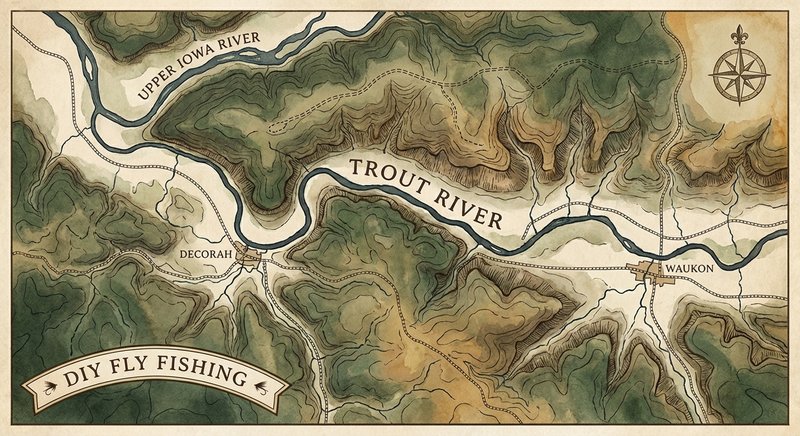
Trout River
Fly fishing in Iowa · intermediate · Best seasons: spring, summer, fall
Target Species
Brown Trout
About This Water
Winneshiek County stream with wild brown trout. Classic Driftless spring creek.
Fishing Recommendations
As an expert guide who has spent years stalking the technical spring creeks of the Driftless Area, I can tell you that Trout River in Winneshiek County, Iowa, is one of the true gems of the Midwest. Located just southeast of Decorah, it offers a classic "limestone" experience that rewards stealth, precision, and an understanding of spring creek entomology.
Here is your comprehensive guide to fly fishing Trout River.
🎣 Location Overview
Trout River is a quintessential Driftless Area spring creek. Unlike the freestone rivers of the West, this is an intimate, winding stream characterized by limestone ledges, deep undercut banks, and lush riparian vegetation.
What makes it special is its cold-water stability. Fed by numerous springs, the water temperature remains relatively constant, allowing for year-round trout activity even when other rivers are too warm or frozen. The river flows through a mix of rugged timber and rolling pastureland. It is smaller and more technical than the nearby Upper Iowa River, making it an ideal destination for the angler who prefers a "stalking" style of fishing.
🐟 Target Species & Behavior
The primary target here is the Brown Trout. While the Iowa DNR does stock some areas, Trout River is famous for its wild, naturally reproducing Brown Trout population.
- Behavior: These fish are notorious for being "spooky." In the clear, slow-moving pools, a shadow or a heavy footfall will send them darting for cover.
- Holding Spots: Look for them tucked tight against undercut banks, hovering at the "tail-out" of pools during hatches, or hiding under submerged limestone shelves.
- Feeding: They are opportunistic but selective. They feed heavily on sub-surface crustaceans (scuds and sowbugs) year-round, but will key in on specific hatches with laser focus.
📅 Best Times to Fish
Seasons
- Spring (March – May): The "awakening." This is prime time for Blue Winged Olives (BWO) and the first major bug activity. Water levels are usually good, though spring rains can occasionally stain the water.
- Summer (June – August): The season of the Terrestrial. While the afternoons can get hot, the spring-fed water stays cool. This is the best time for hopper fishing.
- Fall (September – October): My personal favorite. The Brown Trout become aggressive as they prepare for the spawn. The colors of the valley are spectacular, and the BWO hatches return.
Time of Day
- Summer: High noon is tough. Aim for "The Golden Hour"—first light until 10:00 AM, and 6:00 PM until dusk.
- Cloudy Days: On Trout River, a gray, drizzly day is a gift. The low light makes the fish feel secure, often bringing the largest Browns out of the undercut banks to feed in open water.
🪰 Recommended Flies & Techniques
Top Fly Patterns
- Nymphs/Crustaceans:
- Pink Squirrel: An Iowa staple. The flash and the bead move fish in almost any condition.
- Ray Charles or Scud: (Gray or Olive, sizes 14–18). These represent the primary biomass in the stream.
- Dry Flies:
- BWO Sparkle Dun: (Sizes 18–22) for those technical spring/fall hatches.
- Elk Hair Caddis: (Sizes 14–16) for late afternoon summer riffles.
- Hippie Stomper or Pink Pookie: High-visibility terrestrials that float all day.
- Streamers:
- Woolly Bugger (Olive or Black): Sizes 8–10. Best used after a rain when the water has a "tea" stain.
Techniques
- The Stealth Approach: Approach the stream from downstream and move up. Stay low—if you can see the fish, they have likely already seen you.
- Nymphing: Use a "Dry-Dropper" rig. A buoyant hopper or foam fly with a weighted scud 18–24 inches below it is the most effective way to cover Trout River’s varied depths.
- The "Tuck" Cast: Essential for getting nymphs deep into the narrow slots and under the banks where the big Browns reside.
💡 Pro Tips & Local Knowledge
- Focus on the "Trout River Wildlife Area": This public stretch offers excellent access and diverse water. It features several "Lunker Structures" (man-made wooden overhead cover) installed by the DNR. These are magnet spots for trophy Browns.
- The "Mud Bank" Secret: When the water is very clear, look for "mud lines" where a bit of bank has crumbled. Browns will often sit right in the edge of the slight turbidity to ambush prey.
- Mind the Vegetation: In mid-summer, the "water buttercup" and weeds can get thick. Don’t get frustrated; the trout use these weeds as oxygen-rich refrigerators. Aim for the "lanes" of clear water between the weed beds.
- Check the Gauge: Trout River clears much faster than larger rivers. If the Upper Iowa is blown out and muddy, Trout River might be fishable within 24 hours.
⚠️ Important Information
- Access: Much of the river is on private land. Iowa has specific laws regarding "meandered" vs. "non-meandered" streams. Stick to the DNR Public Access points or the Trout River Wildlife Area unless you have explicit landowner permission.
- Regulations:
- A valid Iowa Fishing License and a Trout Fee are required.
- Be aware that some sections may have specific "Artificial Lures Only" or size limit regulations. Always check the current Iowa DNR Trout Fishing guide.
- Gear: A 3-weight or 4-weight rod (7'6" to 8'6") is perfect. Anything heavier is overkill and will result in "splatting" your line, which scares the fish. Use long leaders (9–12 feet) tapering to 5X or 6X tippet.
- Biosecurity: The Driftless Area is sensitive to invasive species (like New Zealand Mudsnails). Always clean, drain, and dry your wading gear before moving between watersheds.
Tight lines! If you find yourself in Decorah after the trip, stop by a local brewery and swap stories—half the fun of Trout River is the community that surrounds it.
Bug Hatches & Matching Flies
| Hatch | Type | Peak months | Time of day | Hook sizes | Matching flies |
|---|---|---|---|---|---|
| Blue-Winged Olive (BWO) Baetis spp. | mayfly | March, April, September, October | Late Morning/Afternoon | #18-22 | Parachute Adams #18-22, RS2 #20-22, Pheasant Tail #18-20 |
| Grannom Caddis Brachycentrus occidentalis | caddis | April, May | Afternoon/Evening | #14-16 | Elk Hair Caddis #14-16, Peacock Caddis #16, Deep Sparkle Pupa #14-16 |
| Sulphur Ephemerella invaria | mayfly | May, June | Evening | #14-18 | Sulphur Parachute #16-18, Sulphur CDC Emerger #16, Sulphur Spinner #14-16 |
| Trico Tricorythodes | mayfly | July, August, September | Early Morning | #20-24 | Trico Spinner #20-24, Trico Parachute #22, Sunken Trico Spinner #22 |
| Spotted Sedge Hydropsyche spp. | caddis | June, July, August | Evening/Night | #14-18 | Tan Elk Hair Caddis #14-18, Hydropsyche Larva #14-16, Soft Hackle Hare's Ear #16 |
| Midges Chironomidae | midge | January, February, March, December | Late Morning/Afternoon | #18-24 | Griffith's Gnat #18-22, Zebra Midge #18-22, Palomino Midge #20-22 |
| Terrestrials Formicidae / Orthoptera | terrestrial | July, August, September | All Day | #10-18 | Dave's Hopper #10-14, Black Foam Ant #16-18, Humpy #14-16 |
| Crane Fly Tipulidae | terrestrial | August, September | Morning/Evening | #10-14 | Daddy Long Legs #10-12, Crane Fly Larva #10-14 |