Trout River
Fly fishing in Vermont · Beginner · Best seasons: Summer, Fall
Target Species
Brook Trout, Brown Trout
About This Water
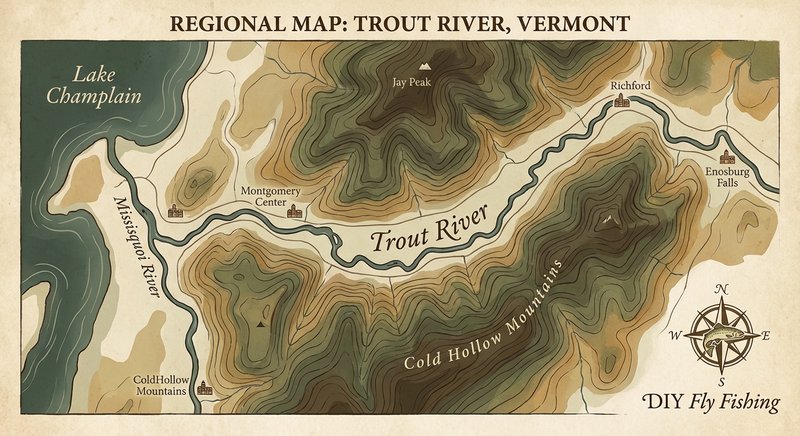
Northern Vermont stream near Montgomery. Aptly named with excellent wild trout populations.
Fishing Recommendations
The Trout River in Franklin County, Vermont, is one of the Green Mountain State’s best-kept secrets. Flowing through the towns of Montgomery and Enosburg before joining the Missisquoi River, it is a quintessential freestone stream. It offers a classic New England fly fishing experience: covered bridges, pocket water, deep ledge pools, and a mix of wild and stocked trout.
Here is your comprehensive guide to fly fishing the Trout River.
🎣 Location Overview
The Trout River is a high-gradient freestone stream characterized by its rugged beauty and diverse water types. In its upper reaches near Montgomery Center, you’ll find classic mountain "pocket water"—small plunge pools, runs, and boulders. As it moves downstream, the river widens, featuring massive ledge formations and deep, emerald-colored pools that provide thermal refuge for larger fish.
What makes this river special is its resilience. Despite being a freestone (dependent on snowmelt and rain), its tributaries flow from the cold high-elevation slopes of Jay Peak, keeping the water cooler than many other Vermont rivers during the mid-summer months. It is an aesthetic masterpiece, often cited as one of the most beautiful rivers in the Northeast.
🐟 Target Species & Behavior
- Brook Trout: The upper reaches and the small mountain tributaries are the domain of the Native Eastern Brook Trout. These fish are opportunistic, vibrant in color, and thrive in the fast, highly oxygenated water. They typically hold in the "cushion" in front of rocks or in the tail-outs of small pools.
- Brown Trout: As you move toward the middle and lower sections (below Montgomery), Brown Trout become the primary target. You will find a mix of hardy stocked fish and "holdovers" that have survived multiple seasons. These Browns are more predatory and cautious; they hold deep in the ledge pools during the day and move into the riffles to feed at dusk.
📅 Best Times to Fish
Summer (Late June – August)
While many Vermont rivers get too warm in July, the Trout River’s upper sections remain viable.
- Conditions: Low, clear water.
- Strategy: Focus on the "broken water" (riffles and pocket water) where oxygen levels are highest.
- Time of Day: Early morning (dawn until 10:00 AM) and the "magic hour" before dark.
Fall (September – October)
This is arguably the prime window for the Trout River.
- Conditions: Cooling water temperatures trigger a feeding frenzy.
- Strategy: Brook Trout and Brown Trout both become more aggressive as they prepare for the fall spawn. The foliage makes this a bucket-list visual experience.
- Time of Day: Late morning through mid-afternoon as the sun warms the water slightly.
🪰 Recommended Flies & Techniques
Dry Flies
The Trout River is a "dry-dropper" paradise. Because the water is often fast, you need high-visibility flies.
- Patterns: Royal Wulff (#12-16), Stimulators (Orange or Yellow, #10-14), Elk Hair Caddis (#14-18), and the classic Hornberg (fished as a dry or a streamer).
- Technique: "Splat" your fly near overhanging brush or in the eddies behind large boulders.
Nymphing
When the fish aren't rising, go deep.
- Patterns: Bead-head Prince Nymph (#12-16), Pheasant Tail (#14-18), and Pat’s Rubber Legs (Stonefly) in black or brown.
- Technique: High-stick nymphing or Euro-nymphing is extremely effective in the pocket water to avoid complex drag caused by multiple current speeds.
Streamers
For the larger Browns in the deep ledge pools.
- Patterns: Black or Olive Woolly Buggers (#6-10), Muddler Minnows, and small Zonkers.
- Technique: Cast across the current into deep shadows and use a "strip-strip-pause" retrieve. In the fall, be aggressive with your movement.
💡 Pro Tips & Local Knowledge
- The "Ledge" Factor: The Trout River is famous for its deep rock ledges. Many anglers fish the surface and move on. To catch the "monsters" of this river, you must get your fly down deep into the dark crevices of these ledges. Use split shot if necessary.
- The Covered Bridge Sections: Fishing near the historic covered bridges (like the Comstock or Fuller bridges) isn't just for the photos—the abutments create some of the best deep-water holding spots on the river.
- The Jay Branch: If the main stem is running high or slightly off-color after a rain, head to the Jay Branch (a major tributary). It clears faster and is loaded with eager, small Brookies.
- Stealth is Key: In the summer, the water is gin-clear. Wear earthy tones, stay low, and try to avoid wading deeply; the vibrations on the rocks will spook fish before you ever see them.
⚠️ Important Information
- Access: Much of the Trout River flows through private land, but Vermont has a generous tradition of open access. Always look for "Posted" signs. Public access is excellent near the bridges and along Route 118.
- Regulations: The Trout River generally falls under Vermont’s General Trout Streams regulations. The season typically runs from the second Saturday in April to October 31st. (Always check the Vermont Fish & Wildlife Law Digest for current year updates).
- Safety: The ledge rock on the Trout River can be incredibly slick when wet. Felt-soled boots or studs are highly recommended. Also, be aware that this area is prime black bear and moose country—keep your eyes open!
- Permits: A valid Vermont Fishing License is required for everyone 15 years of age and older. You can purchase these online or at local general stores in Montgomery.
Guide’s Final Word: The Trout River isn't about "trophy" sizes as much as it is about the quality of the experience. It is a technical, rewarding, and stunningly beautiful fishery that rewards the observant angler. Tight lines!
Bug Hatches & Matching Flies
| Hatch | Type | Peak months | Time of day | Hook sizes | Matching flies |
|---|---|---|---|---|---|
| Hendrickson Ephemerella subvaria | mayfly | April, May | Afternoon | #12-14 | Red Quill #12-14, Hendrickson Emerger #14, Pheasant Tail #12-14 |
| Grannom Caddis Brachycentrus | caddis | May | Morning/Afternoon | #14-16 | Grannom Pupa #14-16, Elk Hair Caddis (Olive) #14-16, LaFontaine's Deep Sparkle Pupa #14-16 |
| March Brown Maccaffertium vicarium | mayfly | May, June | Afternoon | #10-12 | March Brown American #10-12, Hare's Ear Nymph #10-12, March Brown Wet Fly #12 |
| Sulphur Ephemerella dorothea | mayfly | June, July | Evening | #16-20 | Sulphur Parachute #16-18, CDC Sulphur Emerger #16-20, Pale Morning Dun Nymph #16-18 |
| Light Cahill Stenacron interpunctatum | mayfly | June, July, August | Evening | #12-14 | Light Cahill #12-14, Cream Usual #14 |
| Blue-Winged Olive Baetis | mayfly | April, May, September, October | Afternoon | #18-24 | BWO Sparkle Dun #18-22, RS2 (Olive) #20-22, Micro Mayfly Nymph #18-20 |
| Slate Drake Isonychia bicolor | mayfly | June, September | Afternoon/Evening | #10-12 | Isonychia Parachute #10-12, Zug Bug #10-12, Prince Nymph #10-14 |
| Cinnamon Caddis Hydropsyche | caddis | June, July, August | Evening | #14-18 | Tan Elk Hair Caddis #14-16, Holy Grail Caddis #16, Soft Hackle Hare's Ear #14-16 |
| Golden Stonefly Acronuria | stonefly | June, July | Morning/Evening | #6-10 | Kaufmann's Stone #6-10, Golden Stimulator #8-12 |
| Terrestrials (Ants/Beetles) Formicidae/Coleoptera | terrestrial | July, August, September | All Day | #12-18 | Black Foam Ant #14-18, Chernobyl Ant #8-12, Crowe Beetle #14-16 |