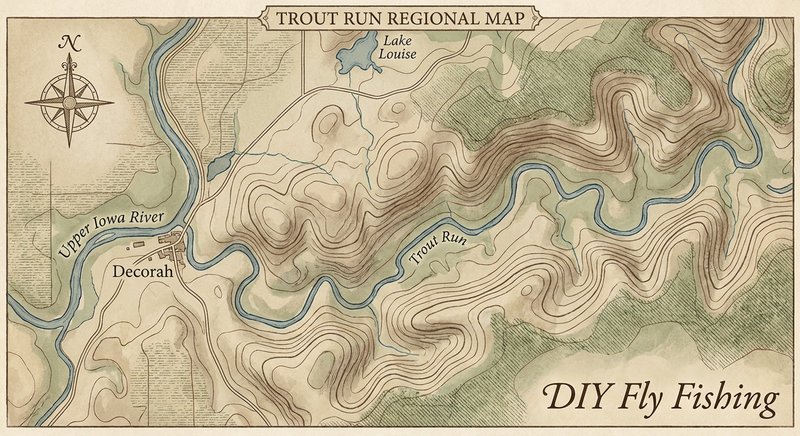
Trout Run
Fly fishing in Iowa · advanced · Best seasons: spring, summer, fall
Target Species
Brown Trout
About This Water
Winneshiek County spring creek with wild brown trout. Technical fishing in pastoral setting.
Fishing Recommendations
Welcome to the Driftless Area! As your guide, I’m excited to walk you through one of Iowa’s most famous spring creeks. Trout Run, located just south of Decorah, is a unique gem. While it is famous for hosting the Decorah Fish Hatchery and the world-renowned Decorah Eagles, for a fly angler, it represents some of the most accessible and productive brown trout water in the Midwest.
Here is your comprehensive guide to fishing Trout Run.
🎣 Location Overview
Trout Run is a classic limestone spring creek. Because it is fed by a massive cold-water spring (at the hatchery), the water temperature remains a consistent 48–52 degrees Fahrenheit year-round. This creates a "thermal refuge"—it stays cool in the heat of summer and never freezes in the dead of winter.
The creek flows through a mix of manicured park-like settings near the hatchery and more rugged, "Driftless" style terrain as it meanders toward the Upper Iowa River. What makes it special is the biomass. The nutrient-rich limestone water produces an incredible amount of aquatic insects and sculpin, leading to fast growth rates for trout. It is one of the most heavily stocked streams in Iowa, but it also holds a surprising number of wary, "holdover" brown trout that have seen every fly in the book.
🐟 Target Species & Behavior
While the Iowa DNR stocks Rainbow Trout here regularly, the Brown Trout are the stars of the show for the technical angler.
- Behavior: These Browns are opportunistic but spooky. In the upper stretches near the hatchery, they are accustomed to human presence but are very "leader shy." As you move downstream, they behave like wild fish, hugging undercut banks and hiding under "lunker structures" (man-made wooden cribs built into the banks).
- Holding Zones: Look for the "seams" where fast water meets slow water. In Trout Run, Browns love to sit in the deep pools beneath the footbridges and in the shadows of the overhanging vegetation.
- Feeding: They are highly focused on scuds (freshwater shrimp) and sowbugs. If there isn’t a hatch, they are looking down at the gravel for these high-protein morsels.
📅 Best Times to Fish
Optimal Seasons
- Spring (April – June): This is prime time. The bankside vegetation hasn't become overgrown yet, and the first major hatches (Blue Winged Olives and Caddis) begin.
- Summer (July – August): While other streams warm up and become unfishable, Trout Run stays cold. This is the peak of Terrestrial Season.
- Fall (September – October): The Brown Trout begin to color up for the spawn. They become more aggressive and will strike larger streamers to defend territory.
Best Times of Day
- Early Morning: Right at sunrise is best for twitching streamers or throwing large terrestrials before the crowds arrive.
- Evening: The "Caddis hour" just before dusk can produce spectacular dry fly action.
- Overcast Days: Brown Trout are light-sensitive. A cloudy, drizzly day is the absolute best time to catch a trophy on Trout Run.
🪰 Recommended Flies & Techniques
Top Fly Patterns
- Nymphs/Scuds:
- Ray Charles (Grey or Tan, size 16-18) – A legendary Driftless fly.
- Pink Squirrel (size 14-16) – The gold standard for Iowa trout.
- Flashback Scud (Olive or Orange, size 16).
- Dry Flies:
- Elk Hair Caddis (Tan, size 16-18).
- Hi-Vis Beetle or Dave’s Hopper (Summer months).
- BWO Sparkle Dun (size 18-20).
- Streamers:
- Black or Olive Woolly Bugger (size 10-12).
- Pine Squirrel Leech (Brown).
Presentation Tips
- The "Trout Run Reach Cast": Because the current is often faster in the middle than at the banks, you must master the reach cast to prevent drag. Drag is the #1 reason anglers get skunked here.
- Light Leaders: Use 6X fluorocarbon tippet when nymphing. The water is gin-clear, and these fish can see heavy mono.
- European Nymphing: This "tight-line" technique is incredibly effective in the deeper runs of Trout Run because it allows you to feel the subtle take of a Brown Trout without the delay of a bobber/indicator.
💡 Pro Tips & Local Knowledge
- Fish the "Trout Run Trail": There is a paved bike trail that follows much of the creek. Use this to scout. If you see a bridge, fish under it—the shadows provide safety for the largest Browns.
- The Hatchery Secret: The water immediately below the hatchery outflow is oxygen-rich and loaded with food. It is crowded, but it holds a massive density of fish. For a quieter experience, walk at least a half-mile downstream from the hatchery.
- Stealth is Key: Since the banks are often elevated, the fish can see your silhouette against the sky. Crouch down and stay low as you approach the bank. If you can see the fish, they have likely already seen you.
- The "Sowbug Slide": Fish a grey sowbug dead-drifted right along the bottom of the limestone ledges. Give it a tiny "hop" at the end of the drift to trigger an instinctive strike.
⚠️ Important Information
- Access: Much of Trout Run is accessible via the Decorah Fish Hatchery grounds and public easements. Look for the "Public Fishing" signs. Iowa has excellent "walk-in" access laws for designated trout streams.
- Regulations:
- You must have a valid Iowa Fishing License AND a Trout Fee (Trout Stamp).
- Trout Run is generally open for "All Methods" (bait/lure/fly), so be prepared to share the water with families and spin-anglers near the hatchery.
- Special Considerations:
- Eagles: Keep an eye on the trees! The Decorah Eagles are often perched directly above the stream.
- Clean Your Gear: To prevent the spread of invasive species like New Zealand Mudsnails or Didymo, always dry your boots and gear completely before moving to another watershed.
Guide’s Final Word: Trout Run is the perfect "confidence" stream. Whether you are a beginner looking to catch your first trout or a pro wanting to technical-fish during a mid-summer heatwave, this creek delivers. Tight lines!
Bug Hatches & Matching Flies
| Hatch | Type | Peak months | Time of day | Hook sizes | Matching flies |
|---|---|---|---|---|---|
| Blue-Winged Olive Baetis | mayfly | March, April, September, October | Late Morning/Afternoon | #18-22 | RS2 #20-22, Parachute BWO #18-20, BWO CDC Emerger #18-22 |
| Scud Gammarus | crustacean | Year-round | All Day | #14-18 | Ray Charles #14-18, Pink Squirrel #14-16, UV Scud #14-18 |
| Grannom Caddis Brachycentrus | caddis | April, May | Afternoon/Evening | #14-16 | Peacock Caddis #14-16, Holy Grail #14-16, LaFontaine's Deep Sparkle Pupa #14-16 |
| Sulfur Ephemerella invaria | mayfly | June, July | Evening | #14-18 | Sulfur Parachute #16-18, Sulfur CDC Emerger #14-16, Pheasant Tail #14-18 |
| Trico Tricorythodes | mayfly | July, August, September | Morning | #20-26 | Trico Spinner #22-24, Drowned Trico Spinner #20-24 |
| Tan Caddis Hydropsyche | caddis | June, July, August | Evening | #14-18 | Elk Hair Caddis #14-18, Soft Hackle Hare's Ear #14-16, Iris Caddis #16-18 |
| Midge Chironomidae | midge | January, February, March | Late Morning/Afternoon | #18-24 | Zebra Midge #18-22, Griffith's Gnat #20-24, Top Secret Midge #20-22 |
| Terrestrials Formicidae/Orthoptera | terrestrial | July, August, September | Afternoon | #10-18 | Black Foam Ant #16-18, Dave's Hopper #10-12, Crowe Beetle #14-16 |