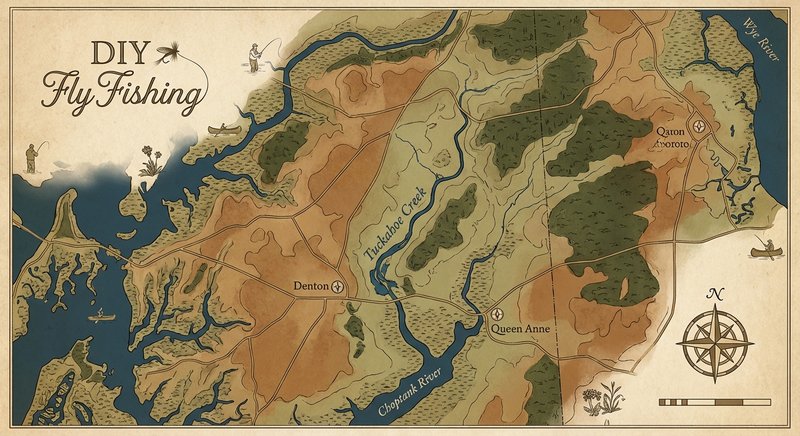
Tuckahoe Creek
Fly fishing in Maryland · Beginner · Best seasons: Spring, Summer, Fall
Target Species
Largemouth Bass, Chain Pickerel, Crappie
About This Water
Eastern Shore stream with bass and pickerel. Flows through state park.
Fishing Recommendations
Welcome to the Eastern Shore. Tuckahoe Creek is one of Maryland’s true "blackwater" gems. Flowing through Caroline and Queen Anne’s counties, it offers a distinct contrast to the rocky rivers of Western Maryland. This is a world of cypress knees, fallen timber, lily pads, and slow-moving, tea-colored water.
As your guide, here is the comprehensive breakdown for fly fishing Tuckahoe Creek.
🎣 Location Overview
Tuckahoe Creek is a primary tributary of the Choptank River. It is divided into two distinct personalities: the nontidal upper reach (centered around Tuckahoe State Park and the 60-acre Tuckahoe Lake) and the tidal lower reach (below Crouse Mill Dam).
What makes the "Tuck" special is its intimacy. The canopy often closes in overhead, creating a quiet, cathedral-like atmosphere. The water is stained with tannins—looking like dark tea—which allows anglers to get closer to fish than they would in crystal-clear water. It is a classic "low and slow" fishery where precision casting to structure is more important than long-distance bombing.
🐟 Target Species & Behavior
Largemouth Bass
The apex predator here. These bass are "structure-oriented." They are rarely in open water; instead, they hug the cypress roots, downed logs, and the edges of spatterdock (lily pads). They feed heavily on bluegill, crayfish, and frogs.
Chain Pickerel
Often called "Eastern Pike," these are the stars of the cooler months. They are ambush predators with lightning-fast strikes. Look for them in the "shallows within the shadows"—vegetation edges and submerged grass beds. They love flashy movements and are less spooked by aggressive presentations than bass.
Crappie
Tuckahoe holds an impressive population of "slabs." They school up around submerged brush piles and bridge pilings. They are delicate feeders compared to bass, preferring small minnow imitations.
📅 Best Times to Fish
- Spring (March – May): This is the prime window. As the water warms, Crappie move to the shallows to spawn (March/April), followed by the Bass. Pickerel are highly active now before the summer heat slows them down.
- Summer (June – August): Focus on the "Golden Hours"—dawn and dusk. The midday heat can push fish deep into the shade of the overhanging trees. This is peak topwater season.
- Fall (September – November): As temperatures drop, fish go on a feeding binge to prepare for winter. The Pickerel activity spikes again as the weed beds begin to die back.
Best Times of Day: In the tidal sections, tide beats time of day. The last two hours of the falling tide and the first hour of the rising tide are the "magic windows" when baitfish are flushed out of the grass and wood.
🪰 Recommended Flies & Techniques
Top Fly Patterns
- For Bass:
- Dahlberg Divers or BoogleBug Poppers: Sizes 2–6. Yellow, Chartreuse, or Frog patterns.
- Gamechangers (Small): In white or shad patterns for the tidal sections.
- Clouser Minnows: Red/White or Chartreuse/White (the Maryland standard).
- For Pickerel:
- Flashabou Streamers: Anything with silver or gold flash.
- Bunny Leeches: In black or olive. The undulating movement drives them wild.
- For Crappie:
- Woolly Buggers: Size 8–12 in white, pink, or chartreuse.
- Micro-Clousers: Size 10.
Techniques & Presentation
- The "Dink and Sit": When using topwater poppers for bass, cast into a pocket in the lily pads. Let the rings disappear completely before moving the fly. Often, the strike occurs while the fly is motionless.
- The Strip-Pause: For Pickerel, use a jerky, erratic retrieve. They will often follow a fly all the way to the boat; be prepared to do a "figure-eight" at the end of your retrieve.
- Vertical Nymphing: For Crappie, find a downed tree and drop a small streamer or bugger straight down into the branches, twitching it rhythmically.
💡 Pro Tips & Local Knowledge
- Bring the Weedguards: You cannot fish Tuckahoe effectively without weedguards on your flies. You will be casting into "the junk"—logs, pads, and brush. If you aren't snagging occasionally, you aren't fishing where the fish are.
- Kayak is King: While there are some bank access points in the State Park, the best way to fish the Tuck is via kayak or canoe. It allows you to stealthily approach wood cover that shore anglers can't reach.
- The "Crouse Mill" Secret: The area just below the Crouse Mill Dam is a hotspot. The moving water oxygenates the stream and concentrates bait, making it a reliable spot for Bass and the occasional stray Yellow Perch.
- Watch the Color: If the water looks like "chocolate milk" after a heavy rain, the fishing will be tough. You want that "root beer" or "black tea" clarity where you can see about 1-2 feet down.
⚠️ Important Information
- Access:
- Tuckahoe State Park: Offers a boat ramp for the lake and several hiking trails for bank access.
- Stony Point Landing: A great launch point for the tidal lower section.
- Hillsboro Boat Ramp: Access to the lower, wider reaches of the creek.
- Regulations:
- A Maryland Non-Tidal Fishing License is required for the lake and upper creek.
- A Bay Sport (Tidal) License is required if you move below the MD Rt. 404 bridge.
- Check current MD DNR regulations for creel limits, especially for Crappie.
- Safety: The Tuck is home to many snakes (mostly harmless Northern Water Snakes) and ticks. Wear bug repellent and be mindful of where you step or reach when unhooking a fly from a tree.
Guide’s Final Word: Tuckahoe Creek is about the experience of the swamp. Slow down, observe the turtles and herons, and pick your targets carefully. When a 5-pound largemouth explodes on a popper in the middle of a silent cypress grove, you’ll understand why we love this water.
Bug Hatches & Matching Flies
| Hatch | Type | Peak months | Time of day | Hook sizes | Matching flies |
|---|---|---|---|---|---|
| Hexagenia (Giant Mayfly) Hexagenia limbata | mayfly | June, July | Dusk and Night | #6-10 | Hexagenia Spinner #6-8, Burrowing Mayfly Nymph #8-10 |
| White Miller Ephoron leukon | mayfly | August, September | Late Evening/After Dark | #12-14 | White Wulff #12-14, White Miller Wet #14 |
| Common Damselfly Enallagma spp. | other | June, July, August | Mid-day | #10-14 | Braided Butt Damsel #10-12, Marabou Damsel Nymph #12-14 |
| Cinnamon Caddis Hydropsyche spp. | caddis | May, June | Evening | #14-18 | Elk Hair Caddis (Tan/Orange) #14-16, LaFontaine Sparkle Pupa #16 |
| Blue-Winged Olive Baetis spp. | mayfly | March, April, October, November | Afternoon | #18-22 | BWO Parachute #18-20, RS2 (Olive) #20-22 |
| Black Carpenter Ant Camponotus pensylvanicus | terrestrial | July, August | Afternoon | #12-16 | Black Foam Ant #12-16, Chernobyl Ant #10-12 |
| Common Midge Chironomidae | midge | January, February, March | Mid-day | #18-24 | Griffith's Gnat #18-22, Zebra Midge #18-24 |
| Green Darner Anax junius | other | July, August | Morning/Afternoon | #4-8 | Dragonfly Nymph #4-8, Blue Dragon #6-8 |