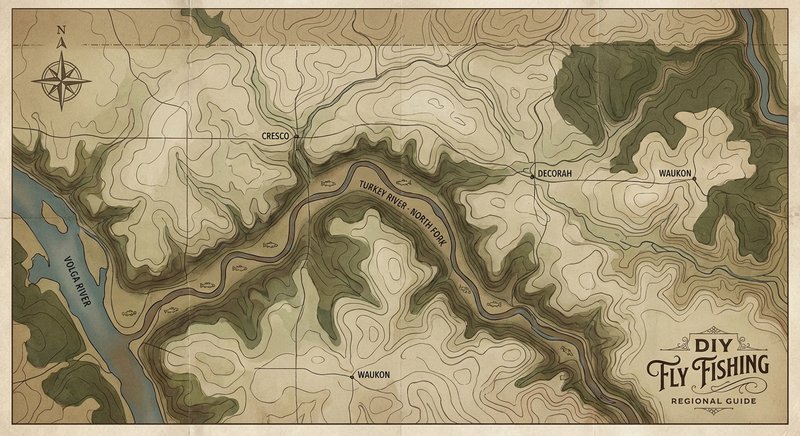
Turkey River - North Fork
Fly fishing in Iowa · intermediate · Best seasons: spring, summer, fall
Target Species
Brown Trout, Rainbow Trout
About This Water
Winneshiek County stream with wild trout. Scenic bluff country setting.
Fishing Recommendations
The North Fork of the Turkey River in Howard County, Iowa, is one of the hidden gems of the Upper Midwest’s "Driftless Area." While many anglers flock to the famous spring creeks of Decorah or Viroqua, the North Fork offers a more secluded, authentic experience for those willing to do a little exploring.
As a guide, I consider the North Fork a "technical meadow stream." It lacks the high-gradient plunging pools of mountain streams but makes up for it with deep undercut banks, complex weed beds, and some of the most beautiful wild Brown Trout in the state.
🎣 Location Overview
The North Fork of the Turkey River originates near the Minnesota border and flows through the rolling limestone bluffs of Howard County. Unlike the main stem of the Turkey, which can become wide and silty, the North Fork retains its cold-water character thanks to numerous limestone springs.
What makes it special:
- Natural Reproduction: This is one of the few Iowa streams with a robust population of wild, naturally reproducing Brown Trout.
- The Scenery: It meanders through a mix of lush cow pastures and timbered limestone outcroppings.
- Low Pressure: Because it is further west than the high-traffic streams in Winneshiek County, you will often have long stretches of water entirely to yourself.
🐟 Target Species & Behavior
Brown Trout (Primary Target)
The North Fork is a Brown Trout factory. These fish are wary, smart, and highly opportunistic.
- Holding Water: Look for "the bend." These fish love the deep water on the outside of river bends where the current has carved out an undercut bank. They also hide in the thick carpets of Elodea (water weed).
- Behavior: Wild Browns here are "bank-tight." If your fly isn't within six inches of the grass line, you’re often out of the strike zone.
Rainbow Trout
While there is some natural carryover, Rainbows are primarily stocked in specific public access areas (like the Big Springs area).
- Behavior: They tend to hold in faster, more oxygenated water (riffle heads) compared to the Browns. They are less "spooky" and more likely to take a flashy attractor nymph.
📅 Best Times to Fish
Spring (March - May)
- Conditions: The "early season" can be spectacular. Look for Blue-winged Olive (BWO) hatches on overcast days.
- Prime Window: 11:00 AM – 3:00 PM when the sun warms the water just enough to trigger insect activity.
Summer (June - August)
- Conditions: This is the time for Tricos and Terrestrials.
- Prime Window: 6:00 AM – 10:00 AM for the Trico spinner fall. After that, switch to hoppers.
- Warning: Monitor water temperatures. If the water hits 68°F, stop fishing to protect the trout.
Fall (September - November)
- Conditions: This is my favorite time. The Browns become aggressive and territorial as they prepare for the spawn.
- Prime Window: All day. Overcast afternoons are lethal for streamer fishing.
🪰 Recommended Flies & Techniques
Nymphing (The Bread and Butter)
Since 80% of a trout's diet is subsurface, you must have these:
- Scuds & Sowbugs (#14–18): These are the primary forage in limestone springs. Pink, olive, or gray work best.
- Pheasant Tail Nymphs (#16–20): Classic representation of mayfly nymphs.
- Zebra Midges (#18–22): Essential for winter and early spring.
Dry Flies (The Excitement)
- Trico Spinners (#20–24): A Howard County staple in mid-summer mornings.
- BWO Sparkle Duns (#18–22): For those drizzly spring and fall days.
- Chubby Chernobyl / Foam Hoppers (#8–12): From July through September, "slapping" a hopper against a cut bank is the most fun you can have.
Streamers (The Big Fish Strategy)
- Black or Olive Wooly Buggers (#8–12): Dead-drift them or strip them slowly through deep holes.
- Small Pine Squirrel Leeches: Very effective for wild Browns.
💡 Pro Tips & Local Knowledge
- The "Stealth" Approach: The water is crystal clear and the banks are often flat. If you stand tall on the bank, the fish will see you from 30 feet away. Kneel. Wear drab colors (camo or olive) to blend into the tall grass.
- The Driftless "Hop": Don't spend two hours in one hole. The North Fork rewards mobility. Fish a spot for 15 minutes, then move 100 yards upstream to the next bend.
- Water Clarity: If the main Turkey River is "chocolate milk" after a rain, check the North Fork. It often clears 24–48 hours faster than the larger rivers.
- Casting: Master the "Roll Cast" and "Reach Cast." Overhanging willow branches and tall reed canary grass make traditional backcasting difficult.
⚠️ Important Information
Access
- Public Land: Look for the Turkey River Wildlife Area and the Vernon Springs area.
- Private Land: Iowa law states that the stream bed is public, but you must enter through public access points or get landowner permission to cross their land. Always respect "No Trespassing" signs.
Regulations
- License: An Iowa Fishing License AND a Trout Fee are required.
- Tackle: Check local signage. Many stretches are "Artificial Lure Only" (no bait), and some have specific length limits or "Catch and Release Only" designations for Brown Trout.
- Barbless Hooks: While not always required by law, I highly recommend pinching your barbs to ensure a clean release for these wild fish.
Gear Recommendation
- Rod: 8'6" or 9' 4-weight fly rod.
- Leader: 9ft to 12ft 5X or 6X fluorocarbon (these fish are leader-shy!).
- Waders: Breathable waders with felt or studded soles, as limestone rocks can be extremely slippery.
Bug Hatches & Matching Flies
| Hatch | Type | Peak months | Time of day | Hook sizes | Matching flies |
|---|---|---|---|---|---|
| Blue-winged Olive Baetis tricaudatus | mayfly | April, May, September, October | Late Morning/Afternoon | #18-22 | RS2 #20-22, BWO Sparkle Dun #18-20, Pheasant Tail Nymph #18-20 |
| Grannom Caddis Brachycentrus | caddis | April, May | Afternoon/Evening | #14-16 | Peacock Caddis #14-16, Green Weenie #14-16, LaFontaine's Deep Sparkle Pupa #14-16 |
| Sulphur Ephemerella invaria | mayfly | May, June | Evening | #14-18 | Sulphur Parachute #16-18, Sulphur Soft Hackle #16, Hare's Ear Nymph #14-16 |
| Trico Tricorythodes | mayfly | July, August, September | Early Morning | #20-24 | Trico Spinner #20-24, Zebra Midge #20-22, Trico Emerger #20-22 |
| Light Cahill Stenacron interpunctatum | mayfly | June, July | Evening | #12-14 | Light Cahill Dry #12-14, Gold Ribbed Hare's Ear #12-14 |
| Terrestrials Formicidae / Gryllidae | terrestrial | July, August, September | All Day | #10-18 | Black Foam Ant #16-18, Dave's Hopper #10-12, Foam Beetle #14-16 |
| Tan Caddis Hydropsyche | caddis | June, July, August | Evening | #14-18 | Elk Hair Caddis (Tan) #14-16, Hydropsyche Larva #14-16, Iris Caddis #16-18 |
| Midges Chironomidae | midge | January, February, March | Midday | #20-24 | Griffith's Gnat #20-22, Black Zebra Midge #20-24, Morgan's Midge #22 |
| Little Black Stonefly Capniidae | stonefly | February, March | Afternoon | #16-18 | Little Black Stone #16-18, Prince Nymph #16-18 |