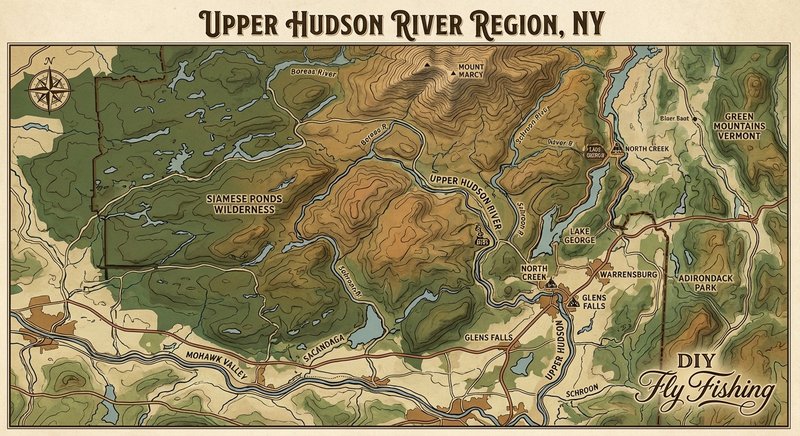
Upper Hudson River
Fly fishing in New York · Beginner · Best seasons: Summer, Fall
Target Species
Brook Trout, Brown Trout
About This Water
Adirondack headwaters with brook trout and some brown trout. Scenic mountain fishing.
Fishing Recommendations
Welcome to the "North Country." The Upper Hudson River in the Adirondack Park of New York is a vastly different beast than the wide, slow-moving river seen near Albany or NYC. Up here, it is a rugged, boulder-strewn freestone river that offers some of the most remote and scenic fly fishing in the Eastern United States.
Here is your comprehensive guide to fly fishing the Upper Hudson.
🎣 Location Overview
The Upper Hudson—specifically the stretch from its headwaters at Lake Henderson down through the town of North Creek—is a classic Adirondack freestone river. It is characterized by high-gradient pocket water, deep pools, and long runs flanked by dense forests and ancient granite.
What makes this water special is its wildness. Much of the river flows through the High Peaks Wilderness and the Hudson Gorge Wilderness. Unlike the manicured banks of the Catskills, the Upper Hudson is raw. Anglers love it for the solitude; it is entirely possible to spend a full day on the water without seeing another soul. The water is chemically "soft" and tea-colored due to natural tannins, making for a beautiful backdrop to a day of wading.
🐟 Target Species & Behavior
Brook Trout (Salvelinus fontinalis)
The "crown jewel" of the Adirondacks. In the main stem of the Upper Hudson, you will find wild brookies, particularly near the mouths of cold-water tributaries (like the Indian River or Cedar River). They are opportunistic but cautious.
- Behavior: They hold in the coldest water available. Look for them in highly oxygenated "bubble curtains" and the heads of pools.
- Feeding: They love terrestrial insects in the summer and small nymphs year-round.
Brown Trout (Salmo trutta)
The Upper Hudson holds both wild and stocked brown trout. These fish grow larger than the brookies and are the primary target for those swinging streamers or nymphing deep runs.
- Behavior: Browns are more structure-oriented. They tuck under overhanging banks, behind large boulders (cushion water), and in the dark depths of the "Blue Ledge" pools.
- Feeding: They are predatory. While they will rise for a heavy hatch, the largest browns are often looking for a "high-calorie" meal like a sculpin or a smaller trout.
📅 Best Times to Fish
While the river is open in spring, your request focuses on the prime windows of Summer and Fall.
Summer (Late June – August)
- Conditions: Water levels drop and clear. However, water temperature is the biggest factor.
- Time of Day: Early morning (dawn to 10:00 AM) and "the magic hour" (the last 90 minutes of light).
- Strategy: Focus on the "pocket water" where the water is most oxygenated. If the main stem hits 70°F, stop fishing to protect the trout and move to the colder, higher-elevation tributaries.
Fall (September – October)
- Conditions: This is arguably the best time. Cooling air temperatures trigger a feeding frenzy as fish prepare for winter and the brook/brown trout spawning season.
- Time of Day: Mid-day becomes more productive as the sun warms the water slightly.
- Strategy: Use aggressive techniques. The fish become more territorial and active. The foliage backdrop is a world-class bonus.
🪰 Recommended Flies & Techniques
Dry Flies
The Hudson isn't known for massive, predictable hatches like the Delaware, but it has steady activity.
- Patterns: Royal Wulff (classic Adirondack attractor), Ausable Wulff, Elk Hair Caddis (Size 14-18), and Stimulators (Size 8-12) in orange or yellow.
- Summer Terrestrials: Chernobyl Ants, Black Foam Beetles, and Dave’s Hopper.
Nymphs
Nymphing is the most consistent way to put fish in the net here.
- Patterns: Pheasant Tail (Size 14-18), Hare’s Ear, and Pat’s Rubber Legs (Stonefly imitations are vital here).
- Technique: High-stick nymphing through the pockets. Use enough weight to get down quickly in the heavy current.
Streamers
Essential for the "big water" stretches and for targeting large Browns in the fall.
- Patterns: Woolly Bugger (Black or Olive), Muddler Minnow, and Galloup’s Dungeon for the deep gorge pools.
- Technique: "Pounding the banks." Cast toward the shore and strip aggressively back toward the center.
💡 Pro Tips & Local Knowledge
- The "Cold Water" Rule: During summer, seek out "thermal refuges." Find where a small, cold mountain stream enters the Hudson. The trout will stack up in these plumes of cold water.
- Wading Safety: The Upper Hudson is notorious for slippery, "greased bowling ball" rocks. Studded wading boots and a wading staff are non-negotiable. The current is stronger than it looks.
- The Hudson Gorge: For the adventurous, the stretch through the Hudson Gorge is spectacular but requires a hike or a raft. If you hike in via the OK Slip Falls trail or Blue Ledge trail, you’ll access water that rarely sees a fly.
- The "Adirondack Bushwhack": Don't be afraid to walk half a mile away from the road access points. The fishing quality improves exponentially once you are out of sight of the bridges.
⚠️ Important Information
- Access Points:
- North Creek: Easy access near the town and the railroad tracks.
- Riparius: Good bridge access and boat launch area.
- Newcomb: High-quality water near the VIC (Visitor Interpretive Center).
- Regulations: Check the NYS DEC Freshwater Fishing Regulations. Much of the Upper Hudson falls under statewide regulations, but specific sections may have "Catch and Release Only" or "Artificial Lures Only" designations.
- Licensing: A valid New York State Fishing License is required for everyone 16 and older.
- Safety: This is bear and moose country. Carry a communication device (though cell service is spotty) and let someone know your plan. Always check the USGS gauge at North Creek; if it's over 4-5 feet, wading can become dangerous.
Tight lines! The Upper Hudson is a place of deep silence and beautiful spots—respect the water, and it will reward you.
Bug Hatches & Matching Flies
| Hatch | Type | Peak months | Time of day | Hook sizes | Matching flies |
|---|---|---|---|---|---|
| Hendrickson Ephemerella subvariabilis | mayfly | April, May | Afternoon | #12-14 | Red Quill #12-14, Hendrickson Emerger #14, Pheasant Tail #12-14 |
| Blue-Winged Olive (BWO) Baetis | mayfly | April, May, September, October | Late Morning/Afternoon | #18-22 | RS2 #20-22, Parachute BWO #18-22, Cdc BWO #20 |
| Grannom Caddis Brachycentrus | caddis | April, May | Morning/Afternoon | #14-16 | Elk Hair Caddis (Olive) #14-16, Peeking Caddis #14, LaFontaine Sparkle Pupa #14-16 |
| March Brown Maccaffertium vicarium | mayfly | May, June | Afternoon | #10-12 | March Brown Dry #10-12, Hare's Ear Nymph #10-12, March Brown Wet Fly #12 |
| Sulphur Ephemerella invaria/dorothea | mayfly | June, July | Evening | #14-18 | Sulphur Parachute #16-18, Sulphur Cripple #16, Split Case Sulphur #16 |
| Isonychia (Slate Drake) Isonychia bicolor | mayfly | June, September | Late Afternoon/Evening | #10-14 | Iso Parachute #12-14, Zug Bug #10-12, Isonychia Wet Fly #12 |
| Golden Stonefly Acroneuria | stonefly | June, July | Morning/Evening | #8-12 | Pat's Rubber Legs #8-12, Golden Stimulator #10-12, Kaufmann's Stone #8-10 |
| White Miller Ephoron leukon | mayfly | August | Last light | #12-14 | White Wulff #12-14, Cream Cahill #14, White Miller Spinner #14 |
| Trico Tricorythodes | mayfly | July, August, September | Early Morning | #22-26 | Trico Spinner #22-24, Trico Dun #24, Zebra Midge #22 |