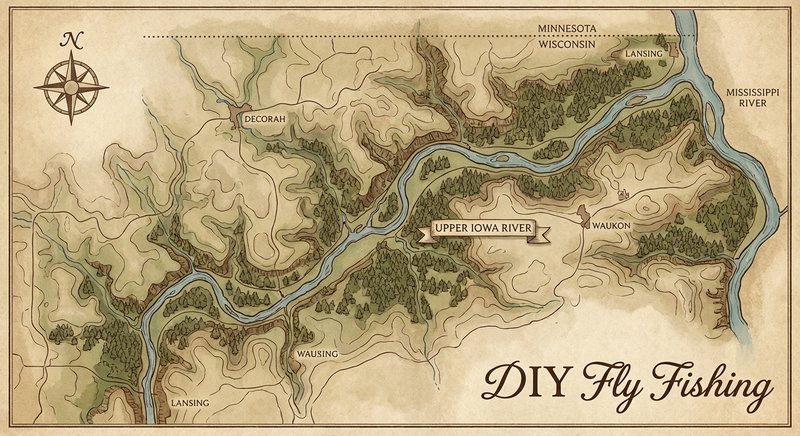
Upper Iowa River
Fly fishing in Iowa · intermediate · Best seasons: spring, summer, fall
Target Species
Brown Trout, Rainbow Trout
About This Water
Premier northeast Iowa trout stream with wild brown trout. Scenic bluffs and spring-fed tributaries.
Fishing Recommendations
Welcome to the Driftless Area of Northeast Iowa. As your guide, I’m excited to introduce you to the Upper Iowa River system. While many people think of Iowa as flat cornfields, the Northeast corner is a rugged landscape of limestone bluffs, deep valleys, and cold, spring-fed coulees.
The Upper Iowa River is unique because while the main stem is a legendary smallmouth bass fishery, its cold-water tributaries and the spring-fed headwaters comprise some of the best technical trout fishing in the Midwest.
🎣 Location Overview
The Upper Iowa River flows through the heart of the "Driftless Area"—a region missed by the last glaciers, leaving behind steep topography and thousands of limestone springs.
The water here is alkaline and mineral-rich, which creates a massive biomass of insects and crustaceans. This leads to fast growth rates for trout. The river is characterized by dramatic limestone palisades, "beaten" undercut banks, and classic riffle-pool-run sequences. It is a "technical" fishery; the water is often crystal clear, requiring stealth and precise presentations.
🐟 Target Species & Behavior
- Brown Trout: The kings of the Driftless. Many of the tributaries have self-sustaining, wild populations. They are wary, prone to hiding under deep undercut banks or fallen timber, and become highly aggressive during low-light hours.
- Rainbow Trout: Generally stocked by the Iowa DNR. They are more likely to hold in faster, oxygenated riffles and are typically less "spooky" than the wild browns.
- Behavior: Because of the limestone influence, these fish are "well-fed." They won’t always move far for a fly. You must "drift it into their bedroom." They feed heavily on scuds and sowbugs year-round.
📅 Best Times to Fish
- Spring (Late March – May): This is the window for the Blue Winged Olive (BWO) hatches. As the water warms, the fish become active after the winter doldrums.
- Summer (June – August): Early mornings and late evenings are essential. This is Terrestrial Season. While many trout streams across the US get too warm, the spring-fed nature of the Upper Iowa's tributaries keeps them fishable, though you should always monitor water temps (avoid fishing if water exceeds 68°F).
- Fall (September – October): This is arguably the prime time. The Brown Trout are preparing to spawn and become aggressive. The colors of the bluffs are spectacular, and the Trico hatches provide challenging dry fly action.
🪰 Recommended Flies & Techniques
Top Fly Patterns
- Nymphs:
- Ray Charles or Pink Squirrel (The "Pink Squirrel" is a legendary Driftless fly).
- Scuds & Sowbugs (Size 14-18, gray or tan).
- Zebra Midges (Size 18-22, black or red).
- Dry Flies:
- Elk Hair Caddis (Size 14-16).
- Hippo Hopper or Dave’s Hopper (Size 10-14).
- Griffith’s Gnat (Size 18-22).
- Streamers:
- Black or Olive Woolly Buggers (Size 8-10).
- Muddler Minnows (to mimic sculpins).
Effective Techniques
- The "Hopper-Dropper": In summer, use a high-floating foam grasshopper as your indicator and hang a weighted nymph (like a bead-head Pheasant Tail) 18-24 inches below it.
- Stealth Nymphing: Use a long leader (9ft to 12ft) tapered to 5X or 6X fluorocarbon. Since the water is clear, a heavy fly line hitting the surface will spook every fish in the pool.
- Tight-Line/Euro Nymphing: Very effective in the deeper runs of the larger tributaries where there is a complex current.
💡 Pro Tips & Local Knowledge
- Focus on the Tributaries: While the main stem of the Upper Iowa has trout near Decorah, the real gems are the tributaries: Waterloo Creek, French Creek, and Coldwater Creek. These are where the wild fish live.
- The "Crawl": Because the banks are often grassy and elevated, trout can see your silhouette from a long way off. Experienced guides often approach a pool on their knees. If you can see the fish, they have likely already seen you.
- Look for Bubbles: In the Driftless, "foam is home." Target the foam lines where the current concentrates floating insects.
- Decorah Hatchery: Visit the trout hatchery in Decorah. It provides great insight into the stocking program and the health of the local watershed.
⚠️ Important Information
- Access: Iowa has excellent "Public Access" signs on many stretches of these streams. However, much of the land surrounding the river is private. Always respect "No Trespassing" signs and stay within the high-water marks unless there is a dedicated easement.
- Regulations:
- A valid Iowa Fishing License and a Trout Fee are mandatory.
- Be aware of "Improved" sections that may have specific lure restrictions (e.g., barbless hooks or artificial lures only). Check the Iowa DNR website for the latest "Trout Fishing" brochure.
- Gear: A 3-weight or 4-weight rod (8'6" to 9') is the perfect tool for these waters. Waders are recommended year-round as the spring water is consistently cold (50-55°F).
- Cow Pastures: Don't be surprised to find yourself sharing a stream bank with cattle. This is part of the Iowa fly fishing experience! Just watch your step and close any gates you open.
Tight lines, and enjoy the hidden beauty of the Iowa Driftless!
Bug Hatches & Matching Flies
| Hatch | Type | Peak months | Time of day | Hook sizes | Matching flies |
|---|---|---|---|---|---|
| Blue-Winged Olive Baetis | mayfly | April, May, September, October | Late Morning/Afternoon | #18-22 | BWO Sparkle Dun #18-22, Pheasant Tail Nymph #18-20, RS2 #20-22 |
| Grannom Caddis Brachycentrus | caddis | April, May | Afternoon/Evening | #14-16 | Elk Hair Caddis (Olive) #14-16, LaFontaine's Deep Sparkle Pupa #14-16, Peacock Caddis #14-16 |
| Sulfur Ephemerella invaria/dorothea | mayfly | May, June | Evening | #14-18 | Sulfur Parachute #16-18, Sulfur CDC Emerger #16-18, Sulfur Spinner #14-18 |
| Light Cahill Stenacron interpunctatum | mayfly | June, July | Evening | #12-14 | Light Cahill #12-14, Gold Ribbed Hare's Ear #12-14 |
| Trico Tricorythodes | mayfly | July, August, September | Early Morning | #20-24 | Trico Spinner #20-24, Zebra Midge #20-22 |
| White Fly Ephoron leukon | mayfly | August | Dusk/Night | #12-14 | Ephoron Wulff #12-14, White Sparkle Dun #12-14 |
| Terrestrials (Grasshoppers) Orthoptera | terrestrial | July, August, September | Late Morning/Afternoon | #8-12 | Dave's Hopper #10-12, Morrish Hopper #8-12, Parachute Hopper #10-14 |
| Crane Fly Tipulidae | other | August, September | Morning/Evening | #10-14 | Daddy Long Legs #10-12, Crane Fly Larva #10-12 |
| Zebra Midge Chironomidae | midge | January, February, March, December | All Day | #18-24 | Zebra Midge (Black/Silver) #18-22, Griffith's Gnat #18-22 |