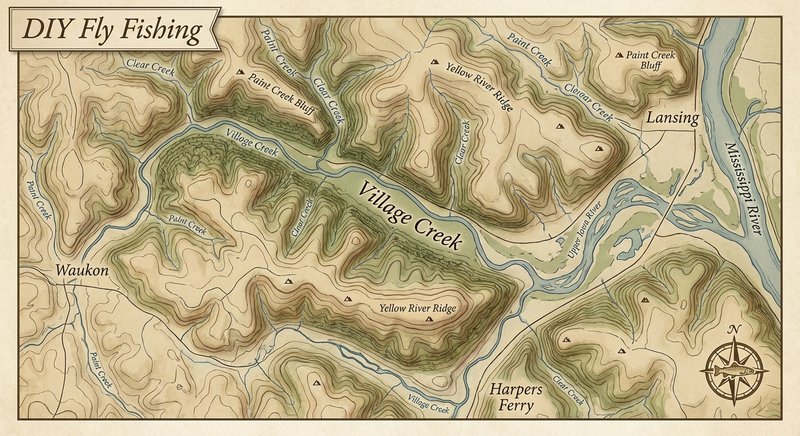
Village Creek
Fly fishing in Iowa · intermediate · Best seasons: spring, summer, fall
Target Species
Brown Trout, Brook Trout
About This Water
Allamakee County stream through state forest. Wild trout with primitive camping.
Fishing Recommendations
Welcome to the heart of the Iowa Driftless. As your guide, I’m excited to walk you through one of the most productive yet underrated gems in the Midwest. Village Creek, located in Allamakee County near Lansing, Iowa, is a quintessential limestone spring stream that offers some of the finest trout fishing in the region.
🎣 Location Overview
Village Creek is a classic "Driftless Area" stream, meaning it flows through a landscape that was missed by the last glaciers, resulting in steep limestone bluffs, deep valleys, and cold, bubbling springs.
What makes Village Creek special is its thermal stability. Because it is heavily fed by underground springs, the water stays cold enough for trout to thrive even during the humid Iowa summers. The creek features a mix of high-gradient riffles, deep limestone-walled pools, and classic "cut-bank" bends. While some Iowa streams can be muddy, Village Creek tends to clear up faster than its neighbors after a rain, making it a reliable destination for traveling anglers.
🐟 Target Species & Behavior
- Brown Trout: The king of Village Creek. These are primarily wild, self-sustaining populations. They are notoriously wary and highly intelligent. They favor "overhead cover"—think undercut banks, fallen timber, and the deep shadows under limestone ledges.
- Brook Trout: Found predominantly in the upper reaches and smaller tributaries where the water is coldest and highest in dissolved oxygen. They are opportunistic feeders but very "spooky." If you see a flash of orange and white-tipped fins in a shallow riffle, you’ve found a Brookie.
Feeding Behavior: In this limestone environment, the biomass is huge. Fish feed heavily on scuds and sowbugs year-round. During hatches, they will move from the deep holes into the heads of riffles to intercept nymphs and emergers.
📅 Best Times to Fish
- Spring (April – June): This is the prime "hatch window." As the valley warms, the aquatic insects become active. Late morning through mid-afternoon is the sweet spot.
- Summer (July – August): The "Terrestrial Season." While other rivers might get too warm, Village Creek remains fishable. Focus on early mornings (dawn to 10 AM) and late evenings.
- Fall (September – October): Perhaps the most beautiful time. The Brown trout become aggressive as they prepare for the fall spawn. The colors of the fish rival the changing leaves on the bluffs.
- Conditions: Look for "cloudy/overcast" days. On bright, blue-bird days, the trout in these clear waters become very cautious and will often retreat to the deepest cover.
🪰 Recommended Flies & Techniques
Dry Flies
- Hatch Specific: Blue-Winged Olives (BWO) in #18-22, Elk Hair Caddis #14-16, and Tricos #20-24 (late summer mornings).
- Terrestrials: This is Iowa—land of beetles, ants, and grasshoppers. Use a Fat Albert or a Hippie Stomper (#12-14) in the summer. A foam beetle dropped right against a cut bank is deadly.
Nymphs (The Bread & Butter)
- Scuds & Sowbugs: These are the primary food source. Sizes #14-18 in pink, grey, or olive.
- Pheasant Tail & Zebra Midges: Classic patterns that work year-round.
- Technique: Use a "European Nymphing" style or a very small, sensitive strike indicator. The takes can be subtle in the slower pools.
Streamers
- Patterns: Black or Olive Woolly Buggers (#8-10) or small sculpin patterns.
- Technique: If the water is slightly stained after a rain, strip a streamer tight against the banks. This is how you find the 18-inch+ "trophy" Browns.
💡 Pro Tips & Local Knowledge
- The "Stealth" Factor: The biggest mistake anglers make here is "lining" the fish. Because the water is clear and the stream is relatively narrow, you should fish upstream. Approach a pool from behind the fish, stay low (sometimes crawling on your knees), and wear drab colors (camo, tan, or olive).
- Focus on the Bends: Village Creek is famous for its "outside bends." The current carves out deep pockets under the grass. If you can tuck a fly 2 inches from the grass edge, you will get a strike.
- The "Dry-Dropper" Setup: In the summer, use a high-floating hopper as your "indicator" and hang a weighted scud 18–24 inches below it. It allows you to cover two parts of the water column simultaneously.
- Upper vs. Lower: If you want Brookies and smaller, faster water, head as far upstream as the public access allows. If you want big, predatory Browns, stick to the middle and lower sections where the water is deeper.
⚠️ Important Information
- Access: Much of Village Creek is bordered by private land. However, there are excellent Public Fishing Access points marked by green Iowa DNR signs. Always respect "No Trespassing" signs. Use the Iowa DNR Trout Map (available online) to find the specific "State Preserve" and "Public Access" zones.
- Regulations:
- An Iowa Fishing License AND a Trout Fee are required.
- Check current regulations regarding "Catch and Release" zones versus "Keep" zones, as these can change by specific stream segment.
- Safety: The banks can be muddy and slippery. Felt-soled boots or studs are highly recommended. Also, be aware that this is "driftless" country—cell service can be spotty in the deep valleys.
Guide’s Final Word: Village Creek is a thinking man’s stream. It rewards patience, delicate presentations, and a quiet approach. Treat the fish with respect, keep them in the water while unhooking, and you’ll find yourself coming back to this valley for years to come. Tight lines!
Bug Hatches & Matching Flies
| Hatch | Type | Peak months | Time of day | Hook sizes | Matching flies |
|---|---|---|---|---|---|
| Blue-Winged Olive (BWO) Baetis species | mayfly | April, May, September, October | Late Morning/Afternoon | #18-22 | RS2 #18-22, Parachute Adams #18-22, Pheasant Tail #18-20 |
| Grannom Caddis Brachycentrus | caddis | April, May | Afternoon | #14-16 | Elk Hair Caddis (Olive) #14-16, LaFontaine's Deep Sparkle Pupa #14-16, Peacock Caddis #14-16 |
| Sulphur / Pale Morning Dun Ephemerella invaria / dorothea | mayfly | May, June | Evening | #14-18 | Sulphur Parachute #16-18, Comparadun #14-18, Sulphur Spinner #16-18 |
| Trico Tricorythodes | mayfly | July, August, September | Morning | #20-24 | Trico Spinner #20-24, Sunken Trico Spinner #20-22 |
| Light Cahill Stenacron interpunctatum | mayfly | June, July | Evening | #12-14 | Light Cahill #12-14, Gold Ribbed Hare's Ear #12-14 |
| Midges Chironomidae | midge | January, February, March, December | Mid-day | #18-24 | Zebra Midge #18-22, Griffith's Gnat #18-22, Mercury Midge #20-22 |
| Terrestrials Formicidae / Orthoptera | terrestrial | July, August, September | All Day | #10-18 | Black Foam Ant #16-18, Dave's Hopper #10-14, Beetle #14-16 |
| Tan Caddis Hydropsyche | caddis | June, July, August | Evening | #14-18 | Elk Hair Caddis (Tan) #14-18, Soft Hackle Hare's Ear #14-16 |