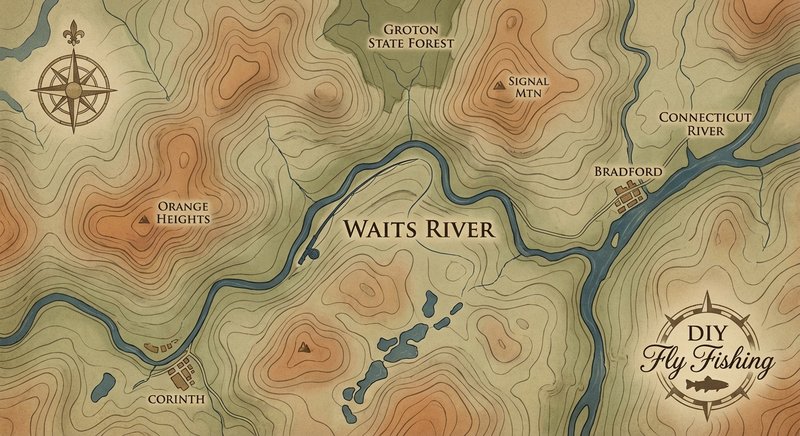
Waits River
Fly fishing in Vermont · Beginner · Best seasons: Spring, Summer, Fall
Target Species
Brown Trout, Brook Trout
About This Water
Eastern Vermont stream with good brown trout. Flows through classic New England farmland.
Fishing Recommendations
As an expert guide who has spent years walking the rocky banks of the Green Mountain State, I can tell you that the Waits River is one of Vermont’s best-kept secrets. While many anglers flock to the more famous White River or the Winooski, the Waits offers a more intimate, classic "New England" freestone experience.
Here is your comprehensive guide to fly fishing the Waits River.
🎣 Location Overview
The Waits River is a major tributary of the Connecticut River, flowing roughly 25 miles through Orange County. It begins in the hills of Orange and Washington and meanders through the quintessential Vermont towns of Corinth and Bradford.
What makes the Waits special is its diversity of water. The upper reaches and its branches (like the South Branch) are tight, brush-lined, and full of plunge pools—classic "blue-ribbon" brook trout territory. As it moves toward Bradford, it widens into a medium-sized river with broad riffles, deep limestone-tinted pools, and undercut banks that house surprisingly large brown trout. It is a "pocket water" lover's dream.
🐟 Target Species & Behavior
The Waits is a dual-threat river.
- Brook Trout (Wild): Found primarily in the upper reaches (West Corinth and above) and in the smaller tributaries. They are opportunistic and aggressive but spook easily. They hold in the highly oxygenated "bubble curtains" at the head of pools.
- Brown Trout (Wild & Stocked): The middle and lower sections hold the browns. Wild browns here are notoriously "bank-shy"—they tuck tight under overhanging grass or fallen timber during the day. They feed heavily on the river's abundant crayfish and sculpin population.
- Behavior: During the heat of summer, fish congregate near the mouths of cold-water "seeps" and smaller mountain feeders. In the fall, browns become highly territorial and will move from the Connecticut River upstream into the lower Waits to spawn.
📅 Best Times to Fish
- Spring (Late April – May): This is "High Water" season. Once the snowmelt (mud season) subsides and the water hits 50°F, the fishing explodes. Use heavy nymphs and streamers.
- Summer (June – August): June is the "Golden Month." Water levels are usually perfect, and hatches are at their peak. In July and August, focus on the early morning (6 AM – 10 AM) or the "magic hour" before dark.
- Fall (September – October): My personal favorite. The brookies turn vibrant orange, and the big browns move up from the Connecticut River. The river is lower, requiring a stealthy approach and longer leaders.
🪰 Recommended Flies & Techniques
Dry Flies
- Elk Hair Caddis (#12-18): The bread and butter of the Waits. Tan or olive.
- Royal Wulff (#12-14): A high-visibility attractor for the fast pocket water in the upper sections.
- Parachute Adams (#14-20): Use this for the technical slow-water flats in the Bradford area.
- Terrestrials (July-Sept): Black ants, beetles, and Dave’s Hoppers. Drop a small nymph 18 inches behind a hopper for a "Hopper-Dropper" rig.
Nymphs
- Pheasant Tail (#14-18): Mimics almost every mayfly in the river.
- Prince Nymph (#12-16): Effective in the faster riffles.
- Pat’s Rubber Legs (#8-12): Essential in the spring when stoneflies are active.
Streamers
- Woolly Bugger (Olive or Black): Size #6-10. Dead-drift these through deep pools and then give them a few erratic strips at the end.
- Muddler Minnow: Excellent for mimicking sculpins or grasshoppers.
💡 Pro Tips & Local Knowledge
- The "Bradford Lower" Secret: The last mile of the river before it hits the Connecticut River is big water. There are boulders the size of Volkswagens here. If you want a trophy Brown (18"+), swing large, articulated streamers through these deep holes at dusk.
- Stealth is Key: Because the Waits is often clear and shallow, "lining" a fish (casting your fly line directly over them) will end the session. Always fish from downstream to upstream, and stay low to the water.
- Check the Temp: The Waits can get warm in August. If the water temperature hits 68°F, please stop fishing. It’s too stressful for the trout to recover. Head to the higher elevations where the water stays cool.
- The South Branch: Don't overlook the South Branch Waits River. It’s smaller and tighter, but it sees much less pressure and is packed with native Brookies.
⚠️ Important Information
Access
- Route 25: This highway parallels the river for much of its length. Look for pull-offs and bridge crossings.
- Public vs. Private: Most of the river flows through private land. In Vermont, you can generally fish as long as the land is not "posted" (look for signs). Always be respectful of landowners, don't leave trash, and close any gates you open.
Regulations & Permits
- License: A valid Vermont Fishing License is required for anyone 15 or older. You can buy these online or at local general stores.
- Season: Generally, the "Trout Season" runs from the second Saturday in April to October 31st.
- C&R: While many sections allow harvest, I highly recommend Catch and Release on all wild fish to preserve this fragile ecosystem.
Gear Recommendation
- Rod: A 7.5ft to 8.5ft 4-weight is the perfect "all-around" tool for the Waits.
- Leader: 9ft 5X is standard, but drop to 6X for the spooky wild fish in the summer.
Guide's Final Word: The Waits River isn't about numbers; it's about the soul of Vermont fly fishing. Take your time, watch the water, and enjoy the scenery. The fish are there if you're patient enough to find them.
Bug Hatches & Matching Flies
| Hatch | Type | Peak months | Time of day | Hook sizes | Matching flies |
|---|---|---|---|---|---|
| Blue-Winged Olive Baetis / Acerpenna | mayfly | April, May, September, October | Late Morning/Afternoon | #18-22 | RS2 #20-22, Parachute Adams #18-22, Pheasant Tail #18-20 |
| Hendrickson Ephemerella subvaria | mayfly | May | Afternoon | #12-14 | Red Quill #12-14, Hendrickson Emerger #14, Hare's Ear #12-14 |
| Grannom Caddis Brachycentrus | caddis | May | Morning/Afternoon | #14-16 | Elk Hair Caddis (Olive) #14-16, Deep Sparkle Pupa #14-16, Peacock Caddis #16 |
| Sulfur Ephemerella invaria/dorothea | mayfly | June, July | Evening | #14-18 | Sulfur Parachute #16-18, Sulfur Cripple #14-18, Pheasant Tail (Gold Ribbed) #16-18 |
| Spotted Sedge Hydropsyche | caddis | June, July, August | Evening | #14-16 | LaFontaine's Emergent Pupa #14-16, Tan Elk Hair Caddis #14-16, Hydropsyche Larva #14 |
| Light Cahill Stenacron interpunctatum | mayfly | June, July | Evening | #12-14 | Light Cahill #12-14, Cream Usual #14, Gold Ribbed Hare's Ear #12-14 |
| Isonychia (Slate Drake) Isonychia bicolor | mayfly | June, September | Late Afternoon/Evening | #10-12 | Iso Parachute #10-12, Prince Nymph #10-14, Zug Bug #10-12 |
| Golden Stonefly Acroneuria lycorias | stonefly | June, July | Morning/Night | #8-12 | Golden Stone Nymph #8-12, Stimulator (Yellow) #8-12, Pat's Rubber Legs #8-12 |
| Trico Tricorythodes | mayfly | July, August, September | Early Morning | #22-26 | Trico Spinner #22-26, Griffith's Gnat #22-24, Trico Drowned Spinner #24 |
| Terrestrials Formicidae / Coleoptera | terrestrial | July, August, September | All Day | #12-18 | Black Foam Ant #14-18, Chernobyl Ant #10-12, Crowe Beetle #14-16 |