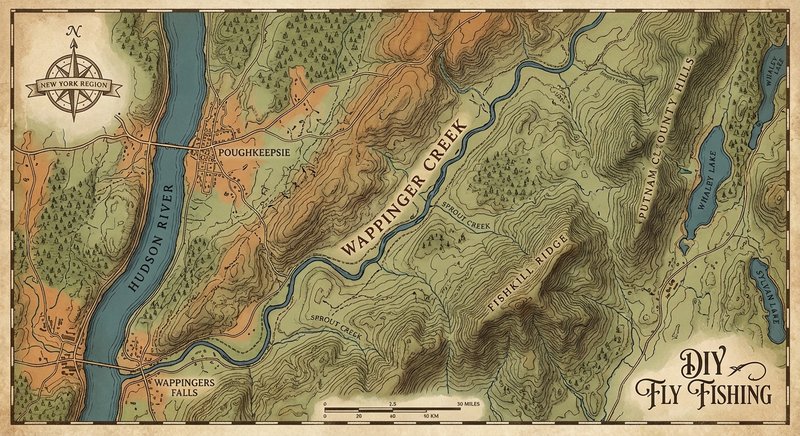
Wappinger Creek
Fly fishing in New York · Beginner · Best seasons: Spring, Summer, Fall
Target Species
Brown Trout
About This Water
Dutchess County stream with wild brown trout. Good access in mid-Hudson Valley.
Fishing Recommendations
Wappinger Creek is one of the hidden gems of the Hudson Valley. While many anglers bypass it on their way to the legendary Esopus or Beaverkill, those in the know find a productive, scenic, and accessible fishery right in Dutchess County. As a guide, I appreciate Wappinger for its "classic" feel—it offers a mix of meadow meanders, rocky riffles, and deep, mysterious limestone-influenced pools.
🎣 Location Overview
Wappinger Creek is the longest creek in Dutchess County, stretching roughly 34 miles before entering the Hudson River. For the trout angler, the focus is on the upper and middle sections, particularly from the village of Hibernia down through Pleasant Valley.
What makes this water special is its character. It isn't a high-gradient mountain stream; instead, it's a fertile valley creek. Because it flows through limestone-rich geology in certain areas, it has a higher pH and more biomass than typical freestone streams. This leads to excellent insect life and healthy, fat trout. It feels intimate—you can often cover the water with a 4-weight or 5-weight rod, yet there are enough "big water" pools to hold a trophy brown.
🐟 Target Species & Behavior
The primary target here is the Brown Trout.
- Stocked vs. Wild: The NYSDEC stocks Wappinger Creek heavily with thousands of browns annually. However, because of the cold-water springs and deep pools, a fair number of these fish "hold over" and become savvy, wild-acting residents. There is also a small, fragile population of wild browns in the headwater tributaries.
- Holding Patterns: In the spring, fish are found in the slower seams and tailouts of pools. As the water warms in early summer, they move into the "heads" of the pools—the oxygenated riffles and pocket water.
- Feeding Behavior: They are opportunistic. In early spring, they are bottom-feeders looking for stoneflies and cranes flies. By May, they become highly surface-oriented during the legendary Hendrickson and Sulfur hatches.
📅 Best Times to Fish
Spring (April – June): Prime Time
This is the pinnacle of the season.
- April: Focus on the afternoons when the water warms a few degrees. This is nymphing season.
- May: The "Golden Month." You’ll see the best hatches of the year. Evening rises are common.
- June: Great morning and late evening fishing before the summer heat sets in.
Summer (July – August): The "Tough" Season
Wappinger Creek is prone to warming. Guide Warning: If the water temperature exceeds 68°F, stop fishing to protect the trout.
- Strategy: Fish the earliest possible hours (dawn until 10:00 AM) or near cold-water tributary inflows.
Fall (September – October): The Streamer Window
As temperatures drop, brown trout become aggressive and territorial ahead of the spawn.
- Conditions: Low, clear water requires stealth, but a good rain event will trigger a "bite" where large browns will chase streamers.
🪰 Recommended Flies & Techniques
Dry Flies (The Hatches)
- Early Spring: Blue Winged Olives (Size 18-22), Quill Gordons (Size 14).
- May/June: Hendricksons (Size 14) are the main event. Followed by Sulfurs (Size 16-18) and Light Cahills.
- Summer: Elk Hair Caddis (Size 14-16) and Terrestrials (Ants and Beetles in size 16-18).
Nymphs (The Bread & Butter)
- Pheasant Tail Nymphs (Size 14-18) – Mimics almost everything in this creek.
- Hare’s Ear (Size 12-16) – Great for the "buggy" look of the creek's bottom.
- Zebra Midges (Size 20) – Vital for those picky fish in slow water.
Streamers
- Wooly Buggers (Black or Olive, Size 8-10) – Swing these through deep pools or under overhanging banks.
- Muddler Minnows – Excellent for mimicking the sculpins and dace present in the system.
💡 Pro Tips & Local Knowledge
- The "Pleasant Valley" Stretch: The area near the Recreation Park in Pleasant Valley is heavily stocked and very accessible, but it gets crowded. If you want peace, hike a half-mile upstream or downstream from the main bridge access points.
- The Stealth Factor: Because Wappinger can be slow-moving and silty in sections, trout are "spooky." Wear natural colors (greens/tans), keep a low profile, and try to avoid splashing.
- The "Spring" Secret: Look for small, unnamed feeder streams. These often pump in cooler, oxygenated water. In the late spring, trout will stack up at these "confluences."
- Limestone Tactics: Treat the slower sections like a spring creek. Use longer leaders (9ft to 12ft) and 5X or 6X fluorocarbon tippet to avoid detection.
⚠️ Important Information
Access
- Public Fishing Rights (PFR): Much of the creek is private, but New York State has purchased PFR on several miles. Look for the yellow and blue "Public Fishing Stream" signs.
- Key Entry Points:
- Hibernia Road (various pull-offs).
- The Taconic State Parkway overpass area.
- Pleasant Valley (Route 44 bridge and the town park).
Regulations
- License: A valid New York State fishing license is required for anyone 16 or older.
- Season: Generally, trout season in NY runs from April 1st to October 15th, with "Catch and Release" allowed with artificial lures only during the winter in certain sections. Always check the current NYSDEC Trout Stream Map for specific reach-by-reach regulations.
Special Considerations
- Wading Safety: The bottom of Wappinger Creek can be very "slick" and occasionally silty. Felt soles or studs are highly recommended.
- Invasive Species: This area is sensitive to Didymo and Rock Snot. Please clean, drain, and dry your gear before moving to another watershed.
Bug Hatches & Matching Flies
| Hatch | Type | Peak months | Time of day | Hook sizes | Matching flies |
|---|---|---|---|---|---|
| Blue-Winged Olive Baetis spp. | mayfly | April, October, November | Mid-day/Afternoon | #18-22 | RS2 #20-22, Parachute Adams #18-22, Pheasant Tail Nymph #18-20 |
| Hendrickson Ephemerella subvaria | mayfly | April, May | Afternoon | #12-14 | Red Quill #12-14, Hendrickson Emerger #14, Hare's Ear Nymph #12-14 |
| Sulphur Ephemerella invaria/dorothea | mayfly | May, June | Evening | #14-18 | Sulphur Parachute #16-18, Sulphur Cripple #16, Mercer's Trigger Micro May #16-18 |
| Tan Caddis Hydropsyche spp. | caddis | May, June, July | Morning/Evening | #14-16 | Elk Hair Caddis #14-16, LaFontaine's Deep Sparkle Pupa #14-16, X-Caddis #16 |
| Light Cahill Stenacron interpunctatum | mayfly | June, July | Evening | #12-14 | Light Cahill Dry #12-14, Gold Ribbed Hare's Ear #14 |
| Slate Drake Isonychia bicolor | mayfly | June, September | Afternoon/Evening | #10-12 | Iso Parachute #10-12, Zug Bug #10-12, Prince Nymph #12 |
| Trico Tricorythodes spp. | mayfly | July, August, September | Early Morning | #22-26 | Trico Spinner #22-24, Trico Drowned Spinner #24 |
| Ants and Beetles Formicidae / Coleoptera | terrestrial | July, August, September | All Day | #12-18 | Black Foam Ant #16-18, Crowe Beetle #14-16, Chernobyl Ant #12 |
| Zebra Midge Chironomidae | midge | February, March, April | Mid-day | #18-24 | Zebra Midge #18-22, Griffith's Gnat #20-22 |