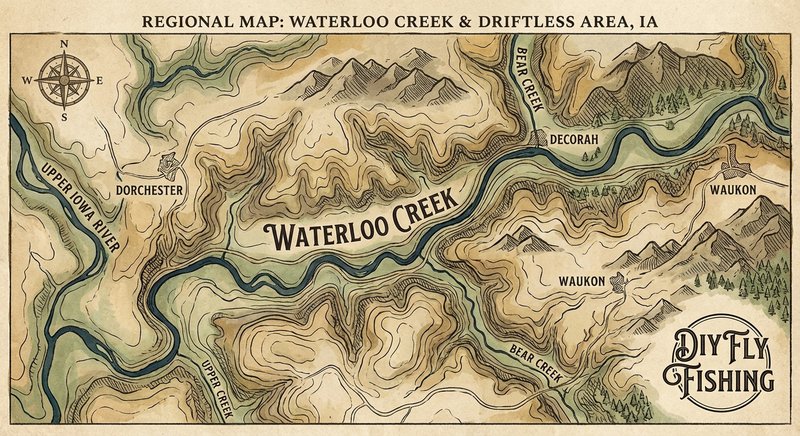
Waterloo Creek
Fly fishing in Iowa · intermediate · Best seasons: spring, summer, fall
Target Species
Brown Trout, Brook Trout
About This Water
Allamakee County stream with wild trout. Classic Driftless Area limestone stream.
Fishing Recommendations
Waterloo Creek is widely considered the "Crown Jewel" of Iowa’s Driftless Area. Located in the far northeast corner of the state near Dorchester, this limestone spring-fed stream offers a world-class trout fishing experience that rivals famous waters in the Western US.
As your guide, here is the comprehensive breakdown for fishing Waterloo Creek.
🎣 Location Overview
Waterloo Creek is a classic limestone spring stream that meanders through the pastoral valleys of Allamakee County. What makes it special is its productivity. Because of the alkaline limestone influence, the water is rich in minerals, which fuels a massive biomass of scuds, sowbugs, and aquatic insects.
The stream is characterized by crystal-clear water, deep undercut banks, lush water cress, and a mix of riffles and long, glassy pools. It is a "tale of two creeks"—the upper reaches near the Minnesota border (where it is known as Bee Creek) are narrower and swifter, while the lower sections near Dorchester broaden out into classic meadow water.
🐟 Target Species & Behavior
- Brown Trout: The primary draw. Waterloo is famous for its wild, stream-reared Brown Trout. These fish are savvy and can reach impressive sizes (18–20+ inches). They are ambush predators, often tucked deep under "Lunker Structures" (man-made bank hides) or shadowed undercut banks.
- Brook Trout: While less dominant than the Browns, you will find Brookies in the colder, upper headwaters and near spring seeps. They are more opportunistic but spook easily in the clear, shallow water.
- Behavior: During the day, larger fish stay tight to cover. They become most active during major hatches (Tricos/BWOs) or during "low light" transitions. Unlike hatchery fish, these wild trout require a stealthy approach and precise presentations.
📅 Best Times to Fish
- Spring (April – June): This is the prime time for hatches. The Grannom Caddis and Blue-Winged Olives (BWO) bring fish to the surface. Water levels are usually stable unless there’s a heavy spring rain.
- Summer (July – August): Focus on the Trico hatch—a Driftless staple. These tiny mayflies hatch in the early morning, creating "clouds" of spinners. Once the sun gets high, switch to terrestrials (hoppers/crickets) along the grassy banks.
- Fall (September – October): My personal favorite. The Browns are in their spawning colors and become highly aggressive. Streamer fishing is at its peak. The BWO hatches return, providing excellent dry fly opportunities on overcast days.
- Time of Day: In summer, be on the water at dawn for the Tricos. In spring and fall, the "10 AM to 3 PM" window is often best as the water warms slightly and bugs begin to move.
🪰 Recommended Flies & Techniques
Top Fly Patterns
- Nymphs: Pink Squirrel (a Driftless legend), Scud (Size 14-18 in gray or olive), Zebra Midge (Black/Silver), and the Frenchie.
- Dry Flies: Trico Spinner (Size 20-24), Elk Hair Caddis (Tan, Size 16), Parachute Adams (Size 18-22), and Hippie Stomper or Fat Albert (for terrestrials).
- Streamers: Black or Olive Woolly Bugger, Gold-Ribbed Hare's Ear Streamer, or small Sculpin patterns.
Techniques
- The "Hopper-Dropper": During summer, hang a small Scud or Pink Squirrel 18-24 inches below a buoyant grasshopper pattern. This covers two water columns and acts as a strike indicator.
- Tight-Line/Euro Nymphing: In the riffles and faster runs, this is the most effective way to reach fish hugging the bottom.
- Stealth Dry Fly: When fish are rising in the flats, use a long leader (9–12 feet) tapered down to 6X or 7X tippet. A downstream reach cast is often necessary to avoid lining the fish.
💡 Pro Tips & Local Knowledge
- Stay Low: The biggest mistake anglers make on Waterloo is standing tall on the high banks. The trout can see your silhouette from a long way off. Kneel when approaching a pool.
- Fish the "Lunker Structures": The Iowa DNR has installed numerous underwater wooden platforms along the banks. If you see a suspiciously straight, grassy bank with deep water underneath, there is likely a large Brown Trout living under it. Drift your fly as tight to that edge as possible.
- The Dorchester Reach: The section of water just upstream and downstream of the town of Dorchester is heavily managed and very productive, but it sees the most pressure. If you want solitude, head further north toward the Minnesota line.
- Cloudy Day Magic: If the forecast calls for a drizzly, overcast day, drop everything and go. The big Browns lose their inhibitions in low light and will often chase large streamers or rise for BWOs all day.
⚠️ Important Information
- Regulations: Waterloo Creek has specific regulations. Currently, there is a 14-inch minimum length limit on Brown Trout, and fishing is restricted to artificial lures and flies only on the primary public stretches. (Always check the latest Iowa DNR Fishing Regulations before heading out).
- Permits: You need a valid Iowa Fishing License and a Trout Fee (trout stamp).
- Access: Much of Waterloo Creek runs through private land, but the Iowa DNR has secured Public Fishing Easements. These are marked with green "Public Fishing" signs. Respect these boundaries—stay within the mowed or fenced corridor along the stream.
- Gear: A 3-weight or 4-weight rod (8’6” to 9’) is the ideal tool for this water. It provides enough backbone for a breezy day but allows for the delicate presentations required for spooky wild trout.
Bug Hatches & Matching Flies
| Hatch | Type | Peak months | Time of day | Hook sizes | Matching flies |
|---|---|---|---|---|---|
| Blue-Winged Olive (Spring) Baetis tricaudatus | mayfly | March, April | Midday | #18-22 | BWO Sparkle Dun #18-20, Pheasant Tail Nymph #18-22, RS2 #20-22 |
| Grannom Caddis Brachycentrus occidentalis | caddis | April, May | Afternoon | #14-16 | Elk Hair Caddis (Dark) #14-16, LaFontaine's Deep Sparkle Pupa #14-16, Peacock Caddis #16 |
| Sulfurs Ephemerella invaria | mayfly | May, June | Evening | #14-18 | Sulfur Parachute #14-18, Sulfur Emerger #16-18, Frenchie #16-18 |
| Scud Gammarus pseudolimnaeus | crustacean | Year-round | All day | #14-18 | Pink Scud #14-18, Olive Scud #14-16, Ray Charles #16-18 |
| Trico Tricorythodes spp. | mayfly | July, August, September | Morning | #20-24 | Trico Spinner #20-24, Sunken Trico Spinner #22-24, Griffith's Gnat #20-22 |
| Light Cahill Stenonema ithaca | mayfly | June, July | Evening | #12-14 | Light Cahill #12-14, Cream Usual #14, Gold Ribbed Hare's Ear #12-14 |
| Terrestrials (Hopper/Ant/Beetle) Various | terrestrial | July, August, September | All day | #10-18 | Parachute Hopper #10-14, Cinnamon Ant #16-18, Black Foam Beetle #14-16 |
| Crane Fly Tipulidae | other | August, September | Afternoon/Evening | #10-14 | Crane Fly Adult #10-12, Crane Fly Larva #10-14, Stimulator #12-14 |
| Cressbug / Sowbug Asellus intermedius | crustacean | Year-round | All day | #14-18 | Cressbug #14-18, Soft Hackle Sowbug #16-18, Killer Bug #14-16 |
| Zebra Midge Chironomidae | midge | January, February, March | Midday | #18-24 | Zebra Midge #18-22, Morgan's Midge #20-24, Palomino Midge #20-22 |