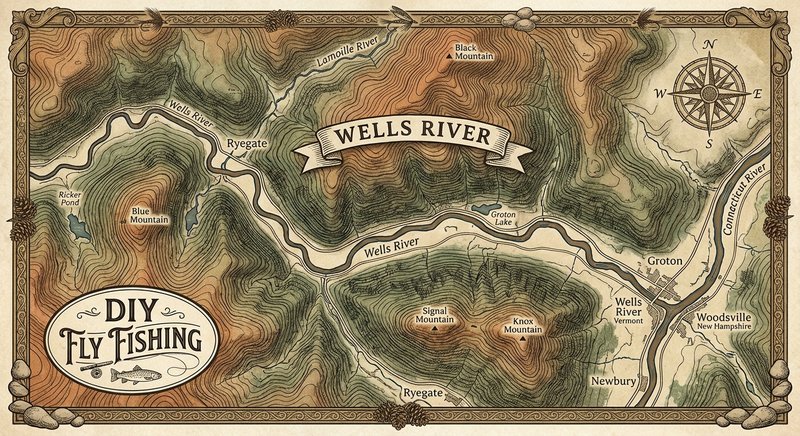
Wells River
Fly fishing in Vermont · Beginner · Best seasons: Spring, Summer, Fall
Target Species
Brook Trout, Brown Trout
About This Water
Eastern Vermont stream near Groton State Forest. Good brook and brown trout in forested sections.
Fishing Recommendations
The Wells River is one of Vermont’s "hidden in plain sight" gems. Flowing from the high country of Groton State Forest down to its confluence with the Connecticut River, it offers a diverse range of water—from tumbling mountain pocket water to slow-moving meadow reaches.
As your guide, here is the breakdown for fishing the Wells River.
🎣 Location Overview
The Wells River is a classic Vermont freestone stream. It drains a significant portion of the Northeast Kingdom’s granite-heavy terrain, which keeps the water relatively clear and crisp.
What makes the Wells special is its diversity of character. The upper sections near Groton are quintessential "Blue Ribbon" mountain brook trout water—tight, technical, and lush. As it moves toward the village of Wells River, it gains volume and heat, becoming a prime habitat for larger, holdover Brown Trout. Anglers love it because it is rarely as crowded as the Winooski or the Lamoille, offering a more solitary experience in a rugged, beautiful setting.
🐟 Target Species & Behavior
- Brook Trout: Found predominantly in the upper reaches and the cold-water tributaries. These are the "jewels" of the river—often wild, aggressive, and stunningly colored. They hold in the "soft" spots behind boulders and in the plunge pools.
- Brown Trout: These dominate the middle and lower sections. Browns here are opportunistic but can be wary. They favor undercut banks, deep woody debris, and the dark shadows under the Route 302 bridges.
- Behavior: During the spring runoff, fish stay deep and tight to the bottom. Once the water hits 50°F, they move into the riffles and "heads" of pools to feed on active nymphs and emerging insects.
📅 Best Times to Fish
- Spring (May – June): This is the "Golden Era" on the Wells. Once the snowmelt subsides (usually mid-May), the Hendrickson and Caddis hatches begin. This is when the largest fish in the system are most active.
- Summer (July – August): Focus on the upper river (Groton area) where the canopy provides shade and the water remains cool. Early morning and "last light" are the only times to fish the lower sections to avoid stressing fish in warm water.
- Fall (September – October): A spectacular time for Brown Trout. As they prepare to spawn, they become aggressive and territorial. Streamer fishing during a drizzly October afternoon can produce the fish of the season.
🪰 Recommended Flies & Techniques
Dry Flies
- Elk Hair Caddis (Size 14-18): The bread and butter of the Wells River. Use tan or olive.
- Parachute Adams (Size 12-20): Works during almost any hatch as a generalist pattern.
- Stimulators (Size 8-12): Excellent for the turbulent upper sections; they float high and are easy to see.
Nymphs
- Pheasant Tail (Size 14-18): Best for mimicking the prolific Mayfly populations.
- Prince Nymph (Size 12-14): Great for "prospecting" deep pools when no hatch is visible.
- Zebra Midge (Size 18-22): Essential for the slower meadow stretches during the summer.
Streamers
- Woolly Bugger (Black or Olive): Move these through deep runs and near downed timber.
- Muddler Minnow: Excellent for mimicking the sculpins and dace that live in the rocky substrate.
Presentation Tips
In the upper sections, short-line high-sticking is the way to go. You rarely need more than 10 feet of fly line out. In the lower river, a "Dry-Dropper" rig (a large dry fly with a nymph tied 18 inches below it) is incredibly effective for covering water.
💡 Pro Tips & Local Knowledge
- The Route 302 Corridor: Route 302 follows the river for much of its length. While this makes access easy, the most successful anglers are those willing to walk 15 minutes away from the pull-outs. Look for the bends in the river that veer away from the road.
- The "Confluence" Secret: The very last stretch of the river before it hits the Connecticut River can hold massive "migratory" fish that move up out of the big river to feed or spawn. Use larger streamers here.
- Check the Rocks: The Wells has a lot of granite. If you see small, tube-like structures made of sand on the rocks, the Cased Caddis are active. Switch to a heavy, bead-head nymph to match.
- The Groton State Forest Stretch: This area is heavily forested. Bring bug spray and be prepared for "stealth fishing." The brookies here can be spooked by a shadow or a heavy footfall.
⚠️ Important Information
- Access: Much of the river is bordered by private land. Vermont has generous access laws, but always look for "Posted" signs. If it’s not posted, you are generally allowed to fish, but always be respectful of hayfields and livestock.
- Regulations: The Wells River generally falls under Vermont General Trout Fishing Regulations (Open 2nd Saturday in April to Oct 31). However, always check the current Vermont Fish & Wildlife Law Digest for any specific "Trophy Section" or "Catch and Release" updates.
- Safety: The rocks in the Wells can be incredibly slick. Felt-soled boots or studs are highly recommended.
- Water Temps: If the water temperature in the lower river exceeds 70°F in mid-summer, please stop fishing or move to the higher, colder tributaries to protect the trout population.
Bug Hatches & Matching Flies
| Hatch | Type | Peak months | Time of day | Hook sizes | Matching flies |
|---|---|---|---|---|---|
| Blue-Winged Olive Baetis | mayfly | April, May, September, October | Midday | #18-22 | RS2 #20-22, Parachute BWO #18-20, Pheasant Tail Nymph #18-22 |
| Hendrickson Ephemerella subvaria | mayfly | May | Afternoon | #12-14 | Red Quill #12-14, Hendrickson Emerger #12-14, Hare's Ear Nymph #12-14 |
| Grannom Caddis Brachycentrus | caddis | May | Morning/Afternoon | #14-16 | Peacock Caddis #14-16, Deep Sparkle Pupa #14-16, Elk Hair Caddis (Olive) #14-16 |
| Sulphur Ephemerella invaria/dorothea | mayfly | June, July | Evening | #14-18 | Sulphur Parachute #14-18, Sulphur Emerger #16-18, Phearson's Sulphur Nymph #16 |
| Light Cahill Stenacron interpunctatum | mayfly | June, July | Evening/Dusk | #12-16 | Light Cahill Dry #12-16, Gold Ribbed Hare's Ear #14-16 |
| Isonychia (Slate Drake) Isonychia bicolor | mayfly | July, August, September | Afternoon/Evening | #10-12 | Iso Parachute #10-12, Zug Bug #10-12, Prince Nymph #10-14 |
| Golden Stonefly Acroneuria lycorias | stonefly | June, July | Morning/Night | #8-12 | Pats Rubber Legs #8-12, Stimulator (Yellow) #8-12, Golden Stone Nymph #10-12 |
| Trico Tricorythodes | mayfly | July, August, September | Early Morning | #22-26 | Trico Spinner #22-24, Trico Parachute #22-24 |
| Tan Caddis Hydropsyche | caddis | June, July, August | Evening | #14-16 | Elk Hair Caddis (Tan) #14-16, LaFontaine's Emergent Pupa #14-16, Caddis Larva (Green/Tan) #14-16 |
| Terrestrials (Ants/Beetles) Formicidae / Coleoptera | terrestrial | July, August, September | All Day | #12-20 | Black Foam Ant #16-20, Cinnamon Ant #16-18, Joan Wulff’s Hoppers #12-14 |