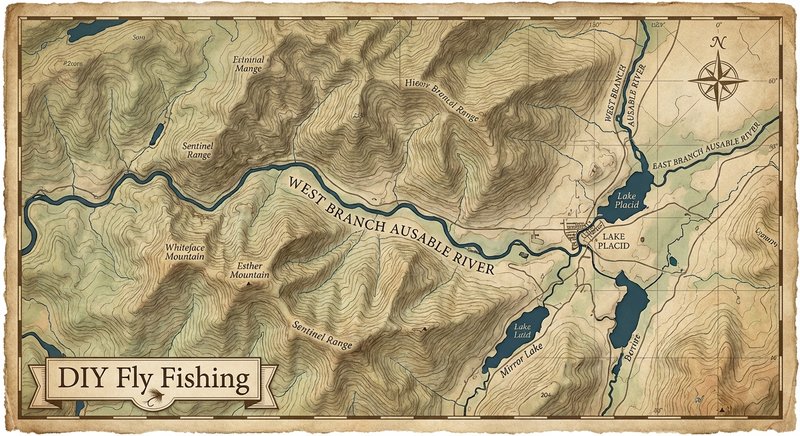
West Branch Ausable River
Fly fishing in New York · Intermediate · Best seasons: Spring, Summer, Fall
Target Species
Brown Trout, Brook Trout, Rainbow Trout
About This Water
Premier Adirondack freestone with wild brown and brook trout. Excellent hatches in scenic gorge.
Fishing Recommendations
The West Branch of the Ausable River is arguably the most famous fly fishing destination in the Adirondacks, if not the entire state of New York. Often referred to as the "Pocket Water Capital of the East," it is a quintessential freestone river that flows through some of the most dramatic scenery in the High Peaks region near Lake Placid and Wilmington.
🎣 Location Overview
The West Branch Ausable is a high-gradient, boulder-strewn river known for its classic "pocket water"—small, swirling pools and eddies created by large rocks. This structure provides incredible oxygenation, which keeps trout active even when other rivers are warming up.
What makes it special is its rugged character. It’s a wild, powerful river that demands respect. Anglers love it for the challenge of its complex currents and the sheer beauty of fishing in the shadow of Whiteface Mountain. Whether you are fishing the "Flume" or the serene meadows near Lake Placid, the river offers a diverse range of water types.
🐟 Target Species & Behavior
- Brown Trout: Both wild and stocked. The Browns are the kings of the West Branch. They tend to hold in the deeper undercuts and the "cushion" water directly in front of large boulders. Large, trophy-sized Browns are often found in the deeper pools of the Catch-and-Release section.
- Rainbow Trout: Primarily stocked. Rainbows love the highly oxygenated, fast-moving riffles and the "tail-outs" of the pockets. They are often more aggressive than the Browns.
- Brook Trout: The native treasure of the Adirondacks. While more common in the smaller tributaries, you will find beautiful, buttery Brookies in the main stem, particularly in the cooler, upper reaches.
Behavior: Because the water is so fast, fish here are "opportunistic feeders." They don't have long to decide whether to eat a fly before the current sweeps it away. Fast reflexes and precise presentations are key.
📅 Best Times to Fish
- Spring (May - June): This is the "Main Event." The legendary Hendrickson hatch starts in mid-to-late May, followed by March Browns and Grey Foxes. Water levels can be high, so heavy wading gear is necessary.
- Summer (July - August): Focus on the early mornings and late evenings. During the day, fish move into the fastest, most oxygenated water. This is prime time for terrestrial patterns (ants, beetles). Note: Always carry a thermometer; if the water exceeds 68°F, stop fishing to protect the trout.
- Fall (September - October): A magical time on the river. The foliage is world-class, and the Brown Trout become aggressive as they prepare for the spawn. Isonychia hatches are the highlight of the fall.
🪰 Recommended Flies & Techniques
Top Fly Patterns
- The Ausable Wulff: Created by local legend Fran Betters. It’s a high-floating, bushy dry fly that is easy to see in the broken water.
- The Haystack: Another Fran Betters classic. A simple deer-hair pattern that mimics many mayfly species.
- Stoneflies: Golden Stones and Pat’s Rubber Legs. The West Branch has a massive population of stoneflies.
- Isonychia: Parachute Iso or a dark Dun (Sizes 10-12) for the late afternoon "Iso" hatch.
- Nymphs: Pheasant Tail, Prince Nymph, and Copper Johns (Size 14-18).
Techniques
- Pocket Water Nymphing: High-sticking or Euro-nymphing is incredibly effective here. Because the currents are so complex, keeping your fly line off the water is the only way to get a natural drift.
- The "Skating" Dry: In the fast water, don't be afraid to twitch or skate your dry fly. The vibration often triggers a strike from a trout hiding behind a rock.
- Streamer Stripping: In the spring or after a rain, use olive or black wooly buggers or sculpin patterns. Swing them through the deep pools and strip them back aggressively.
💡 Pro Tips & Local Knowledge
- The "Ausable Crawl": The rocks in this river are notoriously slippery—often described as "greased bowling balls." Aluminum-studded boots and a wading staff are not optional; they are required for safety.
- The Catch & Release Section: Focus on the 2.2-mile stretch from the mouth of Holcomb Pond Outlet downstream to the bridge on Route 86. This area holds the highest concentration of educated, but large, trout.
- Fish the "Cushion": Most beginners fish the pool behind a rock. Pros fish the "cushion"—the small area of soft water directly in front of the rock where the current splits.
- Stealth Matters: Even in the rough water, the fish see you coming. Approach pockets from downstream and keep a low profile.
⚠️ Important Information
- Wading Safety: As mentioned, the West Branch is a powerful river. Do not underestimate the current, especially in the "Wilmington Notch" section.
- Regulations: New York State requires a valid fishing license. Be sure to check the specific regulations for the "No-Kill" (Catch and Release) zones, as they are strictly enforced.
- Temperature Sensitivity: The West Branch can get warm in late July. If you see fish schooling in the mouths of cold-water tributaries, do not fish for them. These are "thermal refuges" where fish are trying to survive the heat.
- Local Shops: Stop by the Hungry Trout Fly Shop or Wiley’s Flies in Wilmington. They are the heartbeat of the river and provide the most up-to-the-minute hatch reports.
Tight lines, and enjoy one of the most storied rivers in American fly fishing history!
Bug Hatches & Matching Flies
| Hatch | Type | Peak months | Time of day | Hook sizes | Matching flies |
|---|---|---|---|---|---|
| Hendrickson Ephemerella subvaria | mayfly | May | Afternoon | #12-14 | Red Quill #12-14, Hendrickson Emerger #12-14, Pheasant Tail #12-14 |
| March Brown Maccaffertium vicarium | mayfly | May, June | Afternoon | #10-12 | March Brown Parachute #10-12, Gold Ribbed Hare's Ear #10-12 |
| Eastern Green Drake Ephemera guttulata | mayfly | June | Evening | #8-10 | Green Drake Cripple #8-10, Coffin Fly #8-10, Ausable Wulff #10 |
| Isonychia (Slate Drake) Isonychia bicolor | mayfly | July, August, September | Afternoon/Evening | #10-14 | Zug Bug #10-12, Isolynx Parachute #12-14, Prince Nymph #10-14 |
| Blue-Winged Olive Baetis spp. | mayfly | April, May, September, October | Afternoon | #18-24 | BWO Sparkle Dun #18-22, RS2 #20-22 |
| Light Cahill Stenacron interpunctatum | mayfly | June, July | Evening | #12-16 | Light Cahill Dry #12-16, Cream Usual #14-16 |
| Spotted Sedge Hydropsyche spp. | caddis | May, June, July | Evening | #14-16 | Elk Hair Caddis #14-16, LaFontaine's Deep Sparkle Pupa #14-16 |
| Yellow Sally Isoperla spp. | stonefly | June, July | Afternoon/Evening | #14-16 | Yellow Sally Stimulator #14-16, Yellow Little Peter #16 |
| Trico Tricorythodes spp. | mayfly | July, August, September | Morning | #22-26 | Trico Spinner #22-24, Griffith's Gnat #20-22 |