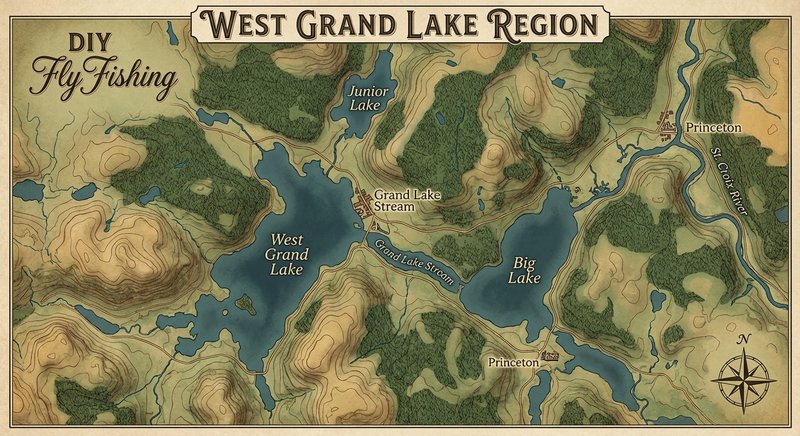
West Grand Lake
Fly fishing in Maine · Intermediate · Best seasons: Spring, Summer, Fall
Target Species
Landlocked Salmon, Smallmouth Bass
About This Water
Washington County lake with landlocked salmon and smallmouth bass. Scenic fishing.
Fishing Recommendations
Welcome to the legendary waters of West Grand Lake, the crown jewel of Washington County in Down East Maine. As your guide, I can tell you that this isn't just another fishing hole—it is hallowed ground. West Grand is one of only four lakes in Maine where Landlocked Atlantic Salmon are native, and its crystal-clear waters and boulder-strewn shorelines offer some of the finest smallmouth bass fishing in the Northeast.
🎣 Location Overview
West Grand Lake is a massive, 14,000-acre glacial lake characterized by its rugged shoreline, over 100 islands, and incredible water clarity. It serves as the headwaters for Grand Lake Stream, arguably the most famous fly fishing river in Maine.
What makes this water special is its "oligotrophic" nature—it is deep, cold, and oxygen-rich. The bottom is a labyrinth of granite boulders and drop-offs. Anglers love West Grand because it offers a true wilderness experience. You are more likely to see a nesting Bald Eagle or a Moose on the shoreline than you are a jet ski. It is a place where the "Grand Lake Canoe"—a traditional 20-foot wood-and-canvas boat—is still the preferred vessel for local guides.
🐟 Target Species & Behavior
Landlocked Atlantic Salmon (Salmo salar sebago)
- Behavior: These fish are high-jumping, aggressive predators. In West Grand, their lives revolve around Rainbow Smelt.
- Holding Areas: In the spring, they follow the smelt into the shallows and near the mouths of tributaries. As the water warms, they retreat to the thermocline (30–50 feet deep). In the fall, they congregate near the dam and the rocky shoals as they prepare for their spawning run.
- Feeding: Primarily smelt, but they will take caddis and mayfly hatches when the conditions are right in the late spring.
Smallmouth Bass
- Behavior: Known for their "pound-for-pound" fighting strength, the smallmouth here are abundant and hardy.
- Holding Areas: Look for "structure on structure." They love the transition zones where a rocky point drops into deep water, or around the massive glacial erratics (submerged boulders) that litter the lake floor.
- Feeding: They focus on crawfish and various minnow species. During June, they are notoriously aggressive during the Hexagenia (Giant Mayfly) hatch.
📅 Best Times to Fish
- Spring (Ice-out through June): Prime Salmon Time. Just after the ice melts (usually late April/early May), the salmon are in the top 10 feet of water. This is when fly anglers have the best chance at hooking them on streamers.
- Summer (July through August): Peak Smallmouth Bass. While salmon go deep and become harder to reach with a fly rod, the bass fishing is world-class. Focus on early mornings and late evenings for topwater action.
- Fall (September through October): The Transition. Salmon return to the surface and move toward the outlet (Grand Lake Stream). The colors on the fish are spectacular this time of year, matching the foliage.
🪰 Recommended Flies & Techniques
For Landlocked Salmon
- Patterns:
- Streamers: Grey Ghost, Black Ghost, Mickey Finn, and the Governor Aiken. Use long-shank hooks (size 2-6).
- Smelt Imitations: Herb Johnson’s Smelt or any Marabou Smelt pattern in white/blue or white/lavender.
- Technique: "Trolling the fly" is the traditional method. Use a sinking-tip line and 100+ feet of line behind the boat, moving at a brisk walking pace. If casting, target "seams" where wind-driven current hits a point.
For Smallmouth Bass
- Patterns:
- Topwater: BoogleBug Poppers, Sneaky Petes, or any foam-bodied frog pattern.
- Subsurface: Murdich Minnow (white/silver), Clouser Minnows (olive/white), and the classic Woolly Bugger (black or olive).
- Technique: Focus on the "Drop-off." Cast your fly right against the shoreline boulders and strip it back over the ledge into deeper water.
💡 Pro Tips & Local Knowledge
- The "Grand Lake Twitch": When fishing streamers for salmon, don't just steady-strip. Give the rod tip short, erratic jerks. Landlocked salmon are triggered by the "wounded" action of a smelt.
- The Hex Hatch: Late June brings the Hexagenia limbata hatch. This is one of the few times large salmon and trophy bass will both feed ravenously on the surface. Be on the water at dusk with large, yellow/tan mayfly dry flies.
- Wind is Your Friend (and Enemy): A "smelt breeze" (a light chop) pushes baitfish toward the windward shores, bringing the salmon with them. However, West Grand can get dangerously rough very quickly. If the wind picks up from the Northwest, head for the lee of an island immediately.
- Hire a Guide with a Canoe: If you want the authentic experience, book a guide who uses a traditional square-stern wood-and-canvas canoe. They are designed to handle the "West Grand chop" and allow for a stealthy approach you can't get in a fiberglass bass boat.
⚠️ Important Information
- Access: The main public launch is in the village of Grand Lake Stream. There are also primitive launches at Farm Cove and Pine Tree Point.
- Regulations: Maine fishing laws are specific. West Grand has length limits and bag limits for salmon (usually a 1 fish limit, 16-inch minimum, but check current IFW Law Books). Lead tackle is strictly prohibited to protect the local loon population.
- Permits: A valid Maine Fishing License is required. You can purchase these online at the Maine IFW website.
- Safety: This is remote country. Cell service is spotty at best. Always carry a physical map, extra fuel, and foul-weather gear—even in July.
Tight lines, and enjoy the "Maine Wilderness" at its absolute finest!
Bug Hatches & Matching Flies
| Hatch | Type | Peak months | Time of day | Hook sizes | Matching flies |
|---|---|---|---|---|---|
| Hendrickson Ephemerella subvaria | mayfly | May | Afternoon | #12-14 | Red Quill #12-14, Hendrickson Nymph #12-14, Hendrickson Emerger #12-14 |
| Grannom Caddis Brachycentrus | caddis | May | Morning/Afternoon | #14-16 | Elk Hair Caddis (Green body) #14-16, Peeking Caddis #14-16, Pupa #14-16 |
| March Brown Maccaffertium vicarium | mayfly | June | Afternoon | #10-12 | March Brown Dry #10-12, Hare's Ear Nymph #10-12, March Brown Wet Fly #10-12 |
| Light Cahill Stenacron interpunctatum | mayfly | June, July | Evening | #12-14 | Light Cahill Dry #12-14, Cream Variant #14, Pheasant Tail #14 |
| Giant Mayfly (Hex) Hexagenia limbata | mayfly | July | Evening/Night | #4-8 | Hex Paradun #6-8, Hexagenia Wiggle Nymph #6-8, Foam Hex #4-6 |
| Blue-Winged Olive Baetis | mayfly | May, September, October | Afternoon | #18-22 | Parachute Adams #18-22, RS2 #20-22, BWO Sparkle Dun #18-20 |
| Flying Ants Camponotus | terrestrial | August, September | Afternoon | #14-18 | Black Fur Ant #14-18, Chernobyl Ant #12-14, Transparant Wing Ant #16 |
| Slate Drake Isonychia bicolor | mayfly | July, August, September | Evening | #10-12 | Iso Dun #10-12, Prince Nymph #10-12, Isonychia Emerger #12 |