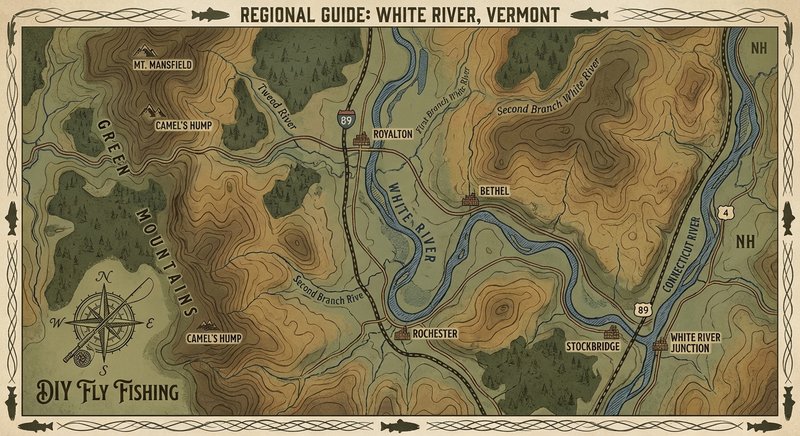
White River
Fly fishing in Vermont · Intermediate · Best seasons: Spring, Summer, Fall
Target Species
Rainbow Trout, Brown Trout
About This Water
Central Vermont stream with excellent rainbow and brown trout. Good access throughout with beautiful Green Mountain scenery.
Fishing Recommendations
The White River in Vermont is one of the crown jewels of New England fly fishing. Unlike many major rivers in the Northeast, the White is a freestone river, meaning it is undammed for its entire length. This creates a natural, rhythmic flow that responds directly to the seasons, providing a classic "mountain river" experience characterized by crystal-clear water, polished granite boulders, and deep emerald pools.
🎣 Location Overview
The White River originates in the Green Mountains and flows through some of Vermont’s most picturesque valleys before joining the Connecticut River. It is divided into the Main Stem and three primary branches (First, Second, and Third Branches).
What makes the White special is its "wild" character. Because there are no dams to regulate temperature or flow, the river has a distinct personality that changes with the weather. It offers everything from technical pocket water in the upper reaches to wide, sweeping runs and deep ledge pools in the lower sections near Sharon and Royalton. Anglers love it for its accessibility, its classic hatches, and the sheer beauty of the surrounding Green Mountain National Forest.
🐟 Target Species & Behavior
The White River is primarily a Rainbow and Brown Trout fishery, though you will find Brook Trout in the cooler headwaters and smaller tributaries.
- Rainbow Trout: These are the river's acrobats. They tend to hold in the faster "oxygenated" water—the heads of riffles, heavy pocket water, and the bubbly "seams" where fast and slow water meet. They are aggressive feeders and will often move several feet to smash a dry fly.
- Brown Trout: The "kings" of the deeper pools. Large Browns on the White are notoriously shy during the day. They prefer holding near heavy structure, under overhanging banks, or in the deep ledge holes. They become most active during low-light periods (dawn/dusk) or when the water is slightly stained after a rain.
- Behavior: During high spring flows, fish hug the banks to escape the current. As summer progresses and water clears, they become more "line shy" and require stealthy approaches and longer leaders.
📅 Best Times to Fish
- Spring (May – Mid-June): This is prime time. Once the "snowmelt" (runoff) subsides, the river comes alive. This period hosts the legendary Hendrickson hatch.
- Summer (Late June – August): Excellent dry fly fishing, but you must be mindful of water temperatures. Because the river is undammed, it can warm up significantly in July and August.
- Pro Tip: If the water hits 68°F, stop fishing for the day to protect the trout. Focus on the early morning or the cooler Third Branch during heatwaves.
- Fall (September – October): A magical time to be in Vermont. As water temperatures drop, Browns become aggressive before spawning. Streamer fishing is highly productive, and the "Isonychia" hatch provides excellent late-season dry fly action.
🪰 Recommended Flies & Techniques
Top Fly Patterns
- Dry Flies: Hendrickson (May), Elk Hair Caddis (All summer), Ausable Wulff (A classic VT attractor), Royal Wulff, and Isonychia Parachute (Late summer/Fall).
- Nymphs: Prince Nymph, Pheasant Tail (size 14-18), Gold-Ribbed Hare’s Ear, and large Stonefly patterns (Pats Rubber Legs) for high water.
- Streamers: Black or Olive Woolly Buggers, Muddler Minnows, and the Black Ghost (a traditional New England staple).
Effective Techniques
- Pocket Water Nymphing: Using a "high-stick" or Euro-nymphing technique in the boulder gardens is incredibly effective. Focus on the soft water behind large rocks.
- Dry-Dropper: A favorite for the White. Hang a small Pheasant Tail nymph 18–24 inches below a buoyant Stimulator or Hopper.
- The "Swing": Swinging wet flies or small streamers through the tails of pools is a classic and very productive technique on the Main Stem.
💡 Pro Tips & Local Knowledge
- Follow the "Branches": If the Main Stem is too high or too warm, head to the Third Branch (near Bethel) or the First Branch. These smaller sections stay cooler and are often more manageable for wading.
- The "Granite Slide": Wading the White can be tricky. The rocks are often large, round, and covered in a fine layer of silt or algae. Studded felt soles and a wading staff are highly recommended.
- Stealth Matters: Because the water is so clear, the fish can see you from a distance. Approach pools from downstream, stay low, and try to avoid "lining" the fish with a heavy fly line.
- Post-Rain Streamers: If a summer thunderstorm colors the water slightly (tea-colored), grab a 6-weight rod and a large articulated streamer. This is your best chance at a trophy-sized Brown.
⚠️ Important Information
- Access: Vermont has generous public access laws, but always respect "Posted" signs. Much of the river follows Route 100 and Route 14, with many pull-offs and bridge access points provided by the state.
- Regulations: While much of the river is open to general regulations, there are specific "Trophy Trout" sections and "Catch and Release only" areas that can change. Always check the current Vermont Fish & Wildlife Law Digest.
- License: You must have a valid Vermont Fishing License, which can be purchased online.
- Clean Your Gear: To prevent the spread of invasive species like Didymo (rock snot), ensure your boots and waders are cleaned and dried before moving between watersheds.
Guide’s Final Word: The White River is the soul of Vermont fly fishing. It’s a river that rewards those who observe the water and match their tactics to the temperature and the hatch. Tight lines!
Bug Hatches & Matching Flies
| Hatch | Type | Peak months | Time of day | Hook sizes | Matching flies |
|---|---|---|---|---|---|
| Hendrickson Ephemerella subvaria | mayfly | April, May | Afternoon | #12-14 | Hendrickson Sparkle Dun #12-14, Red Quill #12-14, Pheasant Tail Nymph #12-14 |
| Blue-Winged Olive Baetis spp. | mayfly | April, May, September, October | Midday | #18-22 | BWO Parachute #18-22, RS2 #20-22, Baetis Nymph #18-20 |
| Grannom Caddis Brachycentrus | caddis | April, May | Afternoon | #14-16 | Elk Hair Caddis (Olive) #14-16, Holy Grail #14-16, Peeping Caddis #14-16 |
| Sulphur Ephemerella invaria/dorothea | mayfly | May, June | Evening | #14-18 | Sulphur Parachute #16-18, Sulphur Emerger #14-16, Split Case Sulphur #16 |
| March Brown Maccaffertium vicarium | mayfly | May, June | Afternoon | #10-12 | March Brown American #10-12, Gold Ribbed Hare's Ear #10-12 |
| Golden Stonefly Acroneuria carolinensis | stonefly | June, July | Daytime/Evening | #6-10 | Pat's Rubber Legs #6-10, Stimulator (Yellow) #8-10 |
| Light Cahill Stenacron interpunctatum | mayfly | June, July | Evening | #12-14 | Light Cahill #12-14, Cream Usual #12-14 |
| Slate Drake Isonychia bicolor | mayfly | June, August, September | Afternoon/Evening | #10-12 | Iso Parachute #10-12, Prince Nymph #10-12, Zug Bug #10-12 |
| Trico Tricorythodes spp. | mayfly | July, August, September | Morning | #22-26 | Trico Spinner #22-24, Griffith's Gnat #22-24 |
| Cinnamon Ant Formicidae | terrestrial | July, August, September | Midday | #14-18 | Transpar-ant #16-18, Chernobyl Ant #12-14 |