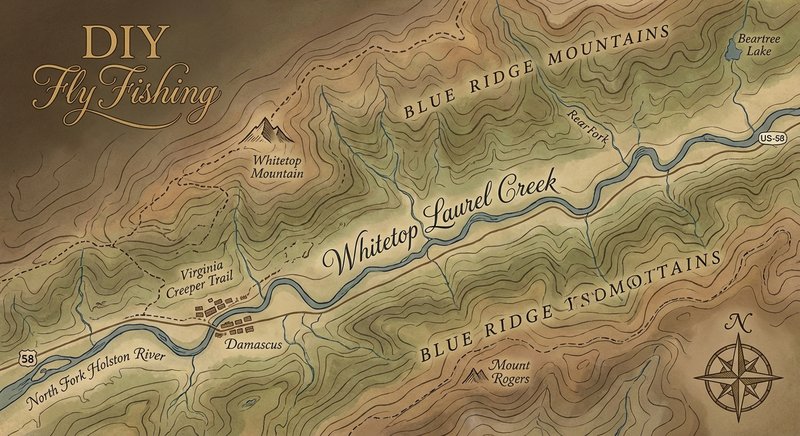
Whitetop Laurel Creek
Fly fishing in Virginia · Intermediate · Best seasons: Spring, Summer, Fall
Target Species
Rainbow Trout, Brown Trout, Brook Trout
About This Water
Southwest Virginia mountain stream with wild rainbow and brown trout. Virginia Creeper Trail access.
Fishing Recommendations
As your guide to the Blue Ridge, it’s a pleasure to introduce you to Whitetop Laurel Creek. Located in the Mount Rogers National Recreation Area near Damascus, Virginia, this is widely considered one of the finest freestone trout streams in the Southeast.
What makes Whitetop Laurel special is its diversity; it offers everything from technical pocket water and deep plunges to wide, flat runs. It is one of the few places in Virginia where you can catch a "Slam" (Brook, Brown, and Rainbow) in a single afternoon.
🎣 Location Overview
Whitetop Laurel is a high-gradient mountain stream that flows through a rugged, scenic gorge. The creek is characterized by its large boulders, step-pool sequences, and heavy rhododendron-lined banks.
What draws anglers from all over the country is the Virginia Creeper Trail. This decommissioned railroad-turned-recreational-trail parallels the creek for miles, providing unparalleled access to remote stretches of water that would otherwise be inaccessible. Whether you are looking for roadside access or a three-mile hike into the wilderness to find solitude, Whitetop Laurel delivers. The water is cold, well-oxygenated, and extremely fertile for a freestone stream.
🐟 Target Species & Behavior
- Rainbow Trout: These are the most prevalent species in the lower and middle sections. They are opportunistic and love the fast, "bubbly" water. Look for them in the heads of pools and in the seams where fast water meets slow water.
- Brown Trout: The "kings" of the deeper pools and undercut banks. The wild Browns here are wary and often nocturnal or active during low-light conditions. They tend to hold in the "tail-outs" of pools during hatches or tight against heavy timber and boulders.
- Brook Trout: Virginia’s state fish. While they can be found throughout the system, they dominate the higher elevations and the smaller tributaries (like Taylor’s Valley). They are aggressive but easily spooked; stealth is more important than fly choice with these jewels.
📅 Best Times to Fish
Optimal Seasons
- Spring (March – June): This is the "Prime Time." Water levels are usually high but clear, and the insect activity is at its peak. This is when you'll see the best dry fly action.
- Fall (Late September – November): The Brown trout become aggressive as they prepare to spawn. The foliage along the Creeper Trail is world-class, and the cooling water temperatures trigger a secondary feeding frenzy.
- Summer (July – August): Focus on the higher elevations or the early morning hours. Terrestrial fishing (ants/beetles) can be spectacular during the dog days of summer.
Best Times of Day
- Spring/Fall: Mid-morning to late afternoon (10:00 AM – 4:00 PM) as the sun warms the water and triggers hatches.
- Summer: First light until 11:00 AM, or the "magic hour" just before dark.
🪰 Recommended Flies & Techniques
Top Fly Patterns
- Dry Flies:
- Quill Gordon (March/April)
- March Brown (May)
- Yellow Stimulator (Summer - great for high visibility in broken water)
- Parachute Adams (Year-round - size 14-20)
- Elk Hair Caddis (Tan or Olive, size 14-16)
- Nymphs:
- Pheasant Tail (Size 14-18)
- Prince Nymph (Size 12-16)
- Hare’s Ear (Size 14-16)
- Pat’s Rubber Legs (Stonefly imitation for higher water)
- Streamers:
- Woolly Bugger (Black or Olive, size 8-10) for swinging through deep holes for big Browns.
Techniques
- Dry-Dropper: This is the most effective way to fish Whitetop. Use a buoyant dry fly (like a Stimulator) and hang a Pheasant Tail nymph 18-24 inches below it.
- Tight-Line Nymphing: In the heavy pocket water, traditional indicators can be tricky. High-sticking through the pockets will keep your fly in the strike zone longer.
- Stealth Approach: Because the water is often crystal clear, stay low, wear drab clothing, and cast upstream. If you can see the fish, they have likely already seen you.
💡 Pro Tips & Local Knowledge
- The "Gorge" Section: For the best wild trout experience, park at the Taylors Valley access and hike up the Creeper Trail. The further you get from the bridge, the less pressured the fish are.
- Check the Gauge: Whitetop Laurel can get "blown out" after heavy rains. Check the USGS gauge at Damascus; if it's over 300 cfs, the wading can be dangerous and the fishing tough. 150-200 cfs is the "sweet spot."
- The Bridge Pillars: Don't overlook the water immediately around the old railroad trestles. The current creates deep scours around the pillars that often hold the largest fish in the stretch.
- Local Secret: If the main stem is crowded, duck into Green Cove Creek. It’s a smaller tributary that feeds into Whitetop and holds a surprising number of wild Brookies.
⚠️ Important Information
Access
- The Virginia Creeper Trail: This is your highway. You can bike in with your gear or hike. Several parking lots are located along US-58 and in Damascus.
- Mount Rogers National Recreation Area: Much of the water is within the National Forest, ensuring public access.
Regulations
- Special Regulation Sections: Large portions of Whitetop Laurel are Catch and Release Only or have specific lure/bait restrictions (Single Hook Artificial Lure only). Always check the latest Virginia Department of Wildlife Resources (DWR) regulations before casting.
- Permits: You need a valid Virginia Freshwater Fishing License AND a Trout License. If you are in the National Forest section, a National Forest Stamp is also required.
Special Considerations
- Bicyclists: On weekends, the Creeper Trail is packed with bikers. Be mindful when casting near the trail and when crossing bridges.
- Wading Safety: The rocks here are notoriously slippery (slicker than most Blue Ridge streams). Felt soles or studded wading boots and a wading staff are highly recommended.
Bug Hatches & Matching Flies
| Hatch | Type | Peak months | Time of day | Hook sizes | Matching flies |
|---|---|---|---|---|---|
| Quill Gordon Epeorus pleuralis | mayfly | March, April | Midday | #12-14 | Quill Gordon #12-14, Quill Gordon Nymph #12-14 |
| Blue Winged Olive Baetis | mayfly | March, April, October, November | Afternoon | #18-22 | RS2 #20-22, Parachute BWO #18-20, Pheasant Tail #18-22 |
| Hendrickson Ephemerella subvaria | mayfly | April | Afternoon | #12-14 | Red Quill #12-14, Hendrickson Nymph #12-14 |
| Eastern Green Drake Ephemera guttulata | mayfly | May, June | Evening | #8-12 | Coffin Fly #10-12, Green Drake Cripple #10-12, Green Drake Nymph #8-10 |
| Yellow Sally Isoperla spp. | stonefly | May, June, July | Afternoon/Evening | #14-16 | Yellow Sally Dry #14-16, Little Yellow Stone Nymph #14-16 |
| Cinnamon Caddis Hydropsyche | caddis | May, June, September | Evening/Dusk | #14-18 | Elk Hair Caddis (Tan) #14-16, LaFontaine Sparkle Pupa #16-18 |
| March Brown Maccaffertium vicarium | mayfly | May | Midday/Afternoon | #10-14 | March Brown Dry #10-12, Hare's Ear #12-14 |
| Light Cahill Stenacron interpunctatum | mayfly | June, July, August | Evening | #14-16 | Light Cahill #14-16 |
| Ants and Beetles Formicidae / Coleoptera | terrestrial | July, August, September | All Day | #12-18 | Black Foam Ant #16-18, Cricket #12-14, Crowe Beetle #14-16 |