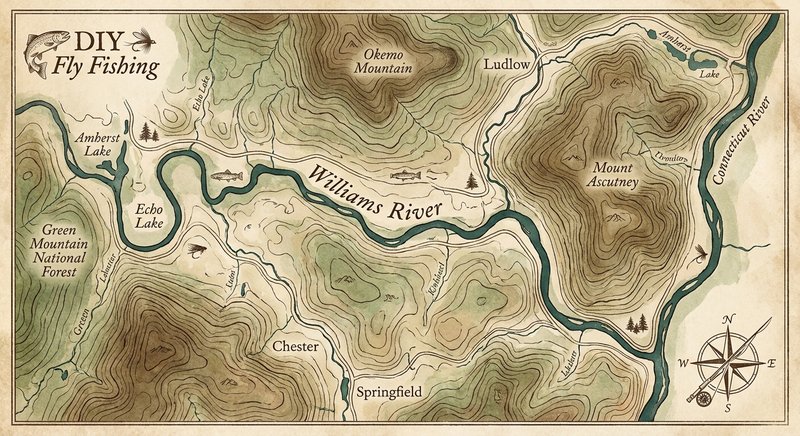
Williams River
Fly fishing in Vermont · Intermediate · Best seasons: Spring, Summer, Fall
Target Species
Brook Trout, Brown Trout
About This Water
Southern Vermont stream with good wild trout. Less pressured than famous waters with scenic pools.
Fishing Recommendations
The Williams River in south-central Vermont is a classic New England freestone stream. While it often plays second fiddle to the nearby Battenkill or the Black River, the Williams is a "sleeper" river that rewards technical anglers and those who appreciate a variety of water types—from tumbling mountain pockets to slow, meandering meadow reaches.
Here is your guide to fly fishing the Williams River.
🎣 Location Overview
The Williams River originates in the Green Mountains near Andover and flows eastward through the towns of Chester and Rockingham before joining the Connecticut River. It is characterized by its accessibility (closely followed by Route 103) and its classic "pool-run-riffle" structure.
What makes the Williams special is its dual personality. The Upper Williams and its branches (North and Middle) are quintessential high-gradient mountain streams filled with wild brook trout. The Main Stem (below Chester) widens out, offering deeper pools and undercut banks that house larger, more selective brown trout. Because it is a freestone river, its character changes with the seasons, requiring anglers to adapt to fluctuating water levels and temperatures.
🐟 Target Species & Behavior
Brook Trout
- Location: Found predominantly in the headwaters and the North/Middle branches above Chester.
- Behavior: Highly opportunistic. In the fast-moving pocket water, they don't have long to decide; they will often strike quickly at anything that looks like food.
- Feeding: They focus on small stoneflies, caddis larvae, and terrestrial insects dropped from the overhanging canopy.
Brown Trout
- Location: Found in the main stem, particularly from Chester downstream toward Bartonsville.
- Behavior: Much more wary than the brookies. They prefer "holding water" with overhead cover—think deep undercuts, the dark shadows beneath overhanging trees, and the soft water behind large boulders.
- Feeding: Browns here are notorious for feeding heavily during low-light conditions. They target larger Hendrickson and Quill Gordon mayflies in the spring and shift to nocturnal streamer-feeding in the heat of summer.
📅 Best Times to Fish
Spring (Late April – June)
This is the "Goldilocks" window. Once the snowmelt (mud season) subsides and the water hits 50°F, the river comes alive.
- Prime Window: Mid-May to mid-June for the major hatches.
- Time of Day: Late morning through mid-afternoon as the water warms.
Summer (July – August)
The Williams is a freestone river, meaning it can get low and warm.
- Prime Window: Early morning (dawn until 10:00 AM) or "the evening rise" (7:00 PM until dark).
- Condition Note: If water temperatures exceed 68°F, stop fishing the main stem to protect the trout. This is the time to head high into the cooler, shaded mountain branches for brookies.
Fall (September – October)
The most beautiful time to be in Vermont.
- Prime Window: All day, but especially during the warmth of the afternoon.
- Behavior: Brown trout become aggressive as they prepare for the spawn. This is your best chance to land a trophy-sized fish on a streamer.
🪰 Recommended Flies & Techniques
Dry Flies
- Hendrickson (Light & Dark): Essential for May.
- Elk Hair Caddis (Size 14-18): The workhorse fly for the Williams. Use tan or olive.
- Stimulators (Size 10-14): Great for the "bushy" water in the upper reaches; acts as a high-vis attractor.
- Royal Wulff: A classic brook trout attractor for the mountain branches.
- Terrestrials (Summer): Foam ants, beetles, and Dave’s Hoppers.
Nymphs
- Pheasant Tail (Size 14-18): Mimics almost any mayfly nymph in the river.
- Prince Nymph: Effective in the faster runs.
- Pat’s Rubber Legs (Size 8-12): Essential for the deeper pools in the main stem, mimicking the large golden stoneflies found here.
Streamers
- Woolly Bugger (Black or Olive): The standard for swinging through deep holes.
- Muddler Minnow: Excellent for mimicking sculpins or being skittered across the surface at dusk.
Techniques
- Dry-Dropper (The "Duo"): This is the most effective way to fish the Williams. Use a buoyant Stimulator or Hopper on top and hang a small Pheasant Tail nymph 18–24 inches below it.
- Tight-Line Nymphing: In the rocky runs below Chester, a European-style nymphing rig allows you to get deep into the pockets where fish hide from the current.
💡 Pro Tips & Local Knowledge
- The Route 103 Corridor: While the road proximity is convenient, the fish near the most obvious pull-offs are the most pressured. Walk 200 yards upstream or downstream from any bridge crossing to find "fresh" fish.
- The "Chester Divide": Local guides generally consider Chester the dividing line. Go West/Upstream for high-frequency brook trout action; go East/Downstream for lower-frequency but higher-quality brown trout.
- Stealth is Key: The Williams can run very clear. Approach pools from downstream, stay low, and wear drab-colored clothing. A 9-foot 4-weight rod with a long leader (9-12 feet) is the ideal setup for the main stem.
- Watch the Gauge: Look for the USGS gauge at Rockingham. Ideal flows for wading are between 100 and 300 cfs. If it’s over 500 cfs, the river can be dangerous to wade and difficult to fish.
⚠️ Important Information
- Access: Most of the river parallels Route 103. Vermont has generous laws regarding fishing access, but always respect "Posted" signs. If a farmhouse is nearby, it’s always polite to ask permission.
- Regulations: Generally follows Vermont General Trout Water regulations (Open 2nd Saturday in April to Oct 31). Always check the current Vermont Fish & Wildlife Law Digest for specific reach-based changes or "Catch and Release only" designations.
- Safety: The rocks in the Williams are notoriously "greasy" with algae. Felt-soled wading boots or studded rubber soles are highly recommended.
- Didymo (Rock Snot): To prevent the spread of invasive species, always clean, drain, and dry your waders and gear before moving to another watershed.
Bug Hatches & Matching Flies
| Hatch | Type | Peak months | Time of day | Hook sizes | Matching flies |
|---|---|---|---|---|---|
| Blue-Winged Olive (BWO) Baetis | mayfly | April, May, September, October | Late Morning/Afternoon | #18-22 | RS2 #18-22, Parachute Blue-Winged Olive #18-20, Pheasant Tail #18-22 |
| Hendrickson Ephemerella subvaria | mayfly | April, May | Afternoon | #12-14 | Red Quill #12-14, Hendrickson Nymph #12-14, Hendrickson Emerger #12-14 |
| March Brown Maccaffertium vicarium | mayfly | May, June | Afternoon | #10-12 | March Brown Dry #10-12, Gold Ribbed Hare's Ear #10-12 |
| Sulphur Ephemerella invaria/dorothea | mayfly | June, July | Evening | #14-18 | Sulphur Parachute #14-18, Sulphur CDC Emerger #16-18 |
| Tan Caddis Hydropsyche | caddis | May, June, July, August | Evening/Late Afternoon | #14-18 | Elk Hair Caddis #14-16, LaFontaine's Deep Sparkle Pupa #14-18, Holy Grail #14-16 |
| Light Cahill Stenacron interpunctatum | mayfly | June, July, August | Evening | #14-16 | Light Cahill Dry #14-16, Light Cahill Wet Fly #14-16 |
| Isonychia (Slate Drake) Isonychia bicolor | mayfly | June, July, August, September | Late Afternoon/Evening | #10-12 | Isonychia Parachute #10-12, Zug Bug #10-12, Prince Nymph #10-14 |
| Giant Black Stonefly Pteronarcys dorsata | stonefly | May, June | Morning/Evening | #4-8 | Pat's Rubber Legs #6-10, Black Stonefly Nymph #4-8 |
| Ants and Beetles Formicidae / Coleoptera | terrestrial | July, August, September | All Day | #12-18 | Chernobyl Ant #8-12, Black Foam Ant #16-18, Cinnamon Ant #14-16 |