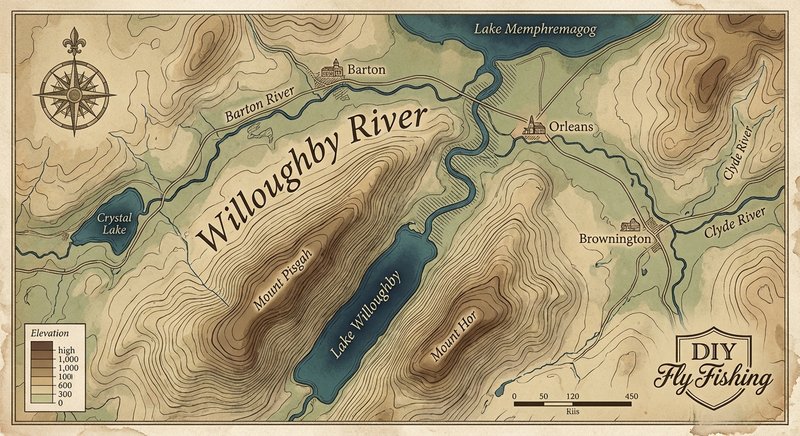
Willoughby River
Fly fishing in Vermont · Intermediate · Best seasons: Spring, Summer, Fall
Target Species
Brook Trout, Landlocked Salmon
About This Water
Northeast Kingdom stream draining Lake Willoughby. Brook trout and landlocked salmon in crystal clear water.
Fishing Recommendations
The Willoughby River in Vermont’s Northeast Kingdom (NEK) is a legendary ribbon of water. While many New England rivers struggle with rising temperatures, the Willoughby benefits from the icy, deep discharge of Lake Willoughby—a glacial lake often called the "Lucerne of America." This ensures a cold-water refuge that supports some of the most exciting salmonid action in the Eastern United States.
🎣 Location Overview
The Willoughby River flows roughly 18 miles from Lake Willoughby in Westmore through the town of Orleans, eventually joining the Barton River and emptying into Lake Memphremagog.
What makes it special is its role as a major spawning tributary. It is most famous for its spring run of wild "Steelhead" (Rainbow Trout), but for the fly angler targeting Landlocked Salmon and Brook Trout, it offers a classic New England freestone experience. The river transitions from a steep, tumbling mountain stream near the lake to a series of deep pools, ledge drops, and long runs as it nears Orleans. The scenery is quintessential Vermont: covered bridges, dense forests, and rocky gorges.
🐟 Target Species & Behavior
Landlocked Atlantic Salmon
Unlike the resident trout, these are migratory fish that move up from Lake Memphremagog.
- Behavior: They are high-energy, acrobatic, and aggressive. They don't "sip" flies like a brown trout; they often smash streamers out of territorial aggression.
- Holding Water: Look for "bubbles and foam." Salmon love highly oxygenated water. They hold in the heads of pools, right in the heavy whitewater, or behind large boulders in the main current.
Brook Trout
The Willoughby and its small feeder streams hold beautiful, wild Brookies.
- Behavior: These are opportunistic feeders. In the upper reaches, they are less selective than the salmon.
- Holding Water: Look for "soft" spots—undercut banks, the tail-outs of small pools, and behind woody debris. They prefer the cooler, shaded stretches of the upper river.
📅 Best Times to Fish
- Spring (Late April – May): This is prime time for the "Steelhead" run, but Landlocked Salmon are often mixed in. The water is high and cold; you’ll need heavy sink tips.
- Summer (June – August): This is the best window for Brook Trout. While other Vermont rivers may get too warm, the Willoughby stays cool. Focus on the upper sections near the Westmore line. Evening rises can be spectacular.
- Fall (September – October): The Trophy Season. This is the primary run of Landlocked Salmon coming up from Lake Memphremagog to spawn. The fish are in their "spawning colors" (darker and more vibrant) and are very aggressive.
- Optimal Windows: Overcast, drizzly days are best for Salmon. For Brookies, the "witching hour" (the last 90 minutes of daylight) in July is unbeatable.
🪰 Recommended Flies & Techniques
For Landlocked Salmon (The "Big Game" Approach)
- Streamers: This is the most effective method.
- Patterns: Grey Ghost, Black Ghost, Mickey Finn, and the Willoughby Special.
- Technique: The "Down and Across" swing. Cast at a 45-degree angle downstream, mend to sink the fly, and let it swing through the current. Give it short, rhythmic strips as it nears the hang-down.
- Nymphing: If the water is low and clear.
- Patterns: Size 8-12 Stoneflies (black or golden), Prince Nymphs, and Pheasant Tails.
- Technique: High-stick nymphing through the deep chutes.
For Brook Trout (The "Finesse" Approach)
- Dry Flies:
- Patterns: Royal Wulff, Elk Hair Caddis (size 14-16), and the classic Hornberg.
- Technique: Short, accurate casts. These fish live in tight quarters; a 7'6" 3-weight or 4-weight rod is ideal.
- Dry-Dropper: A size 12 Stimulator with a size 16 Pheasant Tail dropper is a deadly combo for covering pocket water.
💡 Pro Tips & Local Knowledge
- The Orleans "Falls": The most famous spot is the waterfall in the village of Orleans. While it gets crowded, the pools below the falls are "holding pens" for Salmon waiting to jump. If you want to see fish jump, go here; if you want to catch them in peace, hike half a mile upstream or downstream.
- The "Memory" Factor: Salmon have long memories of where they were born. Look for gravelly sections where the current slows slightly; these are the "redds" (spawning beds). Avoid stepping on the gravel in late fall to protect the eggs.
- Read the Bubbles: In the heavy pocket water, fish the "seams" where fast water meets slow water. If you see a line of bubbles on the surface, your fly should be directly under those bubbles.
- Stealth: The Willoughby is clear. Wear earthy tones (greens/browns) and avoid "lining" the fish (casting your fly line directly over their heads).
⚠️ Important Information
- Access: Much of the river is accessible via Route 58 and Route 5. There are public pull-offs near the bridge in Evansville and several spots in Orleans.
- Regulations: Vermont has very specific regulations for the Willoughby, especially during the spring and fall runs.
- Orleans Special Regulation: There is a section near the falls that is often closed or restricted to specific dates.
- Always check the VT Fish & Wildlife Lawbook for the current year, as "Catch and Release" zones and seasonal closures change frequently.
- Wading: The riverbed is exceptionally slippery. Studded wading boots and a wading staff are highly recommended, especially near the gorge areas.
- Licensing: You need a valid Vermont Fishing License, which can be purchased online at the VT Fish & Wildlife website.
Guide’s Final Word: The Willoughby is a "quality over quantity" river. You might work all day for two or three Salmon, but when a 20-inch Landlocked Salmon hits your streamer and goes airborne, you'll understand why this is considered the crown jewel of Vermont fly fishing.
Bug Hatches & Matching Flies
| Hatch | Type | Peak months | Time of day | Hook sizes | Matching flies |
|---|---|---|---|---|---|
| Hendrickson Ephemerella subvaria | mayfly | May | Afternoon | #12-14 | Red Quill #12-14, Hendrickson Nymph #12-14, Hendrickson Emerger #14 |
| Grannom Caddis Brachycentrus | caddis | May | Morning/Afternoon | #14-16 | Elk Hair Caddis (Olive/Green body) #14-16, Peeking Caddis #14-16, Deep Sparkle Pupa #14-16 |
| Blue-Winged Olive Baetis | mayfly | May, September, October | Afternoon | #18-22 | Parachute BWO #18-22, RS2 #20-22, BWO CDC Emerger #18-20 |
| Yellow Sally Isoperla | stonefly | June, July | Late Afternoon/Evening | #14-16 | Yellow Stimulator #14-16, Iron Lotus (Yellow) #14-16 |
| Slate Drake Isonychia bicolor | mayfly | August, September | Late Afternoon | #10-12 | Isonychia Parachute #10-12, Prince Nymph #10-14, Iso Wet Fly #12 |
| Light Cahill Stenacron / Stenonema | mayfly | June, July | Evening | #12-14 | Light Cahill #12-14, Gold Ribbed Hare's Ear #12-14 |
| Cinnamon Caddis Hydropsyche | caddis | June, July, August | Evening | #14-18 | Tan Elk Hair Caddis #14-18, Hydropsyche Larva #14-16, Pulsating Pupa #16 |
| Golden Stonefly Acroneuria | stonefly | June | Evening/Night | #6-10 | Golden Stone Nymph #6-10, Kaufmann's Stimulator #8-10 |