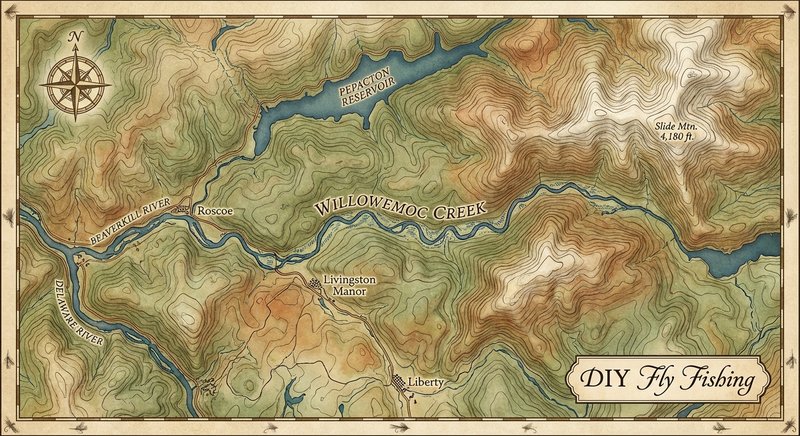
Willowemoc Creek
Fly fishing in New York · Beginner · Best seasons: Spring, Summer, Fall
Target Species
Brown Trout, Brook Trout
About This Water
Another historic Catskills stream. Tributary of the Beaverkill with excellent dry fly fishing.
Fishing Recommendations
Welcome to the "Willy." As an expert guide in the Catskills, I can tell you that Willowemoc Creek is hallowed ground. Flowing through Sullivan County and meeting the Beaverkill at the famous Junction Pool in Roscoe, this is the cradle of American dry fly fishing. It offers a more intimate experience than the main stem Delaware, with classic freestone characteristics that demand finesse and rewarded patience.
🎣 Location Overview
The Willowemoc (or "The Willy") is a quintessential Catskill freestone stream. It originates in the Catskill Park wilderness and flows roughly 27 miles westward.
What makes it special: Unlike its neighbor, the Beaverkill, which can feel wide and daunting, the Willowemoc is manageable and incredibly scenic. The upper reaches feel like a mountain brook, while the lower sections near Livingston Manor and Roscoe provide classic pool-and-riffle water. It is characterized by its clear, cold water, moss-covered rocks, and a deep history rooted in the traditions of Theodore Gordon and Sparse Grey Hackle.
🐟 Target Species & Behavior
- Brown Trout: The star of the show. You’ll find a mix of savvy wild browns and healthy stocked fish. They are notorious for holding in the "seams" between fast and slow water and tucked deep under the undercut banks near Livingston Manor.
- Brook Trout: In the upper reaches (above Livingston Manor and toward Mongaup Pond), you will find beautiful wild Brookies. They are opportunistic but spooky.
- Behavior: During hatch cycles, these fish become highly selective. If your drift isn't perfect, they will snub even the most accurate imitation. During non-hatch periods, they hold in the deeper "guts" of pools or behind large boulders in the pocket water.
📅 Best Times to Fish
- Spring (Mid-April – June): This is the "Golden Era" on the Willy. The hatches are legendary. Late April brings the Hendricksons, followed by the March Browns and Sulphurs in May/June.
- Summer (July – August): Water temperatures can become dangerously high for trout (above 68°F). Guide Tip: Fish the upper sections or "thermally protected" areas early in the morning. If the water hits 70°F, please stop fishing to protect the trout.
- Fall (September – October): A fantastic time as temperatures drop. The Brown trout become aggressive as they prepare for the spawn. Isonychia hatches are the highlight here.
- Best Time of Day:
- Spring: Mid-day (11 AM – 4 PM) when the water warms enough to trigger hatches.
- Summer: First light until 10 AM.
- Fall: Late afternoon.
🪰 Recommended Flies & Techniques
Top Fly Patterns
- Dry Flies:
- Hendrickson (Dark & Light): Size 12-14 (Late April).
- Red Quill: Size 14.
- Sulphur: Size 16-18 (May/June).
- Isonychia: Size 10-12 (Late Summer/Fall).
- Elk Hair Caddis: Size 14-16 (A year-round staple).
- Nymphs:
- Pheasant Tail: Size 14-18.
- Hare’s Ear: Size 12-16.
- Prince Nymph: Size 12-14.
- Streamers:
- Black or Olive Woolly Bugger: Size 6-10.
- Muddler Minnow: Size 8.
Techniques
- Dry Fly Presentation: Use a long leader (9-12 feet) tapered to 5X or 6X. Reach casts and pile casts are essential to avoid drag in the complex currents.
- Nymphing: "High-sticking" or European-style nymphing is incredibly effective in the pocket water sections above Livingston Manor.
- Streamer Stripping: On overcast days or when the water is slightly off-color after a rain, strip a Woolly Bugger through the deep pools for the larger, "cannibal" browns.
💡 Pro Tips & Local Knowledge
- The "No-Kill" Section: There is a legendary 3.2-mile Catch and Release section starting at the mouth of Elm Hollow Brook and extending downstream. This holds the highest concentration of educated, large fish.
- Mind the Temperature: The Willowemoc is a freestone stream, meaning it relies on rain and runoff, not bottom-release dams. It warms up fast. Check the USGS gauge at Livingston Manor; if it’s over 68°F, head to the higher elevations or the tailwaters of the Delaware.
- Stealth is Key: Because the water is often crystal clear, your approach matters. Don't wade into the middle of a pool immediately. Fish the near bank first, staying low.
- The "Junction Pool" Myth: While famous, Junction Pool (where the Willowemoc meets the Beaverkill) is often crowded. Some of the best fishing is actually a mile upstream from the pool, where the pressure is lower.
⚠️ Important Information
- Access: New York State has done a great job with Public Fishing Rights (PFR). Look for the yellow "Public Fishing Stream" signs along Route 17 and Old Route 17.
- Regulations:
- Most of the Willowemoc follows standard NY State trout regs, but the No-Kill section is strictly artificial lures/flies only and zero harvest.
- Always carry a valid New York State Fishing License.
- Invasive Species: To prevent the spread of "Didymo" (rock snot), please clean and dry your wading gear before moving between the Willowemoc and other watersheds. Felt soles are legal in NY, but rubber with studs is often safer on these slippery rocks.
- Parking: Be respectful of private property. Only park in designated pulloffs or public areas.
Tight lines, and remember: on the Willowemoc, the "Catskill Style" of dry fly—sparse and elegant—still catches more fish than anything else!
Bug Hatches & Matching Flies
| Hatch | Type | Peak months | Time of day | Hook sizes | Matching flies |
|---|---|---|---|---|---|
| Quill Gordon Epeorus pleuralis | mayfly | April | Afternoon | #12-14 | Quill Gordon Dry #12-14, Quill Gordon Wet Fly #12-14 |
| Hendrickson Ephemerella subvaria | mayfly | April, May | Afternoon | #12-14 | Red Quill #12-14, Hendrickson Emerger #12-14, Pheasant Tail Nymph #12-14 |
| March Brown Maccaffertium vicarium | mayfly | May, June | Afternoon | #10-12 | March Brown Dry #10-12, Hare's Ear Nymph #10-14 |
| Sulphur Ephemerella invaria/dorothea | mayfly | May, June | Evening | #14-18 | Sulphur Parachute #14-18, Sulphur CDC Emerger #14-18 |
| Green Drake Ephemera guttulata | mayfly | June | Evening | #8-10 | Green Drake Spinner (Coffin Fly) #8-10, Green Drake Nymph #8-10 |
| Grannom Caddis Brachycentrus | caddis | April, May | Morning/Afternoon | #14-16 | Elk Hair Caddis (Green body) #14-16, Pupa-style Caddis #14-16 |
| Blue-Winged Olive Baetis spp. | mayfly | April, May, September, October | Afternoon | #18-22 | BWO Sparkle Dun #18-22, RS2 #18-22 |
| Slate Drake Isonychia bicolor | mayfly | June, September | Late Afternoon | #10-14 | Iso Parachute #10-12, Isonychia Nymph #10-12 |
| Cinnamon Caddis Hydropsyche | caddis | June, July, August | Evening | #14-16 | Tan Elk Hair Caddis #14-16, LaFontaine's Deep Sparkle Pupa #14-16 |
| Black Ants & Beetles Formicidae / Coleoptera | terrestrial | July, August, September | Mid-day/Afternoon | #14-20 | Black Foam Ant #16-20, Crowe Beetle #14-18 |