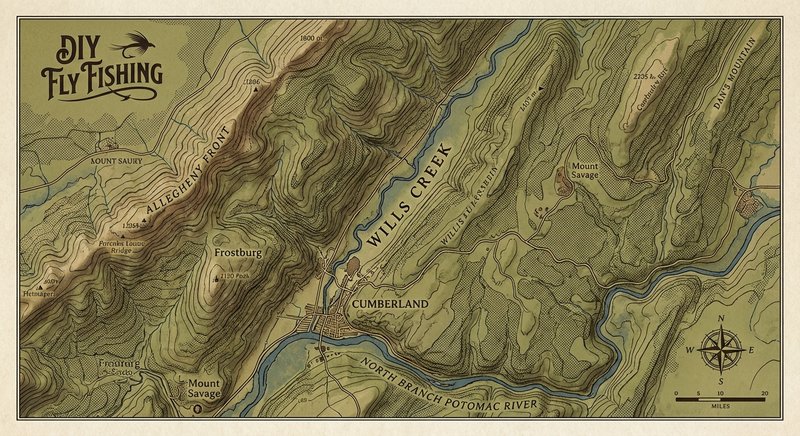
Wills Creek
Fly fishing in Maryland · Beginner · Best seasons: Spring, Summer, Fall
Target Species
Brown Trout, Smallmouth Bass
About This Water
Western Maryland stream near Cumberland. Brown trout and smallmouth bass.
Fishing Recommendations
Wills Creek is one of Western Maryland’s most underrated and structurally interesting fisheries. Flowing through Allegany County and cutting through the dramatic "Cumberland Narrows," this creek offers a unique "split personality" experience: high-quality trout water in its upper reaches and excellent smallmouth bass habitat as it nears its confluence with the North Branch of the Potomac River.
Here is your guide to mastering Wills Creek.
🎣 Location Overview
Wills Creek is a freestone stream that begins in Pennsylvania and flows south into Maryland, carving a deep gorge through the Appalachian Mountains. What makes this water special is the dramatic substrate—massive boulders, ledge rock, and deep pools characterize the "Narrows" section near Cumberland.
The creek is chemically influenced by the limestone geography of the region, which provides a higher alkalinity than many other Appalachian freestones. This leads to excellent insect life and healthy growth rates for fish. Anglers love it because it feels like a rugged mountain river, yet it is easily accessible from the town of Cumberland.
🐟 Target Species & Behavior
Brown Trout
- Behavior: While the state stocks Wills Creek heavily with rainbows, the wild and holdover Brown Trout are the real prize. These fish are predatory and wary. They hold tight to the shadows of large boulders and undercut banks.
- Feeding: In the spring, they focus on heavy insect hatches. As the water warms in summer, they shift their diet toward crayfish and sculpins.
Smallmouth Bass
- Behavior: Found predominantly from the middle reaches down to the mouth at the Potomac. They are aggressive and territorial.
- Feeding: Wills Creek smallmouths are "opportunistic hunters." They hover near current breaks and ledge drops, waiting for minnows or hellgrammites to wash by.
📅 Best Times to Fish
Spring (March – June)
- The Window: This is prime trout season. April and May see the best insect activity.
- Conditions: Look for water temperatures hitting the 50°F–55°F mark for the most aggressive feeding.
Summer (July – Early September)
- The Window: This is the time for Smallmouth Bass.
- Conditions: Trout fishing should be avoided in the lower sections during mid-summer to protect the fish from heat stress. Focus on the early morning or late evening for "Smallies" using topwater flies.
Fall (Late September – November)
- The Window: The "Second Season."
- Conditions: As water temperatures drop, Brown Trout become aggressive ahead of their spawn. The fall colors in the Narrows are spectacular, and the Smallmouth fishing remains excellent until the first frost.
🪰 Recommended Flies & Techniques
Dry Flies (Spring/Early Summer)
- Sulphurs (Size 14-18): A staple hatch on Wills Creek.
- Blue Winged Olives (Size 18-22): Essential for overcast or drizzly days.
- Caddis (Size 14-16): Elk Hair Caddis in tan or olive are effective year-round.
Nymphs (The Workhorses)
- Pheasant Tail (Size 14-18): Mimics various mayflies.
- Prince Nymph (Size 12-16): Great for the turbulent water in the gorge.
- Pat’s Rubber Legs (Size 8-12): Essential for Smallmouth and large Browns, mimicking stones or crayfish.
Streamers & Subsurface
- Woolly Buggers (Black or Olive): The universal fly for this creek.
- Clouser Minnows: Best for Smallmouth in the lower reaches.
- Hellgrammite Patterns: Vital for the rocky sections where Smallmouth dominate.
Techniques
- High-Stick Nymphing: Because of the heavy pocket water and boulders, keeping your line off the water is crucial to avoid "micro-drag."
- The Swing: Swinging small streamers through the tails of pools is a highly effective way to find active Smallmouth.
💡 Pro Tips & Local Knowledge
- The "Narrows" Secret: The section of the creek that runs through the Cumberland Narrows looks intimidating due to the giant rocks, but this is where the biggest fish hide. Focus on the "seams" where fast water meets slow water behind the boulders.
- Follow the Cold Water: In the heat of summer, look for small tributary inflows. These "cold water plumes" act as thermal refuges for trout.
- Watch the Gauge: Wills Creek can rise and discolor quickly after a mountain rain. Check the USGS gauge at Cumberland; if it’s spiking or chocolate milk colored, head to the smaller tributaries instead.
- Stealth Matters: Despite its urban proximity, the water can be very clear. Long leaders (9ft–12ft) and 5x or 6x tippet are often necessary for the educated trout.
⚠️ Important Information
Access
- Western Maryland Scenic Railroad: The tracks run parallel to much of the creek. While beautiful, be extremely careful near the tracks and stay on established paths.
- Public Parks: Access is available via Mason Complex and several pull-offs along MD Route 36 and US 40.
Regulations & Permits
- License: A Maryland Non-Tidal Fishing License is required. If you plan to keep trout (where permitted), you must have a Trout Stamp.
- Zones: Be aware that certain sections may have specific regulations (Catch and Release vs. Put and Take). Always check the Maryland DNR Fishing Guide for current seasonal boundary changes.
Special Considerations
- Wading Safety: The rocks in Wills Creek are notoriously slippery. Felt-soled boots or studs are highly recommended. A wading staff is a wise investment for navigating the gorge.
- Temperature Watch: If the water temperature exceeds 68°F, stop targeting trout and switch exclusively to Smallmouth Bass to ensure fish survival.
Bug Hatches & Matching Flies
| Hatch | Type | Peak months | Time of day | Hook sizes | Matching flies |
|---|---|---|---|---|---|
| Blue Winged Olive Baetis spp. | mayfly | March, April, September, October | Afternoon | #18-22 | RS2 #18-22, Parachute BWO #18-20, Pheasant Tail #18-22 |
| Grannom Caddis Brachycentrus | caddis | April | Morning/Afternoon | #14-16 | LaFontaine's Deep Sparkle Pupa #14-16, Elk Hair Caddis (Dark) #14-16, Peacock Caddis #16 |
| March Brown Maccaffertium vicarium | mayfly | May | Afternoon | #10-14 | March Brown Wet Fly #12-14, Gold Ribbed Hare's Ear #10-12, March Brown Parachute #12-14 |
| Sulphur Ephemerella invaria/dorothea | mayfly | May, June | Evening | #14-18 | Sulphur Parachute #14-18, Sulphur Snowshoe Emerger #16-18, Pheasant Tail (Flashback) #14-16 |
| Golden Stonefly Acroneuria | stonefly | June, July | Morning/Evening | #8-12 | Pat's Rubber Legs #8-12, Stimulator (Yellow) #10-12, Golden Stone Nymph #8-10 |
| Tan Caddis Hydropsyche | caddis | June, July, August | Evening | #14-18 | Elk Hair Caddis (Tan) #14-16, Holy Grail #16-18, Pupa (Tan/Green) #14-18 |
| Light Cahill Stenacron interpunctatum | mayfly | June, July | Evening | #12-14 | Light Cahill Dry #12-14, Cream Usual #14, Gold Ribbed Hare's Ear #14 |
| Terrestrials Formicidae / Coleoptera | terrestrial | July, August, September | Afternoon | #12-20 | Chernobyl Ant #12-14, Black Foam Beetle #14-18, Cinnamon Ant #16-20 |
| Zebra Midge Chironomidae | midge | January, February, March, December | Morning/Afternoon | #18-24 | Zebra Midge #18-22, Griffith's Gnat #18-22, Top Secret Midge #20-24 |