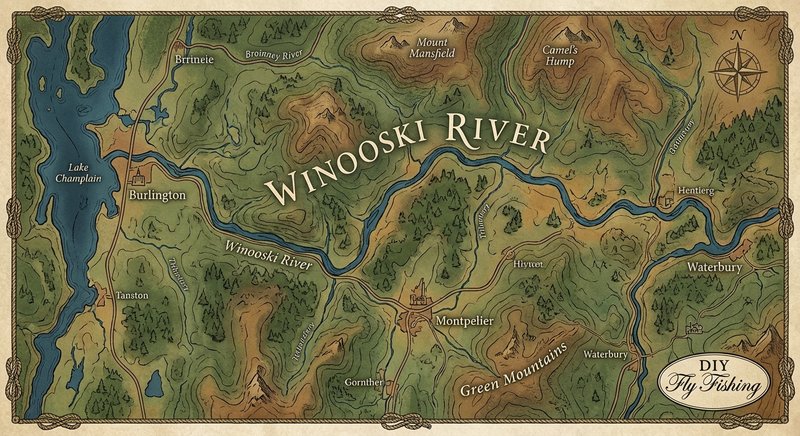
Winooski River
Fly fishing in Vermont · Intermediate · Best seasons: Spring, Summer, Fall
Target Species
Rainbow Trout, Brown Trout, Steelhead
About This Water
Central Vermont river near Burlington. Rainbow and brown trout with occasional steelhead runs.
Fishing Recommendations
The Winooski River, often called the "Onion River," is the longest river located entirely within Vermont. It flows from the Green Mountains through Montpelier and Waterbury before emptying into Lake Champlain. It is a diverse fishery that transforms from a classic mountain trout stream in its upper reaches to a powerful, wide river hosting lake-run monsters near its mouth.
🎣 Location Overview
The Winooski is special because of its accessibility and its variety. You can fish technical pocket water in the morning and swing big streamers for trophy browns in the afternoon.
The river is generally divided into three sections by anglers:
- Upper Winooski (Headwaters to Montpelier): Smaller water, high oxygen, and home to many wild fish.
- Middle Winooski (Montpelier to Richmond): The most popular trout water. It features wide runs, deep holding pools, and classic riffle-pool-run geometry.
- Lower Winooski (Below the Winooski Dam): This is the "big water" influenced by Lake Champlain, where you find the lake-run "steelhead" and landlocked salmon.
🐟 Target Species & Behavior
- Brown Trout: The "kings" of the middle Winooski. They love the deep, slow-moving pools and undercut banks. Many are wild, and they are notoriously wary. They become highly aggressive during the fall spawn and on overcast days.
- Rainbow Trout: Found in the faster, more oxygenated "bubbly" water and riffles. The state stocks several sections, but there are plenty of holdovers and wild fish that provide a spirited fight.
- Steelhead (Adfluvial Rainbows): These are Lake Champlain rainbows that migrate up the river to spawn. Unlike the West Coast version, these are freshwater-only but reach impressive sizes. They hold in the lower river below the first impassable dam.
- Feeding Habits: The Winooski is a "caddis factory." However, the fish are also highly opportunistic, feeding on stoneflies, mayflies, and a significant population of sculpins and crayfish.
📅 Best Times to Fish
- Spring (Late April – June): This is the peak. The Hendrickson hatch (late April/early May) is the most famous event on the river. The "Steelhead" run occurs in early spring as soon as the ice clears and the water hits 40–45°F.
- Summer (July – August): Water temperatures can rise. Focus on the early morning (5 AM – 9 AM) or late evening. If the main stem hits 70°F, head to the colder tributaries (like the Little River or Huntington River) to protect the fish.
- Fall (September – October): Fantastic for Brown Trout. As the water cools, they move out of deep holes to feed aggressively before spawning. The fall colors make this the most scenic time to be on the water.
🪰 Recommended Flies & Techniques
Dry Flies
- Hendrickson (Size 12-14): Essential for May.
- Elk Hair Caddis (Size 14-18): The bread and butter of the Winooski. Tan and olive are best.
- Stimulators (Size 8-12): Great for the faster water in summer.
Nymphs
- Pheasant Tail & Prince Nymphs (Size 14-18): Standard staples.
- Pat’s Rubber Legs (Size 8-12): Excellent in high spring water to mimic large stoneflies.
- Zebra Midge (Size 18-20): Vital for picky fish in low-water summer conditions.
Streamers
- Woolly Buggers (Black or Olive): Never leave home without them.
- Sculpin Patterns: Swing these through deep runs or "strip" them near submerged logs for big Browns.
Techniques
- Tight-Line Nymphing: Very effective in the rocky riffles between Waterbury and Richmond.
- The "Greased Line": For the lower-river Steelhead, swinging wet flies or small streamers on a sink-tip line is the traditional method.
💡 Pro Tips & Local Knowledge
- The "Dam" Factor: The Winooski is heavily dammed. Always check the USGS gauges for Montpelier and Waterbury before heading out. A sudden release from the Waterbury dam can make the river dangerous and unfishable in minutes.
- Focus on the Shadows: The Winooski browns are light-sensitive. On bright sunny days, look for sections where the high banks or trees cast shadows on the water.
- The "Bolton" Stretch: The area around Bolton Flats offers some of the most consistent trout fishing, with a mix of deep holes and long, gravelly runs.
- Go Big for Steelhead: When fishing the lower river for lake-run fish, don't be afraid to use 2x or 3x tippet. These fish are powerful and will head straight for the heaviest current once hooked.
⚠️ Important Information
- Access: Much of the Winooski follows Route 2. There are numerous designated fishing access points maintained by the state (look for the green and white signs).
- Regulations: Vermont has specific "Trophy Trout" sections on the Winooski where special limits apply (usually a 2-fish limit). Check the current Vermont Fish & Wildlife Law Digest as rules can change annually.
- Wading Safety: The rocks in the Winooski are famously slippery and often covered in "Didymo" (rock snot). Felt soles or studs are highly recommended.
- Invasive Species: To prevent the spread of Didymo and other invasives, always "Clean, Drain, and Dry" your gear before moving to another watershed.
Tight lines! The Winooski is a rewarding river that requires patience and a good read of the water, but it holds some of the finest trout in New England.
Bug Hatches & Matching Flies
| Hatch | Type | Peak months | Time of day | Hook sizes | Matching flies |
|---|---|---|---|---|---|
| Hendrickson Ephemerella subvariabilis | mayfly | April, May | Afternoon | #12-14 | Red Quill #12-14, Hendrickson Emerger #12-14, Pheasant Tail #12-14 |
| Blue Winged Olive (BWO) Baetis spp. | mayfly | April, May, September, October | Midday | #18-22 | RS2 #18-22, Parachute Adams #18-22, WD-40 #18-22 |
| Grannom Caddis Brachycentrus | caddis | May | Morning/Afternoon | #14-16 | Elk Hair Caddis (Olive) #14-16, Peeking Caddis #14-16, Deep Sparkle Pupa #14-16 |
| Sulphurs Ephemerella invaria/dorothea | mayfly | June, July | Evening | #14-18 | Sulphur Parachute #14-18, Sulphur Cripple #14-16, Pale Morning Dun Nymph #14-18 |
| Golden Stonefly Acroneuria spp. | stonefly | June, July | Morning/Evening | #6-10 | Golden Stone #8-10, Pat's Rubber Leg #6-10, Kaufmann's Stone #8-12 |
| Light Cahill Stenonema ithaca | mayfly | June, July, August | Late Afternoon/Evening | #12-14 | Light Cahill #12-14, Gold Ribbed Hare's Ear #12-14 |
| Trico Tricorythodes | mayfly | July, August, September | Early Morning | #22-26 | Trico Spinner #22-24, Trico Duns #22-24 |
| October Caddis Pycnopsyche | caddis | September, October | Afternoon/Evening | #8-12 | Orange Stimulator #8-12, October Caddis Pupa #10-12 |
| Eastern Terrestrials Formicidae/Coleoptera | terrestrial | July, August, September | All Day | #10-18 | Chernobyl Ant #10-14, Black Foam Beetle #14-18, Cinnamon Ant #16-18 |