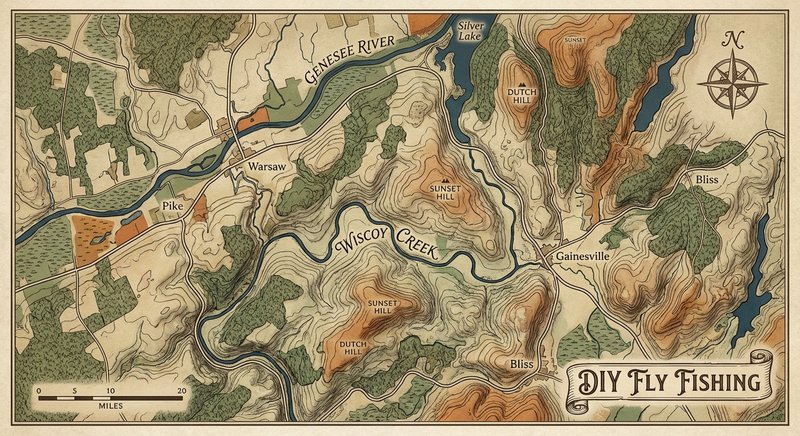
Wiscoy Creek
Fly fishing in New York · Intermediate · Best seasons: Spring, Summer, Fall
Target Species
Brown Trout
About This Water
Western NY spring creek with wild brown trout. Technical fishing near Letchworth Park.
Fishing Recommendations
Wiscoy Creek is widely considered the crown jewel of Western New York trout fishing. As a guide, I often tell folks that if you want to test your mettle against wild, wary brown trout in a classic meadow-stream setting, there is no better place in the state.
Here is your comprehensive guide to fishing Wiscoy Creek, New York.
🎣 Location Overview
Located primarily in Wyoming County, near the towns of Bliss and Pike, Wiscoy Creek is a high-gradient, limestone-influenced stream. Unlike many Western NY tribs that suffer from summer thermal stress, the Wiscoy is blessed with significant groundwater springs. This keep the water cold, clear, and oxygenated year-round.
What makes it special is the wild trout biomass. The Wiscoy is not stocked; it manages a self-sustaining population of wild Brown Trout that is staggering—often exceeding 500 pounds of fish per river mile. The character of the water varies from tight, brushy headwaters to classic "English Chalkstream" style meadow stretches with undercut banks, deep bends, and silty bottoms.
🐟 Target Species & Behavior
Primary Species: Wild Brown Trout These are not your average hatchery fish. Wiscoy Browns are buttery-gold, vibrantly spotted, and incredibly "spooky."
- Behavior: They are highly sensitive to shadows and bank vibration. If they see you, the fishing in that pool is over for the next hour.
- Where they hold: Look for "the Three U’s"—Undercut banks, Under logs/wood debris, and Upstream of riffles in the evening. During the day, they tuck deep into the shadows or under overhanging brush.
- Feeding: They are opportunistic but can become extremely selective during the Trico or Hendrickson hatches. They rely heavily on the stream’s rich crustacean population (scuds and sowbugs) between hatches.
📅 Best Times to Fish
Spring (Mid-April – June)
- The Window: This is prime time. The Hendrickson (Ephemerella subvariabilis) hatch in late April/early May is legendary here.
- Conditions: Water levels are usually high but clear. This is when the largest fish in the system are most likely to rise to a dry fly.
Summer (July – August)
- The Window: Early morning (6 AM – 10 AM) or "the magic hour" before dark.
- Conditions: While other streams are too warm to fish, the Wiscoy stays cool. However, the water becomes gin-clear. Stealth is paramount. Trico hatches in the morning are prolific.
Fall (September – October)
- The Window: All day, especially overcast afternoons.
- Conditions: Browns become aggressive as they prepare to spawn. This is streamer season. The colors of the fish are at their peak.
🪰 Recommended Flies & Techniques
Top Fly Patterns
- Dries:
- Hendrickson (Red Quill) #12-14 (Spring)
- Sulphurs #16-18 (June)
- Tricos #22-24 (Summer mornings)
- Terrestrials: Foam Ants and Beetles #14-18 (Essential in the meadow stretches)
- Nymphs:
- Pheasant Tail #16-20 (The gold standard here)
- Scuds/Sowbugs #16-18 in grey or olive (A staple diet)
- Zebra Midge #18-22
- Streamers:
- Wooly Buggers (Olive or Black) #8-10
- Black Ghost or small Muddler Minnows
Techniques
- Dry Fly: Use a long leader (9–12 feet) tapered to 5X or 6X. A "Reach Cast" is vital to prevent drag in the swirling meadow currents.
- Nymphing: European Style (Euro) nymphing is incredibly effective in the riffles, but in the slow pools, a small strike indicator or "dry-dropper" rig is better to avoid spooking fish.
- The "Dapping" Method: In the brushiest sections, you may not be able to cast. Simply poking the rod tip through the brush and dropping a beetle or ant on the water is a pro move.
💡 Pro Tips & Local Knowledge
- Stay Out of the Water: The Wiscoy is narrow. Whenever possible, fish from the bank. If you must wade, move like a heron—slow and deliberate. The silt on the bottom can send a "puff" of mud downstream that warns every fish you’re coming.
- The "Pike to Bliss" Stretch: This is the most famous water. Focus on the areas where the creek meanders through open pastures.
- Mind the Beaver Dams: Beaver activity is high on the Wiscoy. The pools created by these dams hold the largest "resident" browns, but the water is still. Use long, light tippets here.
- Check the Gauge: The Wiscoy can blow out after heavy rains, but because of its spring-fed nature, it clears faster than the nearby Genesee River.
⚠️ Important Information
- Access: New York State has done an excellent job securing Public Fishing Rights (PFR). Look for the yellow "Public Fishing Stream" signs. Always respect private property boundaries that are not marked.
- Regulations: As of recent NYSDEC changes, much of the Wiscoy is Catch and Release Only, Artificial Lures Only year-round. Always check the current NYS Trout Stream Regulations before heading out.
- Parking: There are several designated pull-offs along Route 39 and East Koy Road. Do not block farm gates.
- Gear Recommendation: A 7.5' to 8.5' 4-weight rod is the perfect tool for this water. A 5-weight is fine for streamers, but anything heavier is overkill.
Guide’s Final Word: The Wiscoy isn't a "numbers" stream for beginners; it’s a "finesse" stream for the dedicated angler. Bring your best casting game and a high-quality pair of polarized sunglasses. Tight lines!
Bug Hatches & Matching Flies
| Hatch | Type | Peak months | Time of day | Hook sizes | Matching flies |
|---|---|---|---|---|---|
| Blue-Winged Olive Baetis / Acerpenna | mayfly | April, May, September, October | Midday | #18-22 | RS2 #18-22, Parachute Adams #18-22, Pheasant Tail Nymph #18-20 |
| Hendrickson Ephemerella subvaria | mayfly | April, May | Afternoon | #12-14 | Red Quill #12-14, Hendrickson Nymph #12-14, Hendrickson Emerger #14 |
| Grannom Caddis Brachycentrus | caddis | April, May | All day | #14-16 | LaFontaine's Deep Pupa #14-16, Elk Hair Caddis #14-16, Pupa Emerger #14-16 |
| Sulfur Ephemerella invaria / dorothea | mayfly | May, June, July | Evening | #14-18 | Sulfur Parachute #14-18, Sulfur Spinner #14-18, Pheasant Tail #14-18 |
| Light Cahill Stenonema / Stenacron | mayfly | June, July | Evening | #12-14 | Light Cahill Dry #12-14, Cream Usual #14 |
| Trico Tricorythodes | mayfly | July, August, September | Morning | #22-26 | Trico Spinner #22-26, Zebra Midge #22 |
| Terrestrials Formicidae / Coleoptera | terrestrial | July, August, September | All day | #12-18 | Black Foam Ant #14-18, Crowe Beetle #12-16, Cinnamon Ant #16-18 |
| Tan Caddis Hydropsyche | caddis | June, July, August | Evening | #14-18 | X-Caddis #14-18, Hare's Ear Nymph #14-16 |