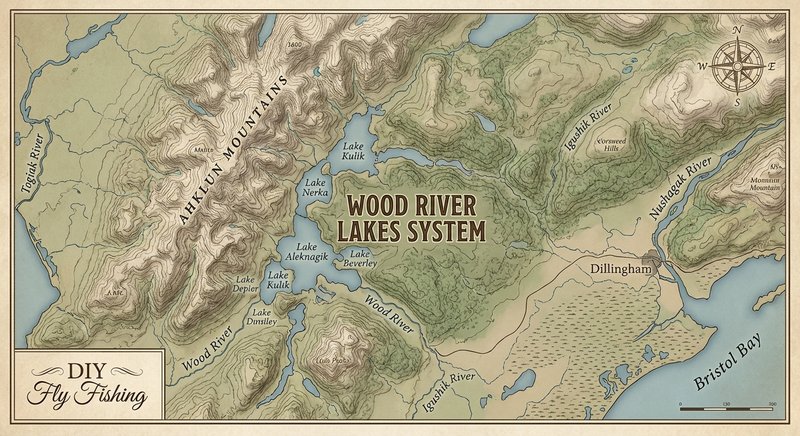
Wood River Lakes System
Fly fishing in Alaska · Intermediate · Best seasons: Summer, Fall
Target Species
Rainbow Trout, Sockeye Salmon, Arctic Char
About This Water
Bristol Bay lake chain with world-class rainbow trout. Multiple interconnected waters.
Fishing Recommendations
Welcome to the Wood River Lakes system, one of the most prolific and breathtaking freshwater fisheries on the planet. Located within Wood-Tikchik State Park—the largest state park in the United States—this system is a sprawling labyrinth of six large, deep glacial lakes connected by short, swift rivers.
As your guide, I’m here to break down how to navigate this wilderness paradise.
🎣 Location Overview
The Wood River Lakes system (Lake Aleknagik, Nerka, Beverley, Kulik, Mikchalk, and Manokotak) is the "nursery" for the Bristol Bay salmon runs. What makes this area special is the interconnectivity. Because these lakes are linked by short river stretches (agulukpaks), fish congregate in high densities at the "mouths" and "outlets" of these rivers.
The water is crystalline, often allowing for sight-fishing, and is surrounded by the jagged, snow-capped Kilbuk and Ahklun Mountains. Anglers love it because it offers a "triple threat": world-class dry fly fishing for Arctic Char, massive Rainbow Trout, and the sheer biomass of the Sockeye Salmon run.
🐟 Target Species & Behavior
Rainbow Trout
These are wild, native "leopard" rainbows, known for their heavy spotting.
- Behavior: In early summer, they hold in moving water eating out-migrating salmon smolt. In late summer/fall, they become "egg commandos," sitting directly behind spawning Sockeye.
- Feeding: Smolt, sculpins, and eventually millions of salmon eggs and flesh chunks.
Arctic Char
The Wood River system is world-famous for its Char.
- Behavior: They are highly nomadic. They follow the food. You'll find them in the lake shallows in June and moving into the river connectors by July.
- Feeding: They are notorious for "cruising" the surface in the lakes to gulp dry flies, but they transition to eggs and smolt as the season progresses.
Sockeye Salmon
The lifeblood of the system.
- Behavior: They enter the system in late June/early July. While they don't "feed" once they hit freshwater, they are aggressive and will strike flies out of territorial instinct or muscle memory.
- Feeding: They are generally targeted using the "Alaska Floss" technique or small, sparse wet flies.
📅 Best Times to Fish
- Mid-June to Early July (The Smolt Out-Migration): This is prime time for aggressive takes. Millions of salmon smolt head to sea, and Rainbows/Char stack up at the lake outlets to gorge. Expect explosive streamer action.
- July (The Sockeye Run): The rivers fill with red fish. This is the best time for Sockeye fishing and the beginning of the "egg drop."
- August to September (The Egg & Flesh Window): This is "Peak Season." As Sockeye spawn and die, Rainbows and Char reach their maximum weight. You will catch the largest fish of the year during these months.
- Time of Day: In the land of the midnight sun, the fish don't stop. However, early morning and late evening often provide the calmest winds for lake-shore sight-fishing.
🪰 Recommended Flies & Techniques
For Rainbows & Char
- Technique (Early Season): "Swing and Strip." Use sink-tip lines with smolt patterns.
- Technique (Late Season): Dead-drifting beads (egg imitations) under an indicator is the gold standard.
- Top Flies:
- Beads: 6mm and 8mm in "Mottled Roe," "Orange Clear," and "Peachy King."
- Streamers: Dolly Varden Specials, Thunder Creek Smolt, and Sculpzilla (Olive/White).
- Dries (For Char): Royal Wulff, parachute Adams, or large Foam Ants.
For Sockeye Salmon
- Technique: The "Bristol Bay Sweep." A short cast at a 45-degree angle, letting the fly drift into the mouths of the fish.
- Top Flies: Montana Red Snatcher, Sockeye Special, or simple Sparsely Tied Hare’s Ear.
💡 Pro Tips & Local Knowledge
- The "Agulukpak" Focus: The Agulukpak River (the "Pak") is perhaps the most famous stretch. If you can get there, fish the upper mile where it leaves Lake Beverley. It is a Rainbow Trout factory.
- Watch the Gulls: In the big lakes, look for hovering gulls. They are spotting schools of smolt being pushed to the surface by predatory Char. This is your cue to cast streamers or dries into the "boil."
- The "Walking the Dog" Flesh Technique: In September, use a ginger-colored "flesh fly." Instead of a standard drift, give it slight twitches to mimic a piece of salmon meat tumbling in the current.
- Match the Egg: Not all eggs are the same color. Early in the spawn, use bright, translucent beads. As the season progresses and eggs "die," switch to opaque, washed-out pinks and whites.
⚠️ Important Information
Access
- Remote Only: This system is not on the road grid. You must fly into Dillingham (DLG) via Anchorage. From Dillingham, you take a floatplane or a long boat ride from Aleknagik.
- Lodges vs. DIY: Most anglers stay at fly-out lodges (like Tikchik Narrows or Royal Coachman), but DIY float trips are possible for experienced wilderness travelers.
Regulations & Permits
- License: You need an Alaska State Fishing License and a King Salmon stamp (if targeting Kings, though they are less common in the upper lakes).
- Catch & Release: Most of the upper Wood River system is Single-Hook, Unbaited, Artificial Lure ONLY, and Rainbow Trout are generally catch-and-release only to preserve the trophy genetics.
Special Considerations
- Bears: This is Brown Bear country. You will see them, especially during the salmon spawn. Carry bear spray, stay vocal, and never keep fish near your person if a bear is within 100 yards.
- Gear: 6-weight rods for Trout/Char; 8-weight rods for Sockeye. High-quality Gore-Tex waders are non-negotiable—the water is glacial and cold year-round.
Guide’s Final Word: The Wood River system is the soul of Alaska. Respect the fish, watch the horizon for weather, and keep your fly in the water. Tight lines!
Bug Hatches & Matching Flies
| Hatch | Type | Peak months | Time of day | Hook sizes | Matching flies |
|---|---|---|---|---|---|
| Chironomid (Midge) Family Chironomidae | midge | May, June, September | All Day | #18-24 | Zebra Midge #18-22, Griffith's Gnat #20-22, Ice Bud #18-20 |
| Grannom Caddis Brachycentrus spp. | caddis | June | Afternoon/Evening | #12-16 | Peacock Caddis #14-16, Deep Sparkle Pupa #14-16, Elk Hair Caddis (Olive) #14-16 |
| Blue Winged Olive (BWO) Baetis spp. | mayfly | May, August, September | Late Morning/Afternoon | #16-20 | RS2 #18-20, Parachute Adams #16-20, Pheasant Tail #16-18 |
| Golden Stonefly Hesperoperla pacifica | stonefly | June, July | Morning/Afternoon | #6-10 | Pat's Rubber Legs (Tan/Orange) #8-10, Stimulator #8-12, 20 Incher #10 |
| Traveling Sedge Hesperophylax spp. | caddis | July, August | Evening | #8-12 | Goddard Caddis #8-10, Miked-Up Sedge #10-12, Soft Hackle Hare's Ear #12 |
| Little Black Stonefly Capniidae family | stonefly | May | Midday | #14-18 | Early Girl Stone #16-18, Black Copper John #16-18, Black Biot Stone #14-16 |
| Pale Morning Dun Ephemerella spp. | mayfly | July, August | Late Morning/Early Afternoon | #14-16 | PMD Sparkle Dun #14-16, Hare's Ear Nymph #14-16, Quill Gordon #14 |
| Crane Fly Tipulidae family | terrestrial | August | Afternoon | #8-12 | Daddy Long Legs #10-12, Foam Crane Fly #8-10 |