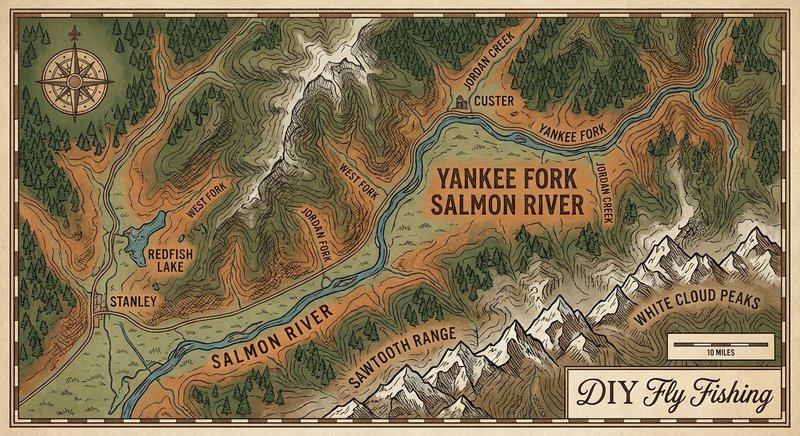
Yankee Fork Salmon River
Fly fishing in Idaho · Intermediate · Best seasons: Summer, Fall
Target Species
Rainbow Trout, Bull Trout
About This Water
Historic mining area stream with wild rainbow and bull trout. Scenic backcountry fishing.
Fishing Recommendations
Welcome to one of Central Idaho’s most intriguing and rugged fisheries. As your guide, I’m excited to walk you through the Yankee Fork of the Salmon River. Located near the historic town of Stanley and the ghost town of Bonanza, this river offers a mix of raw mountain beauty and a fascinating (though scarred) mining history.
🎣 Location Overview
The Yankee Fork is a major tributary of the Upper Salmon River. It is a high-elevation freestone stream that flows through the heart of the Salmon-Challis National Forest.
What makes this water special is its resilience. For decades, the lower section was heavily impacted by gold dredging (leaving behind the famous tailing piles), but extensive restoration projects have breathed new life into the river. Anglers love the Yankee Fork because it offers a "choose your own adventure" experience: you can fish the lower restored meadow sections, the high-gradient canyon stretches, or the pristine alpine headwaters. It is less crowded than the main Salmon River and offers a true "wild Idaho" feel.
🐟 Target Species & Behavior
While you mentioned Rainbows and Bull Trout, it is critical to note that Westslope Cutthroat Trout are the primary residents here.
- Rainbow/Redband Trout: Found throughout the system, particularly in the swifter runs and deeper pockets. They are opportunistic and hard-fighting.
- Bull Trout: These are the "ghosts" of the river. They are predatory and migratory. They hold in deep, cold pools and near the mouths of cold-water tributaries. They follow the Kokanee and Chinook runs to feast on eggs and flesh.
- Westslope Cutthroat: These are the stars of the upper river. They are notorious for rising to dry flies and will hold in surprisingly shallow water at the tail-outs of pools.
- Mountain Whitefish: Plentiful and great fun on a light rod when the trout are finicky.
📅 Best Times to Fish
The Yankee Fork is a high-country fishery, meaning the window is relatively short.
- July (Post-Runoff): The magic begins once the spring snowmelt subsides (usually early to mid-July). This is prime time for dry fly action.
- August: The most consistent month. Water levels are stable, and the "hopper-copper-drop" rig is king.
- September & October: This is the "Golden Window." The cottonwoods turn yellow, the Bull Trout become more active as they prepare to spawn, and the Cutthroat are looking to fatten up before winter.
- Time of Day: During the heat of summer, 9:00 AM to 4:00 PM is fantastic for dry flies. In the fall, wait for the water to warm up slightly; 11:00 AM to 3:00 PM is the sweet spot.
🪰 Recommended Flies & Techniques
Top Fly Patterns
- Dries:
- Chubby Chernobyl (Orange, Purple, or Tan) - Size 8-12.
- Parachute Adams - Size 14-18.
- Stimulators (Yellow or Royal) - Size 10-14.
- Nymphs:
- Pat’s Rubber Legs (Brown/Black) - Size 8-10.
- Perdigons (Olive or Blue) - Size 14-16.
- Bead-head Prince Nymphs - Size 12-16.
- Streamers (for Bull Trout):
- White or Olive Sculpzilla - Size 4.
- Sex Dungeon - Size 2.
- Game Changers (White/Cream).
Techniques & Presentation
- The "Pocket Water" Approach: The Yankee Fork is full of boulders. High-sticking nymphs or "skating" a large dry fly through the cushion in front of boulders is deadly.
- Dry-Dropper: Use a buoyant Chubby Chernobyl as your indicator and hang a heavy perdigon 2–3 feet below it.
- Streamer Stripping: If targeting Bulls, find the deepest, darkest holes. Cast your streamer upstream, let it sink deep, and use an aggressive, erratic strip back.
💡 Pro Tips & Local Knowledge
- Look for the Restoration Zones: The lower river (near the Custer Motorway) has undergone massive restoration. Look for the man-placed log jams and boulder complexes; these are magnets for larger Rainbows and the occasional Bull Trout.
- The "Custer" Stretch: Fishing near the ghost town of Custer offers great access. The river here is smaller and very manageable for wading.
- The Bull Trout "Tell": If you see a 12-inch Cutthroat suddenly go quiet or dive for cover, there is likely a large Bull Trout in that hole. Switch to a streamer immediately.
- Stealth Matters: In the clear summer water, these fish can be spooky. Avoid wearing bright colors and try to stay low when approaching the banks.
⚠️ Important Information
Access
- Custer Motorway: This is your primary access road. It follows the river for many miles. Some sections are paved, but much of it is well-maintained gravel.
- Wading: The river is generally very "wadeable" in late summer, but be careful of the dredge tailings—those rocks can be loose and unstable.
Regulations & Permits
- License: You must have a valid Idaho Fishing License.
- Bull Trout: These are a federally protected species. You may target them for catch-and-release, but they cannot be removed from the water. Use barbless hooks and handle them with extreme care.
- Barbless Hooks: While not always required by law in every stretch, they are highly recommended to preserve the wild fish population.
- Check the Rulebook: Idaho Fish & Game (IDFG) regulations can change annually regarding Chinook Salmon seasons, which may close certain sections of the river to all fishing to protect spawning beds. Always check the current IDFG seasons and rules.
Safety
- Bears: This is Bear Country (both Black and Grizzly). Carry bear spray and know how to use it.
- Sun/Elevation: You are at high altitude. Wear sunscreen and stay hydrated.
Enjoy the Yankee Fork—it’s a piece of Idaho history that just happens to have some of the funnest trout fishing in the West!
Bug Hatches & Matching Flies
| Hatch | Type | Peak months | Time of day | Hook sizes | Matching flies |
|---|---|---|---|---|---|
| Salmonfly Pteronarcys californica | stonefly | June, July | All Day | #4-8 | Rogue River Stone #4-6, Pats Rubber Legs #6-8, Chubby Chernobyl (Orange) #6-10 |
| Golden Stonefly Hesperoperla pacifica | stonefly | July | Morning/Evening | #8-12 | Norm Wood Special #8-10, Golden Twenty-Incher #10-12, Yankee Fork Stone #10 |
| Pale Morning Dun (PMD) Ephemerella invaria/excrucians | mayfly | July, August | Late Morning/Afternoon | #14-18 | Sparkle Dun #16-18, Parachute Adams #14-18, Pheasant Tail #16-18 |
| Western Green Drake Drunella doddsii | mayfly | July | Afternoon | #10-12 | Green Drake Hairwing Dun #10-12, Military Mayfly #10-12, Drake Cripple #12 |
| Blue Winged Olive (BWO) Baetis tricaudatus | mayfly | April, May, September, October | Mid-day | #18-22 | RS2 #20-22, BWO Parachute #18-20, Micro Mayfly #18-22 |
| Little Yellow Stonefly (Yellow Sally) Isoperla spp. | stonefly | July, August | Late Afternoon/Evening | #14-16 | Yellow Sally Stimulator #14-16, Iron Lotus (Yellow) #16, Little Yellow Stone #14 |
| Spotted Sedge Hydropsyche | caddis | July, August, September | Evening | #14-18 | Elk Hair Caddis (Tan) #14-16, LaFontaine's Deep Sparkle Pupa #16, X-Caddis #14-18 |
| Grasshoppers Orthoptera | terrestrial | August, September | Late Morning/Afternoon | #8-12 | Morrish Hopper #8-12, Letort Hopper #10-12, Amy's Ant #10 |
| Black Ants Formicidae | terrestrial | July, August | All Day | #16-20 | Cinnamon Ant #16-18, Black Foam Ant #16-20, Transparant #18 |