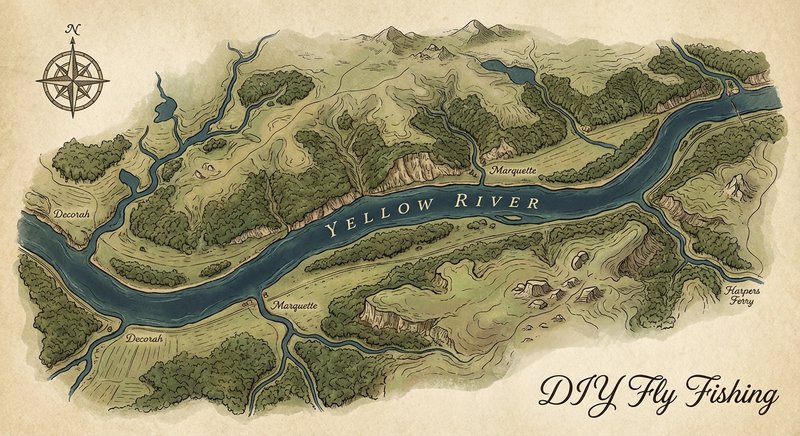
Yellow River
Fly fishing in Iowa · intermediate · Best seasons: spring, summer, fall
Target Species
Brown Trout, Brook Trout
About This Water
Driftless Area stream with excellent trout habitat. Paint Creek unit offers quality fishing.
Fishing Recommendations
The Yellow River in Northeast Iowa is often called the "gem of the Driftless." Unlike many of the tiny, brush-choked spring creeks common to the region, the Yellow River offers a larger, more expansive feel, flowing through dramatic limestone bluffs and the lush hardwoods of the Yellow River State Forest. It is one of the most scenic and productive cold-water fisheries in the Midwest.
🎣 Location Overview
The Yellow River is a freestone-style river fed by numerous cold-water springs. It winds through Allamakee and Winneshiek counties, carving deep valleys into the limestone plateau.
What makes it special is the diversity of the water. You’ll find classic riffle-run-pool sequences, expansive flats, and deep, dark undercut banks. Because it is slightly larger than neighboring creeks like Waterloo or French Creek, it allows for a wider variety of tactics, including dedicated streamer stripping and longer dry fly drifts. The section flowing through the Yellow River State Forest (Paint Creek Unit) is particularly beloved for its public access and "big water" feel in a land of small streams.
🐟 Target Species & Behavior
- Brown Trout: The king of the Yellow River. You’ll find a mix of savvy holdover fish and wild-reproduction browns. They are predatory and territorial. Large browns (18”+) tend to hold in the deepest "guts" of pools during the day or tight against submerged timber and limestone ledges.
- Brook Trout: Primarily found in the upper reaches and the cold-water tributaries (like North Blue Creek or Paint Creek). They are more opportunistic and aggressive than the browns but much more sensitive to water temperature.
- Behavior: In the spring, fish are active in the midday sun. As summer hits, they become "crepuscular," feeding heavily at dawn and dusk. They rely heavily on the Driftless area’s incredible biomass—scuds, sowbugs, and a massive variety of aquatic insects.
📅 Best Times to Fish
- Spring (Late March – May): This is the prime window for hatches. The Blue-Winged Olive (BWO) and Grannom Sedge hatches can be spectacular. Water levels are usually good, though spring rains can blow the river out occasionally.
- Summer (June – August): This is Terrestrial Season. While the main stem can get warm in late July, the shaded sections and areas near spring inflows remain productive. Focus on early mornings and late evenings.
- Fall (September – October): This is arguably the best time for trophy Browns. As they prepare to spawn, they become aggressive and territorial. The fall colors in the State Forest are world-class.
- Optimal Window: 10:00 AM to 3:00 PM in Spring/Fall; 5:30 AM to 10:00 AM and 6:00 PM to Dark in Summer.
🪰 Recommended Flies & Techniques
Dry Flies
- Terrestrials (Summer): Dave’s Hopper (size 10-14), Black Ants (16-18), and Hippie Stompers.
- Mayflies: BWO Sparkle Duns (18-22), Light Cahills (14-16) in early summer.
- Caddis: Elk Hair Caddis (14-18) in tan or olive.
Nymphs (The Bread & Butter)
- Scuds & Sowbugs: This is the Driftless staple. Gray or Olive Scud (14-18) and Ray Charles (16-18).
- Attractors: Pheasant Tail (14-18), Zebra Midge (18-22), and the Frenchie.
Streamers
- Patterns: Black or Olive Wooly Buggers (6-10), Sculpzilla, or Gold Ribbed Hare’s Ear streamers.
- Technique: "Pounding the banks." Cast tight to the undercut banks and strip back aggressively to trigger a reaction strike from a big Brown.
💡 Pro Tips & Local Knowledge
- The "Big Timber" Strategy: The Yellow River has a lot of fallen trees. Don't be afraid to lose flies. The biggest trout sit directly under the tangles of wood where the current sweeps food toward them.
- Water Clarity: The Yellow River can take a day or two longer to clear than smaller spring creeks after a rain. If the main stem is "chocolate milk," head upstream to the smaller tributaries like Paint Creek, which clear faster.
- Stealth is Key: Despite the river being larger, the water is often crystal clear. Keep a low profile, wear earthy tones (no bright white shirts), and try to avoid wading deeply unless necessary to cross.
- The "Dropper" Rig: A very effective local tactic is a "Hopper-Copper-Dropper"—a large foam hopper on top with a weighted nymph (like a Copper John or Pheasant Tail) suspended 18-24 inches below it.
⚠️ Important Information
- Access: The Yellow River State Forest provides miles of public access. Look for the "Fishing Access" signs and DNR parking lots. There are also several easements on private land; always respect "End of Public Access" signs.
- Regulations: Iowa requires a valid fishing license and a Trout Fee.
- Barbless Hooks: While not always mandated by law, using barbless hooks is highly recommended to protect the wild trout populations and make catch-and-release easier.
- Safety: The banks can be muddy and slippery. Felt-soled boots or studs are recommended for navigating the limestone rocks. Watch out for wild parsnip in the summer—it can cause nasty skin burns if you brush against it in shorts!
Guide’s Final Word: The Yellow River isn't just a fishing trip; it's an immersion into the wildest corner of Iowa. Bring a 4-weight or 5-weight rod, a box of scuds, and your camera. Tight lines!
Bug Hatches & Matching Flies
| Hatch | Type | Peak months | Time of day | Hook sizes | Matching flies |
|---|---|---|---|---|---|
| Blue-Winged Olive Baetis | mayfly | April, May, September, October | Mid-day/Afternoon | #18-22 | RS2 #20-22, BWO Parachute #18-20, Pheasant Tail #18-22 |
| Grannom Caddis Brachycentrus | caddis | April, May | Afternoon/Evening | #14-16 | Peacock Caddis #14-16, Green Weenie #14-16, LaFontaine's Deep Sparkle Pupa #14-16 |
| Sulphur Ephemerella invaria | mayfly | May, June | Evening | #14-18 | Sulphur Parachute #16-18, Sulphur Emerger #16-18, Hares Ear #14-18 |
| Trico Tricorythodes | mayfly | July, August, September | Morning | #20-24 | Trico Spinner #20-24, Zebra Midge #20-24, Griffith's Gnat #20-22 |
| Light Cahill Stenacron interpunctatum | mayfly | June, July | Late Afternoon/Evening | #12-14 | Light Cahill #12-14, Gold Ribbed Hare's Ear #12-14 |
| Spotted Sedge Hydropsyche | caddis | June, July, August | Evening | #14-18 | Elk Hair Caddis (Tan) #14-18, Hydropsyche Larva #14-16, Soft Hackle Hare's Ear #14-16 |
| Terrestrials Orthoptera/Formicidae | terrestrial | July, August, September | All Day | #8-16 | Dave's Hopper #8-12, Black Foam Ant #14-18, Chernobyl Ant #8-12 |
| Little Black Stonefly Capniidae | stonefly | March, April | Mid-day | #14-18 | Early Girl Stonefly #16-18, Prince Nymph #14-18, Kaufmann's Stone #14-16 |
| Crane Fly Tipulidae | terrestrial | August, September | Morning/Evening | #10-14 | Daddy Long Legs #10-12, Crane Fly Larva #10-12 |