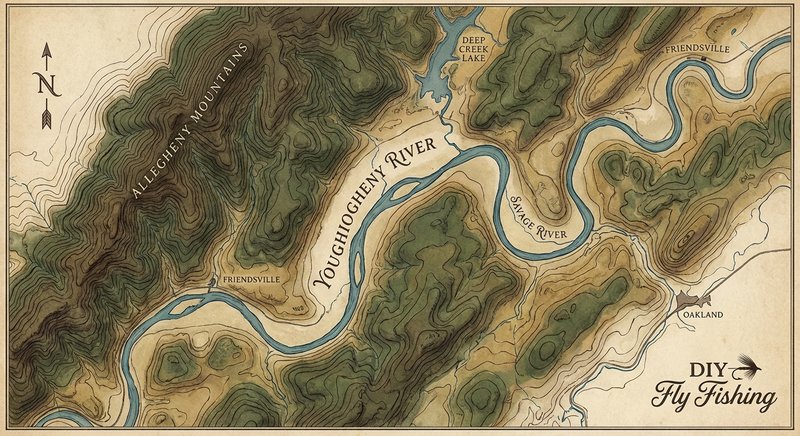
Youghiogheny River
Fly fishing in Maryland · Intermediate · Best seasons: Spring, Summer, Fall
Target Species
Smallmouth Bass, Brown Trout, Rainbow Trout
About This Water
Western Maryland river with smallmouth bass and trout. Scenic Deep Creek Lake region.
Fishing Recommendations
The "Yough" (pronounced yock) in Western Maryland is one of the most rugged, beautiful, and rewarding rivers in the Mid-Atlantic. Located in Garrett County, it is Maryland’s only designated "Wild and Scenic River." It offers a unique dual-personality fishery: a premier tailwater trout fishery in its upper reaches and a world-class smallmouth bass fishery as you move downstream.
Here is your comprehensive guide to fly fishing the Youghiogheny.
🎣 Location Overview
The Youghiogheny is a high-gradient, rocky river characterized by large boulders, deep pools, and heavy pocket water. What makes it special is the Deep Creek Lake Power Plant. Cold water is released from the bottom of Deep Creek Lake into the river, creating a "tailwater effect" that keeps water temperatures cool enough for trout even in the heat of July.
The river is physically demanding. Wading here is notoriously difficult due to "Yough Grease" (slick algae) and unstable boulders. However, the reward is a wild, backcountry feel with the chance to land 20-inch wild brown trout or aggressive river smallmouth in a stunning canyon setting.
🐟 Target Species & Behavior
Brown and Rainbow Trout
- Behavior: The trout in the Yough are hardy and strong due to the heavy current. They are primarily found in the Catch and Release (C&R) Trout Management Area, which runs from the Deep Creek Lake Power Plant downstream to the Sang Run Bridge.
- Holding Spots: Look for trout in "pocket water"—the soft eddies behind large boulders—and at the heads of deep pools. During high sun, they tuck deep under ledge rocks.
- Feeding: They are opportunistic but can be selective during hatches. They lean heavily on caddis, stoneflies, and sculpins.
Smallmouth Bass
- Behavior: Smallmouth dominate the river from Sang Run downstream through Friendsville and into the "Gap." These are hard-fighting, wild fish.
- Holding Spots: Look for "slack water" near fast currents, behind mid-river obstructions, and along shaded banks with overhanging trees.
- Feeding: Their diet is heavy on crayfish and hellgrammites (dobsonfly larvae), which are incredibly abundant in this river.
📅 Best Times to Fish
Spring (April – June)
- Conditions: The best time for trout. High water can be an issue, but this is when the major hatches occur.
- Windows: Mid-day to evening. Look for the Hendrickson and March Brown hatches in May.
Summer (July – August)
- Conditions: Peak Smallmouth season. For trout, the Yough is a "summer sanctuary" because of the cold-water releases.
- Windows: Early morning and late evening. CRITICAL: You must check the Deep Creek Hydro release schedule. If the plant is generating for whitewater rafters, the river becomes unfishable and dangerous for waders.
Fall (September – November)
- Conditions: The "Golden Hour" for big Brown Trout. As temperatures drop, Browns become aggressive before their spawn.
- Windows: All day. Smallmouth remain active until water temps dip below 50°F.
🪰 Recommended Flies & Techniques
Trout Patterns
- Nymphs: Pat’s Rubber Legs (Black/Tan #6-10), Pheasant Tail (#14-18), Prince Nymph (#12-16).
- Dry Flies: Elk Hair Caddis (Tan/Olive #14-16), Stimulators (Orange/Yellow #8-12), Sulphurs (#16) in June.
- Streamers: Black or Olive Wooly Buggers, Sculpin patterns (muddler minnows) swung through deep slots.
Smallmouth Patterns
- Sub-surface: Murray’s Hellgrammite (a local legend), Clouser Minnows (Chartreuse/White), and Crayfish patterns.
- Topwater: BoogleBugs or small poppers in yellow or green.
Presentation Tips
- High-Sticking/Euro Nymphing: Because the river is so rocky, traditional long-line nymphing results in constant snags. Use a short line and heavy nymphs to "bounce" through the pockets.
- The "Yough Swing": Swing large streamers through the "tail-outs" of pools for aggressive brown trout.
💡 Pro Tips & Local Knowledge
- The "Release" is Everything: The Brookfield Renewable website posts the release schedule.
- No Release: Best for fishing.
- One Unit: Wading is difficult but possible for experienced anglers in certain spots.
- Two Units: Get out of the water. The river rises rapidly and becomes a Class IV/V whitewater run.
- Stealth Matters: Despite the heavy water, the Yough is very clear. Wear earthy tones and avoid splashing while wading.
- The Sang Run "Gap": If you are physically fit, hike downstream from Sang Run into the roadless canyon. The fishing pressure drops significantly, and the smallmouth size increases.
- Hellgrammites: If you aren't sure what to use, tie on a black hellgrammite pattern. Everything in the river—trout and bass—eats them year-round.
⚠️ Important Information
- Access:
- Hoyes Run: Popular access point for the trout section.
- Sang Run State Park: Great access for the transition between trout and bass water.
- Friendsville: Best access for lower river smallmouth.
- Regulations: The section from the Power Plant to Sang Run is Catch and Release Only, Artificial Lures/Flies Only. Check the Maryland DNR Maryland Guide to Fishing & Boating for updated boundary lines.
- Safety: Studded wading boots and a wading staff are mandatory. The rocks are incredibly slippery.
- Permits: A Maryland Non-Tidal Fishing License and a Trout Stamp are required for all anglers over 16.
Guide’s Final Word: The Yough isn't an easy river, but it is a "honest" river. If you put in the miles and watch your footing, it will produce some of the most beautiful wild fish in the Eastern United States.
Bug Hatches & Matching Flies
| Hatch | Type | Peak months | Time of day | Hook sizes | Matching flies |
|---|---|---|---|---|---|
| Blue Winged Olive Baetis | mayfly | April, May, September, October | Afternoon | #18-22 | BWO Sparkle Dun #18-20, Pheasant Tail #18-22, RS2 #20-22 |
| Grannom Caddis Brachycentrus | caddis | April | Morning/Afternoon | #14-16 | Elk Hair Caddis (Olive) #14-16, LaFontaine's Deep Sparkle Pupa #14-16, Peacock Caddis #16 |
| Sulphur Ephemerella invaria/dorothea | mayfly | May, June | Evening | #14-18 | Sulphur Parachute #14-18, Sulphur Snowshoe Emerger #16-18, Frenchie #14-16 |
| Golden Stonefly Acroneuria lycorias | stonefly | June, July | Afternoon/Evening | #8-12 | Golden Stone Nymph #8-12, Stimulator #10-12, Pat's Rubber Leg #8-12 |
| Cinnamon Caddis Hydropsyche | caddis | June, July, August | Evening | #14-18 | Tan Elk Hair Caddis #14-18, Holy Grail #14-16, X-Caddis #16-18 |
| Trico Tricorythodes | mayfly | July, August, September | Morning | #22-26 | Trico Spinner #22-26, Griffith's Gnat #22-24, Trico Emerger #24 |
| Light Cahill Stenacron | mayfly | June, July | Evening | #12-14 | Light Cahill #12-14, Cream Usual #14, Hare's Ear (Light) #14 |
| Ants and Beetles Hymenoptera / Coleoptera | terrestrial | July, August, September | All Day | #12-18 | Black Foam Ant #16-18, Cricket #12-14, Flash Beetle #14-16 |
| Zebra Midge Chironomidae | midge | January, February, March, December | All Day | #18-24 | Zebra Midge (Red or Black) #18-22, Mercury Midge #20-24, Midge Cluster #18-20 |