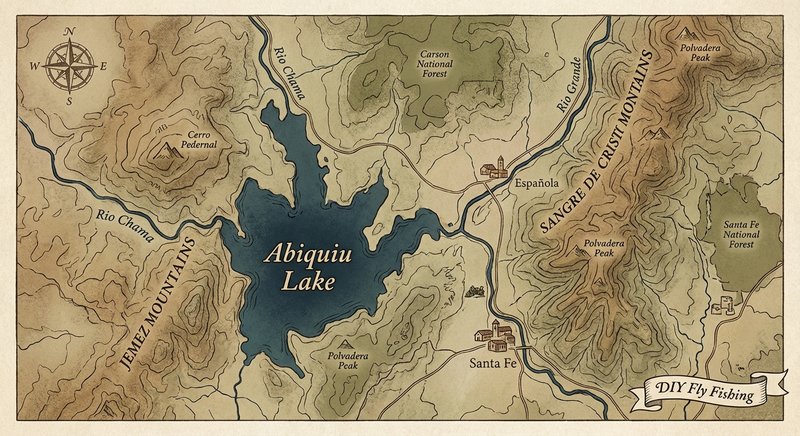
Abiquiu Lake
Fly fishing in New Mexico · Beginner · Best seasons: Spring, Summer, Fall
Target Species
Smallmouth Bass, Walleye, Rainbow Trout
About This Water
Reservoir on the Chama River in red rock country. Warm water species and some trout.
Fishing Recommendations
Abiquiu Lake is one of New Mexico’s most visually stunning and rewarding fisheries. Tucked into the red rock country made famous by Georgia O’Keeffe, this 5,200-acre reservoir is fed by the Rio Chama. While many New Mexico anglers focus on the trout streams to the north, fly fishing "the Lake" offers a world-class opportunity for warm-water species and nomadic salmonids.
Here is your guide to mastering Abiquiu Lake.
🎣 Location Overview
Abiquiu Lake is a high-desert reservoir defined by dramatic sandstone cliffs, deep blue water, and a rugged shoreline. What makes it special is its diversity; it is arguably the best Smallmouth Bass fishery in the state, while simultaneously hosting a healthy population of Walleye and Rainbow Trout.
The water characteristics fluctuate based on the Rio Chama’s flow. In the spring, runoff can bring silt, but for most of the year, the water is clear enough for sight-fishing along the rocky ledges. Anglers love it because it offers a "big water" experience where you can catch 20-inch Smallmouth and trophy Walleye on a fly rod—a rarity in the Southwest.
🐟 Target Species & Behavior
Smallmouth Bass
The "bronzeback" is the king of Abiquiu. They are extremely aggressive and inhabit the rocky points, talus slopes, and submerged ledges.
- Behavior: In spring, they move to shallow flats for the spawn. In summer and fall, they hover around submerged structures and "the drop-off" (where the shelf falls into deep water).
- Feed: Primarily crawfish and juvenile gizzard shad or yellow perch.
Walleye
Abiquiu is one of the few places in the West where you can consistently target Walleye on the fly.
- Behavior: They are light-sensitive. During the day, they hold deep (20–40 feet). However, during "the magic hour" (dawn/dusk) or on overcast, windy days, they move into 5–10 feet of water to hunt.
- Feed: High-protein baitfish and leeches.
Rainbow Trout
These are nomadic here. They prefer the cooler water near the dam or the oxygenated water near the Rio Chama inlet.
- Behavior: They often cruise the surface in the early morning looking for midges or follow the baitfish schools.
- Feed: Midges, callibaetis, and small minnows.
📅 Best Times to Fish
- Spring (Late April – June): This is the Prime Window. As water temperatures hit 55–60°F, Smallmouth move to the shallows. Walleye are also active post-spawn.
- Summer (July – August): Best for "low light" sessions. Fish from 5:00 AM to 9:00 AM or the two hours before dark. Mid-day heat pushes fish deep, often out of fly rod range.
- Fall (September – November): The "Second Prime." As the water cools, bass and walleye move back to the shallows to gorge before winter. The clarity is usually at its peak.
🪰 Recommended Flies & Techniques
For Smallmouth & Walleye
You must get your fly to the fish. Intermediate or Type 3 sinking lines are essential unless the fish are spawning in the shallows.
- Streamers:
- Clouser Minnow: (Size 2-6) Chartreuse/White or Blue/White. The "jigging" motion is irresistible to Walleye.
- Near Nuff Craw: (Size 4-6) Rust or Olive. Fish this on the bottom with short, erratic strips.
- Game Changers: Small (3-inch) versions in shad patterns for trophy bass.
- Topwater:
- BoogleBugs or Popper Droppers: Use these early morning along the cliff faces for explosive Smallmouth strikes.
For Rainbow Trout
- Balanced Leeches: (Size 8-12) Black or Olive under an indicator.
- Zebra Midges: (Size 18-22) Silver or Red.
- Woolly Buggers: (Size 8-10) Thin Mint or White.
Techniques
- The "Countdown" Method: When fishing the ledges, cast toward the shore, count to 10 or 15 to let the sinking line get the fly down the rock face, and strip back toward the boat/tube.
- The Drag & Drop: For Walleye, use a heavy fly (bead-head) and literally "bounce" it off the bottom rocks.
💡 Pro Tips & Local Knowledge
- The "Walleye Chop": If the wind picks up and the water gets a bit "choppy," don't head for the ramp. This breaks up the light penetration, and Walleye will move into shallower water to hunt. Target the windward shores.
- Focus on the Inflow: The area where the Rio Chama enters the lake (the north end) is a biological hotspot. It brings in cooler water and nutrients. If the main lake is slow, head to the "river arm."
- Use a Float Tube or Kayak: Much of Abiquiu’s best shoreline is inaccessible by foot due to private land or vertical cliffs. Being on the water allows you to stay in the "strike zone" (15 feet off the rocks) consistently.
- Color Palette: In Abiquiu’s clear water, "Match the Canyon." Oranges, reds, and tans (crawfish colors) work exceptionally well.
⚠️ Important Information
- Access: The primary access is through the Abiquiu Lake Recreation Area (U.S. Army Corps of Engineers). There is a daily use fee.
- Regulations: A valid New Mexico Fishing License is required. Check the current NM Department of Game & Fish "Ribbon Press" for bag limits, as Walleye regulations can be specific to ensure a healthy population.
- Safety: This is a high-altitude desert. The sun is brutal, and wind storms can kick up in minutes. Always wear a PFD if you are in a kayak or float tube.
- Water Levels: Abiquiu is a reservoir used for irrigation and flood control. Check the USACE water levels before heading out; a rapidly dropping lake can make the fish "lock-jawed."
Guide’s Final Word: Abiquiu is a "quality over quantity" lake. You might work for your fish, but when the rod bends, it’s usually something you’ll want to take a picture of. Tight lines!
Bug Hatches & Matching Flies
| Hatch | Type | Peak months | Time of day | Hook sizes | Matching flies |
|---|---|---|---|---|---|
| Chironomids Chironomidae | midge | March, April, May, October | All Day | #12-22 | Ice Cream Cone #12-18, Zebra Midge #16-22, Griffith's Gnat #18-22 |
| Damselfly Enallagma spp. | terrestrial | June, July | Morning/Afternoon | #10-14 | Marabou Damsel #10-12, Adult Damsel #12-14 |
| Callibaetis Callibaetis | mayfly | June, August, September | Morning | #12-16 | Callibaetis Spinner #14-16, Hare's Ear Nymph #12-16, Parachute Adams #14-18 |
| Grasshoppers Melanoplus spp. | terrestrial | July, August, September | Afternoon | #6-12 | Amy's Ant #8-12, Parachute Hopper #10-12, Fat Albert #6-10 |
| Cinnamon Caddis Hydropsyche | caddis | June, July | Evening | #14-18 | Elk Hair Caddis #14-16, LaFontaine's Emerger #14-18 |
| Water Boatmen Corixidae | terrestrial | September, October | Afternoon | #14-18 | Water Boatman #14-16, Prince Nymph #14-18 |
| Black Ants Formicidae | terrestrial | July, August | All Day | #14-20 | Cinnamon or Black Ant #16-20, Chernobyl Ant #12-14 |
| Dragonfly Anisoptera | terrestrial | July, August | Afternoon | #4-10 | Dragonfly Nymph #6-10, Woolly Bugger (Olive) #4-8 |