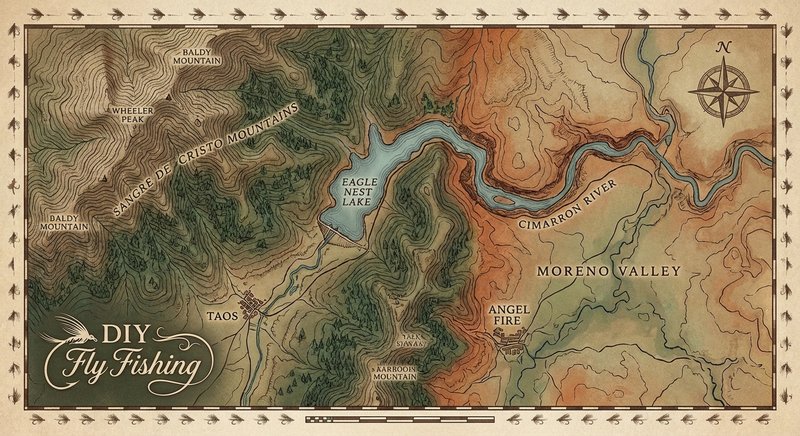
Eagle Nest Lake
Fly fishing in New Mexico · Beginner · Best seasons: Spring, Summer, Fall
Target Species
Rainbow Trout, Kokanee Salmon, Brown Trout
About This Water
Large high-altitude lake with trophy trout and kokanee salmon. Beautiful Moreno Valley setting.
Fishing Recommendations
Welcome to the high-country jewel of the Moreno Valley. As a guide who has spent years navigating the winds and hatches of the Sangre de Cristo Mountains, I can tell you that Eagle Nest Lake is one of the most productive stillwater fisheries in the American Southwest.
At an elevation of 8,200 feet, this 2,400-acre alpine reservoir offers a unique blend of "big water" tactics and delicate insect imitations. Here is your comprehensive guide to fly fishing Eagle Nest Lake.
🎣 Location Overview
Eagle Nest Lake is the center-piece of Eagle Nest Lake State Park, framed by the towering peaks of Wheeler Peak and Baldy Mountain. Unlike the technical tailwaters of the San Juan, Eagle Nest is a nutrient-rich stillwater environment.
The lake is characterized by extensive weed beds, shallow shelves, and a deep central channel. It is famous for its "cool summer" climate, making it a refuge when the lower elevation rivers become too warm to fish. Anglers love it because it offers the rare opportunity to catch trophy-sized trout and landlocked salmon in a setting that feels like the Swiss Alps.
🐟 Target Species & Behavior
Rainbow Trout
These are the most common targets. They range from recent stockies to "holdovers" that reach 20+ inches.
- Behavior: They are constant cruisers. They follow the shorelines in the spring and fall, moving into 10–20 feet of water during the heat of summer.
- Feeding: They focus heavily on Chironomids (midges) and Scuds.
Brown Trout
Eagle Nest holds some "monsters" that have migrated down from the tributary creeks or survived for years in the lake.
- Behavior: Highly predatory and structure-oriented. They often hold near the rocky dam area or deep within the submerged weed lines.
- Feeding: Larger Browns transition to a piscivorous (fish-eating) diet early, targeting yellow perch fry and smaller trout.
Kokanee Salmon
These landlocked Sockeye salmon are a prized catch, known for their incredible fight and silver flash.
- Behavior: They are school fish. During the summer, they stay deep in the thermocline (25–40 feet). In late fall (October), they move toward the shoreline and inlets for their terminal spawning run.
- Feeding: Primarily plankton feeders, but they will strike out of aggression at bright, flashy attractors.
📅 Best Times to Fish
Spring (Ice-out to Mid-June)
- The Window: This is arguably the best time for trophy trout. As the ice melts (usually April), trout move into the shallows to feed aggressively on winter-starved insects.
- Condition: Watch for the "Chironomid Buzz." On calm mornings, the water can look like it's raining from the sheer volume of emerging midges.
Summer (July to August)
- The Window: Early morning (sunrise to 10:00 AM) and late evening.
- Condition: The wind usually kicks up by noon. Get on the water early. This is "Callibaetis" season—look for mayfly hatches in the weed beds.
Fall (September to November)
- The Window: Late September through November.
- Condition: The Kokanee begin their run, and the Brown Trout become aggressive before their spawn. The water cools, and trout return to the shorelines.
🪰 Recommended Flies & Techniques
Nymphing Under an Indicator (The #1 Method)
Stillwater nymphing is the most effective way to fish Eagle Nest. Use a long leader (12–15 feet) to get flies down to the weed tops.
- Chironomids: Zebra Midges (black/silver, red/gold) in sizes 14–18. Ice Cream Cones in white or blood red.
- Scuds: Use olive or orange Scud patterns (size 14–16). The lake is crawling with these freshwater shrimp.
- Technique: Use a slow, rhythmic "static" retrieve. Let it sit, then move it an inch.
Stripping Streamers
Best for Browns and aggressive Rainbows.
- Patterns: Woolly Buggers (Black, Olive, or Thin Mint), Autumn Splendor, and Perch imitations.
- Technique: Fish an intermediate sinking line along the drop-offs. Use erratic strips to mimic a wounded perch.
Dry Fly Action
- Patterns: Parachute Adams (size 14–18), Callibaetis Cripples, and Griffiths Gnat.
- Technique: Target the "cruisers." If you see a rise, cast 3 feet in front of the direction the fish is traveling.
💡 Pro Tips & Local Knowledge
- Beware the Wind: Eagle Nest is notoriously windy. "The Moreno Valley Wind" usually arrives by 11:00 AM. If you are in a float tube or kayak, stay upwind of your vehicle so the wind blows you back to your launch point, not away from it.
- Find the "Inlets": Focus on the areas where Six Mile Creek and Moreno Creek enter the lake. These areas bring in fresh oxygen and nutrients, attracting schools of fish.
- The Perch Factor: There is a huge population of Yellow Perch in the lake. While they are a nuisance to some, they are the primary food source for trophy fish. Use flies with a "perch" color profile (chartreuse and orange) to trigger big strikes.
- The "Must-Kill" Rule: Be aware that Northern Pike have been illegally introduced to the lake. To protect the trout and salmon, New Mexico Game & Fish often has a "no release" policy for Pike. Bring a wire leader if you want to target these toothy predators!
⚠️ Important Information
- Access: Access is primarily through the State Park entrances. There is a daily vehicle fee (usually $5) unless you have an annual pass.
- Regulations: A valid New Mexico Fishing License and a Habitat Management & Access Validation (HMAV) are required.
- Boating: Gas motors are allowed but are "no wake" speed only. This makes it a paradise for paddle-craft and float tubes.
- Weather: High-altitude weather changes in minutes. Even in July, a thunderstorm can drop the temperature by 30 degrees. Always carry a rain shell and a life jacket (PFD).
Guide’s Final Word: If you see the water go glass-calm at dawn, tie on a two-midge rig 6 feet under a small indicator and fish the edge of the weed lines near the boat ramp. You’ll have the session of a lifetime. Tight lines!
Bug Hatches & Matching Flies
| Hatch | Type | Peak months | Time of day | Hook sizes | Matching flies |
|---|---|---|---|---|---|
| Chironomids (Midges) Chironomidae | midge | April, May, June, September, October | All Day | #14-22 | Zebra Midge #16-20, Ice Cream Cone #14-18, Griffith's Gnat #18-22 |
| Callibaetis (Speckled Duns) Callibaetis nigritus | mayfly | June, July, August | Morning/Early Afternoon | #12-16 | Callibaetis Spinner #14-16, Hare's Ear Nymph #12-16, Parachute Adams #14-18 |
| Damselfly Enallagma | terrestrial | June, July | Late Morning/Afternoon | #10-14 | Marabou Damsel Nymph #10-12, Adult Blue Damsel #12-14 |
| Cinnamon Caddis Hesperophylax designatus | caddis | July, August | Evening | #12-16 | Elk Hair Caddis (Cinnamon) #14-16, Pupa Emerger #14-16 |
| Dragonfly Anisoptera | terrestrial | July, August | Afternoon | #4-10 | Dragonfly Nymph #6-10, Bunny Leech (Olive) #4-8 |
| Grasshoppers Melanoplus | terrestrial | August, September | Afternoon | #8-12 | Joe's Hopper #8-12, Dave's Hopper #10-12 |
| Water Boatmen Corixidae | terrestrial | September, October | All Day | #14-18 | Prince Nymph #14-18, Water Boatman (Specific) #14-16 |
| Scud Gammarus | terrestrial | April, May, October, November | All Day | #12-18 | Ray Charles #14-18, Scud (Olive or Orange) #12-16 |