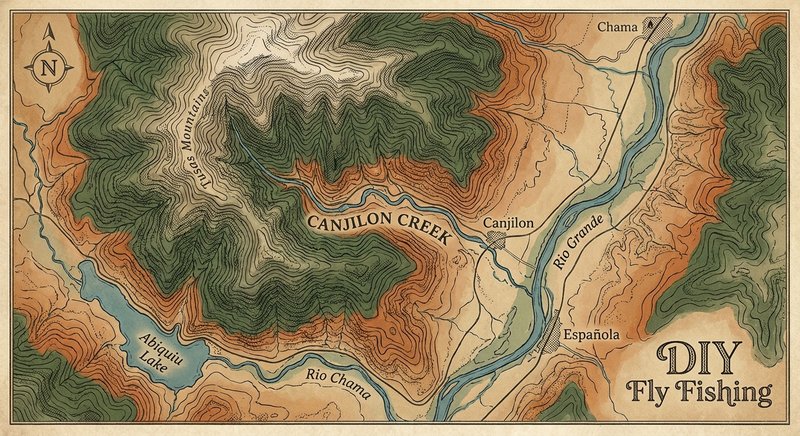
Canjilon Creek
Fly fishing in New Mexico · Beginner · Best seasons: Summer, Fall
Target Species
Rainbow Trout, Brown Trout
About This Water
Small northern New Mexico stream with wild trout. Scenic fishing in Carson National Forest.
Fishing Recommendations
As an expert guide who has spent years traversing the high-country waters of Northern New Mexico, I can tell you that Canjilon Creek is one of the state's best-kept "open secrets." Tucked away in the Carson National Forest near the iconic Canjilon Lakes, this creek offers a quintessential small-stream experience that rewards stealth, precision, and an appreciation for wild mountain scenery.
🎣 Location Overview
Canjilon Creek is a classic high-elevation freestone stream. What makes it special is its diversity; it transitions from tumbling pocket water and plunge pools in the upper reaches to meandering meadow bends and willow-lined undercut banks as it moves toward the valley.
The water is generally crystal clear and cold, fed by snowmelt and the overflow from the Canjilon Lakes system. Anglers love it because it offers "blue-ribbon" scenery without the crowds of the San Juan or the Pecos. It is an intimate fishery where a 20-foot cast is considered a long bomb, and the rewards are jewel-colored trout in a pristine alpine setting.
🐟 Target Species & Behavior
- Brown Trout: These are the "smart" residents of the creek. They are often wild and highly territorial. They tuck deep into undercut banks, beneath fallen timber, and in the dark shadows of the willow overshoots.
- Rainbow Trout: While some are wild, many in the upper reaches near the lakes are holdovers from stocking efforts. They tend to be more opportunistic and will hold in the faster "bubble lines" at the heads of pools.
Behavior: Because the growing season at 9,000+ feet is short, these fish are generally opportunistic feeders. However, they are incredibly "spooky." The vibration of a heavy footstep on the bank or a shadow casting over a pool will send every fish in the hole darting for cover.
📅 Best Times to Fish
- Summer (Late June – August): This is the prime window. Once the spring runoff subsides (usually by mid-June), the dry fly fishing becomes world-class. The water temperatures are perfect, and the fish are looking up.
- Fall (September – October): My personal favorite. The Gambel oaks and Aspens turn brilliant gold, and the Brown Trout become aggressive as they prepare for the spawn. The water levels drop, concentrating fish into the deeper holes.
- Time of Day: In the summer, wait for the sun to hit the water (around 9:30 AM) to activate insect life. In the fall, the "golden hour" (3:00 PM to sunset) provides spectacular dry fly action.
🪰 Recommended Flies & Techniques
Top Fly Patterns
- Dry Flies:
- Parachute Adams (Size 14-18): The ultimate generalist for this water.
- Elk Hair Caddis (Size 14-16): Best for the riffles and faster pocket water.
- Royal Wulff or Stimulator (Size 12-14): Great high-visibility attractors for the "choppy" sections.
- Nymphs:
- Bead-head Pheasant Tail (Size 16-18): Mimics the natural mayfly nymphs found under the rocks.
- Gold-ribbed Hare’s Ear (Size 16): Effective in the deeper beaver ponds.
- Streamers:
- Small Wooly Bugger (Black or Olive, Size 10-12): Use these in the larger pools or beaver ponds to find the "boss" Brown Trout.
Techniques
- The Dry-Dropper: This is the most effective rig for Canjilon. Use a buoyant Stimulator or Foam Hopper as your "indicator" and hang a small Pheasant Tail nymph 18–24 inches below it.
- Stealth Approach: Fish upstream. Stay low—sometimes even kneeling on the bank—to keep your silhouette off the horizon.
- Short Line Nymphing: In the tight, willow-choked sections, use a "high-stick" technique to drift your nymph through pocket water without your fly line touching the varying currents.
💡 Pro Tips & Local Knowledge
- Focus on the Beaver Ponds: Canjilon Creek is famous for its beaver activity. These ponds act as "growing chambers" where trout can reach much larger sizes than in the thin riffles. Approach these ponds like you are hunting; move slowly and cast to the edges of the submerged dam structures.
- The "Willow Flick": You will encounter heavy brush. Practice your side-arm cast and your "roll flick." If you can't get your fly under the overhanging willows, you are missing 50% of the fish.
- Look for Cold Inflows: During the heat of August, look for small spring seeps entering the creek. Fish will stack up in these oxygen-rich, cooler spots.
- Gear Selection: Leave the 5-weight at home. A 7.5ft to 8.5ft 3-weight rod is the perfect tool for this creek. It allows for delicate presentations and makes a 10-inch trout feel like a monster.
⚠️ Important Information
- Access: Access is primarily via NM-115 and then Forest Road 115. The road to the lakes is generally well-maintained but can become a muddy mess after a monsoon rain—4WD is recommended if the weather looks "sporty."
- Regulations: You must have a valid New Mexico Fishing License and a Gila Trout/Habitat Stamp. Always check the current NM Department of Game & Fish proclamation for seasonal closures or special lure restrictions.
- Safety: This is bear country. While Black Bears usually avoid humans, keep your snacks sealed and be "bear aware." Also, at 10,000 feet, afternoon thunderstorms move in fast. If you hear thunder, get off the water immediately—you are the tallest thing in the meadow.
- Leave No Trace: This is a fragile ecosystem. Please pack out everything you pack in and practice Catch and Release to preserve this mountain gem for the next generation.
Bug Hatches & Matching Flies
| Hatch | Type | Peak months | Time of day | Hook sizes | Matching flies |
|---|---|---|---|---|---|
| Midges Chironomidae | midge | March, April, May | All Day | #18-24 | Zebra Midge #18-22, Griffith's Gnat #20-22, Morgan's Midge #20-24 |
| Blue Winged Olive Baetis spp. | mayfly | April, May, September, October | Mid-day | #18-22 | Parachute Adams #18-22, RS2 #20-22, Pheasant Tail Nymph #18-20 |
| Western March Brown Rhithrogena morrisoni | mayfly | May, June | Afternoon | #12-14 | March Brown Dry #12-14, Gold Ribbed Hare's Ear #12-14 |
| Pale Morning Dun Ephemerella excrucians | mayfly | June, July | Late Morning/Afternoon | #16-18 | PMD Sparkle Dun #16-18, PMD Emerger #16-18, Frenchie #16-18 |
| Spotted Sedge Hydropsyche spp. | caddis | June, July, August | Evening | #14-18 | Elk Hair Caddis #14-18, LaFontaine's Deep Sparkle Pupa #14-16, Caddis Variant #16 |
| Golden Stonefly Hesperoperla pacifica | stonefly | June, July | Morning/Evening | #8-12 | Stimulator (Yellow) #10-12, Pat's Rubber Legs #8-12 |
| Terrestrials Formicidae / Gryllidae | terrestrial | July, August, September | Afternoon | #10-16 | Amy's Ant #12-14, Chernobyl Ant #10-14, Black Foam Beetle #14-16 |
| Little Brown Sedge Glossosoma spp. | caddis | May, June | Morning | #18-20 | Peeping Caddis #18, CDC Caddis Emerger #18-20 |