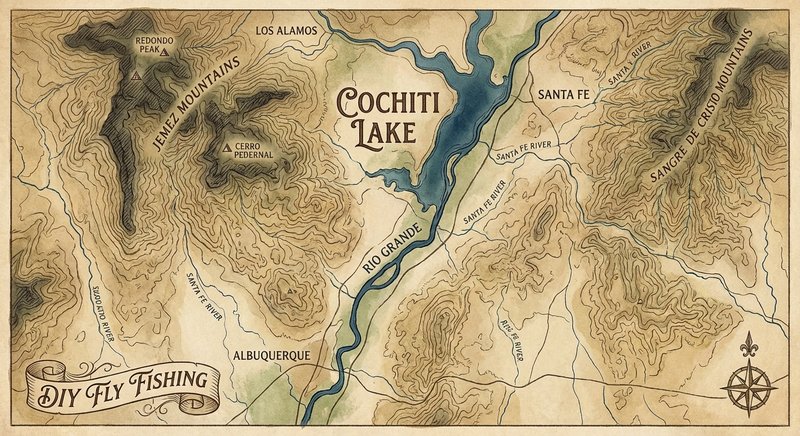
Cochiti Lake
Fly fishing in New Mexico · Beginner · Best seasons: Spring, Summer, Fall
Target Species
Largemouth Bass, Smallmouth Bass, Channel Catfish
About This Water
Large reservoir near Santa Fe with excellent bass and catfish. Easy access from Albuquerque.
Fishing Recommendations
Tighten your cinch knot and listen up—Cochiti Lake is a unique beast in the High Desert. While New Mexico is famous for its trout streams, Cochiti offers some of the best warm-water fly fishing in the state, provided you know how to handle its moods.
Located on the Rio Grande between Santa Fe and Albuquerque, Cochiti is a "no-wake" lake, making it a sanctuary for fly anglers in kayaks, canoes, and small motorboats who want to avoid the chaos of jet skis.
🎣 Location Overview
Cochiti Lake is a man-made reservoir managed by the U.S. Army Corps of Engineers. What makes it special is its permanent "no-wake" status, which keeps the water calm and the environment quiet. The lake is divided into two distinct personalities: the southern end near the dam features steep, rocky basalt cliffs and deep water, while the northern end (where the Rio Grande enters) is characterized by flooded timber, silt flats, and shallower willow lines.
The water clarity can be "New Mexico murky," especially after a monsoon or high spring runoff from the Rio Grande, which means fly anglers need to focus on vibration, silhouette, and movement rather than hyper-realistic imitations.
🐟 Target Species & Behavior
Smallmouth Bass
The "bronzebacks" are the stars of the rocky areas. They hold tight to the basalt ledges and the rip-rap along the dam. They are aggressive and will move from 15 feet deep up to the surface to smash a popper if the light is low. They feed primarily on crayfish and small gizzard shad.
Largemouth Bass
You’ll find the "buckets" primarily in the northern reaches and the Tetilla Peak side. They love the flooded salt cedar, submerged timber, and weed edges. They are more ambush-oriented than the smallmouth, waiting for a fly to twitch past a specific stump.
Channel Catfish
Wait, on a fly? Yes. Cochiti has a healthy population. During the summer, they move into the shallows of the northern flats to feed on baitfish and crawfish. Stripping a heavy, dark streamer slowly along the bottom can lead to a surprising (and very heavy) bend in an 8-weight rod.
📅 Best Times to Fish
- Spring (Late April – June): This is the prime window. As water temps hit the 55–60°F mark, bass move into the shallows for the pre-spawn and spawn. This is your best chance at a trophy Largemouth.
- Summer (July – August): Focus on the "Golden Hours"—dawn and dusk. The midday heat pushes fish deep, but the topwater action at sunrise can be explosive. This is also the best time for Catfish in the shallows at night/dusk.
- Fall (September – October): As the water cools, bass go on a feeding binge to prepare for winter. The Smallmouth action on the rocky points becomes world-class during these months.
Optimal Conditions: Overcast days are a gift at Cochiti. The lack of shade on the water means clouds keep the fish shallow and active longer into the day.
🪰 Recommended Flies & Techniques
Top Patterns
- Topwater: BoogleBugs (size 4), Gurglers (white or chartreuse), and foam frogs.
- Sub-surface: Clouser Minnows (Chartreuse/White or Grey/White to mimic Shad), Meat Whistles (Olive or Black), and Near Nuff Craws (Rusty Orange).
- The "Cochiti Special": A black or purple Woolly Bugger (size 4-6) with plenty of flash and a heavy brass bead.
Techniques
- The "Pop and Pause": When using poppers, the pause is more important than the pop. Let the rings disappear before moving the fly again. Bass often hit when the fly is dead still.
- Dredging the Ledges: Use a sink-tip line (Type 3 or 6) to get streamers down 10–20 feet along the basalt cliffs for Smallmouth.
- Peripheral Casting: In the flooded timber, you must cast tight to the wood. If you aren't risking a snag, you aren't in the strike zone.
💡 Pro Tips & Local Knowledge
- The "Tetilla Hole": The area near the Tetilla Peak boat ramp often holds more Largemouth due to the structure. However, the road to this side is frequently closed for seasons at a time—check the Corps of Engineers website before driving out.
- Wind Management: The "Canyon Effect" can create sudden, high winds at Cochiti. If you see whitecaps forming, get off the main body of the lake immediately.
- Mud Lines: Look for where the clearer lake water meets the murkier Rio Grande inflow. Predatory fish sit right on that seam to ambush baitfish coming down the river.
- Kayaker's Advantage: Because it’s no-wake, a pedal-drive kayak is the ultimate weapon here. You can stealthily maneuver through the flooded timber where big fiberglass bass boats fear to tread.
⚠️ Important Information
- Access: There are two main recreation areas: Cochiti (West side, near the town of Pena Blanca) and Tetilla Peak (East side). Both require a day-use fee.
- Regulations: A valid New Mexico Fishing License is required. Cochiti is a "Special Trout Water" isn't applicable here, but standard warm-water limits apply. Check the current NM Department of Game & Fish Rib for bag limits.
- Safety: The lake is on Cochiti Pueblo land, though the water and recreation areas are federal. Respect all posted signs. Some areas of the shoreline are Pueblo land and are off-limits to foot traffic.
- No-Wake Rule: This is strictly enforced. Even if you have a 300HP motor, you must stay at idle speed. This makes it a paradise for fly casters who hate dealing with boat wakes.
Guide’s Final Word: Bring an 8-weight rod. You might think it's overkill for bass, but when a 6-pound Cochiti Largemouth dives for the salt cedars, or a rogue 10-pound Carp or Catfish grabs your fly, you'll want the backbone to turn their head.
Bug Hatches & Matching Flies
| Hatch | Type | Peak months | Time of day | Hook sizes | Matching flies |
|---|---|---|---|---|---|
| Midges Chironomidae | midge | March, April, October, November | All Day | #18-24 | Zebra Midge #18-22, Griffith's Gnat #20-24, Palomino Midge #20-22 |
| Callibaetis (Speckled Duns) Callibaetis spp. | mayfly | May, June, September | Late Morning | #12-16 | Parachute Adams #14-16, Hare's Ear Nymph #12-16, Callibaetis Spinner #14-16 |
| Damselflies Enallagma spp. | terrestrial | June, July, August | Afternoon | #10-12 | Marabou Damselfly Nymph #10-12, Adult Damselfly #10-12 |
| Blue Winged Olives Baetis spp. | mayfly | April, May, October | Midday | #18-22 | BWO Sparkle Dun #18-22, RS2 #20-22, Pheasant Tail Nymph #18-20 |
| Grasshoppers Melanoplus spp. | terrestrial | July, August, September | Afternoon | #6-12 | Dave's Hopper #8-12, Amy's Ant #10-12, Morrish Hopper #8-10 |
| Water Boatmen Corixidae | terrestrial | September, October | All Day | #14-16 | Water Boatman #14-16, Prince Nymph #14-16 |
| Spotted Sedge Hydropsyche spp. | caddis | May, June | Evening | #14-18 | Elk Hair Caddis #14-16, LaFontaine's Deep Sparkle Pupa #14-18 |
| Dragonflies Anisoptera | terrestrial | June, July, August | All Day | #4-8 | Dragonfly Nymph #4-8, Gummi Dragonfly #6-8 |