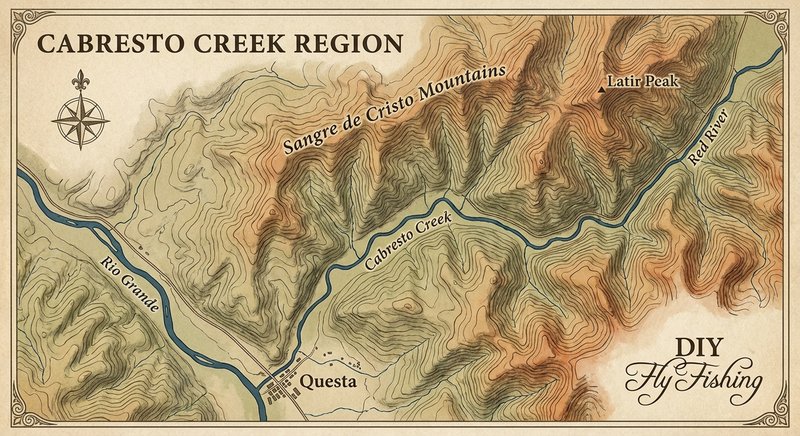
Cabresto Creek
Fly fishing in New Mexico · Beginner · Best seasons: Summer, Fall
Target Species
Brown Trout, Rainbow Trout
About This Water
Mountain stream near Questa with wild trout. Good access and scenic views.
Fishing Recommendations
Welcome to the high country of the Sangre de Cristo Mountains. As your guide, I can tell you that Cabresto Creek is one of Northern New Mexico’s hidden gems. While most anglers flock to the Red River or the Rio Grande, Cabresto offers a classic "small water" experience characterized by crystal-clear plunge pools, tight technical casting, and stunning alpine scenery.
Here is your comprehensive guide to fishing Cabresto Creek.
🎣 Location Overview
Cabresto Creek is a high-altitude tributary located north of Questa, New Mexico. It flows out of the Latir Peak Wilderness, through Cabresto Lake, and winds its way down toward the Red River.
What makes this water special is its intimacy. This is not "big river" fishing; it is a quintessential mountain creek. The water is characterized by pocket water, small waterfalls, and deep, emerald-colored undercut banks. Because it requires a bit of a drive up a rugged forest road, the fishing pressure is significantly lower than nearby waters, offering a sense of solitude that is hard to find elsewhere in the Enchanted Circle.
🐟 Target Species & Behavior
While the creek is home to various trout, your primary targets are:
- Brown Trout: Found predominantly in the middle and lower stretches. These fish are wild, spooky, and highly territorial. They love to hold in the shadows of undercut banks and beneath overhanging willows.
- Rainbow Trout: Often found in the pools closer to the Cabresto Lake dam and the canyon stretches just below. They tend to hang in the faster "bubble line" at the head of pools.
- The "Bonus" Fish: Be prepared to encounter Brook Trout in the upper reaches and the occasional Rio Grande Cutthroat, New Mexico's state fish, which are being protected and restored in the higher elevations of this drainage.
Behavior: These fish are opportunistic but wary. In the clear, thin water of the high desert mountains, their "window of vision" is small. If they see your shadow or a splashy line, the pool is "blown" for thirty minutes.
📅 Best Times to Fish
Optimal Seasons: Summer & Fall
- Summer (Late June – August): This is the prime window for dry fly action. The water temperatures have stabilized after the snowmelt (runoff), and the insect life is peaking. Note: Watch the afternoon monsoons in July and August; they can turn the creek murky quickly, but the fishing right before the rain hits can be electric.
- Fall (September – October): My personal favorite. The Brown Trout become aggressive as they prepare for the spawn. The aspen trees turn gold, and the fish are eager to bulk up for winter.
Best Times of Day
- 10:00 AM – 4:00 PM: Because this is a high-altitude shaded canyon, the water stays cold. You don't need to be there at the crack of dawn. Wait for the sun to hit the water and activate the bugs.
🪰 Recommended Flies & Techniques
Top Fly Patterns
- Dry Flies:
- Elk Hair Caddis (Size 14–18): The gold standard here. Tan or Olive.
- Parachute Adams (Size 16–20): For when the fish are being picky in flat water.
- Royal Wulff or Stimulator (Size 12–16): Great high-visibility "attractor" patterns for the fast pocket water.
- Nymphs:
- Bead-head Pheasant Tail (Size 16–18): Mimics almost any mayfly nymph in the system.
- Hare’s Ear (Size 14–16): Great for the deeper plunge pools.
- Terrestrials (Late Summer):
- Amy’s Ant or Foam Grasshoppers (Size 12–14): The trout here love a big meal dropped near the bank.
Effective Techniques
- The Dry-Dropper: This is the most effective rig for Cabresto. Use a buoyant dry fly (like a Stimulator) and hang a small nymph 12–18 inches below it.
- The "Bow and Arrow" Cast: The brush is thick here. You will often find yourself in spots where a traditional backcast is impossible. Learn the bow-and-arrow cast to flick your fly into tight pockets.
- High-Sticking: Keep as much fly line off the water as possible to avoid "drag." The complex currents in small creeks will pull your fly unnaturally if the line sits on the water.
💡 Pro Tips & Local Knowledge
- Stealth is Survival: Wear drab colors (greens/browns) to blend into the forest. Approach every pool from downstream, staying low. If you can see the fish, they have likely already seen you.
- Focus on the "Tail-outs": While everyone casts to the "head" of the pool where the water falls in, the bigger Browns often sit in the "tail-out" (the flat water at the end of the pool) during the evening to sip emerging insects.
- The "Hike-to-Fish" Ratio: The best fishing starts about half a mile away from any parking pull-off. If you are willing to bushwhack through the willows, you will find fish that haven't seen a fly in weeks.
⚠️ Important Information
- Access: To reach the upper creek and Cabresto Lake, you will take Forest Road 134 from Questa.
- Warning: This road is steep and can be rough. While a passenger car can sometimes make it in dry conditions, a high-clearance vehicle (4WD/AWD) is strongly recommended.
- Regulations: A valid New Mexico Fishing License is required. Check the current NM Department of Game and Fish "Ribbons of Blue" proclamation for any emergency closures or specific bag limits (catch and release is always encouraged for wild mountain trout).
- Safety:
- Bears: This is active Black Bear country. Carry bear spray and keep food locked in your vehicle.
- Altitude: You will be fishing at 9,000+ feet. Drink twice as much water as you think you need to avoid altitude sickness.
Tight lines, and enjoy the silence of the Sangres!
Bug Hatches & Matching Flies
| Hatch | Type | Peak months | Time of day | Hook sizes | Matching flies |
|---|---|---|---|---|---|
| Blue-Winged Olive Baetis spp. | mayfly | April, May, September, October | Late Morning/Afternoon | #18-22 | RS2 #18-22, Parachute Adams #18-22, Pheasant Tail Nymph #18-20 |
| American Grannom Brachycentrus occidentalis | caddis | April, May | Afternoon/Evening | #14-16 | Peacock Caddis #14-16, Holy Grail #14-16, LaFontaine's Deep Sparkle Pupa #14-16 |
| Pale Morning Dun Ephemerella excrucians | mayfly | June, July | Late Morning/Afternoon | #16-18 | PMD Sparkle Dun #16-18, Mercury PMD #16-18, Split Case PMD #16-18 |
| Yellow Sally Isoperla spp. | stonefly | June, July, August | Late Afternoon/Evening | #14-16 | Stimulator (Yellow) #14-16, Yellow Sally Foam Run #16, Iron Lotus #14-16 |
| Golden Stonefly Hesperoperla pacifica | stonefly | June, July | Morning/Evening | #8-12 | Pat's Rubber Legs #8-12, Golden Stimulator #8-12, 20 Incher Stone #10-12 |
| Spotted Sedge Hydropsyche spp. | caddis | July, August, September | Evening | #14-18 | Elk Hair Caddis (Tan) #14-18, Caddis Variant #14-16, Z-Wing Caddis #16 |
| Terrestrials (Grasshoppers, Ants, Beetles) Various | terrestrial | July, August, September | Late Morning/Afternoon | #10-18 | Amy's Ant #12-14, Parachute Hopper #10-14, Black Foam Beetle #16-18 |
| Chironomids (Midges) Chironomidae | midge | January, February, March, December | Morning/Mid-day | #20-24 | Zebra Midge #20-22, Griffith's Gnat #20-24, Top Secret Midge #20-22 |