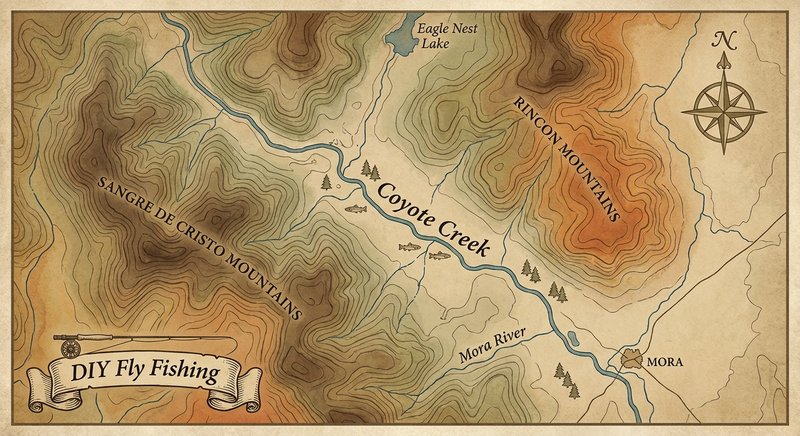
Coyote Creek
Fly fishing in New Mexico · Beginner · Best seasons: Summer, Fall
Target Species
Brown Trout, Rainbow Trout
About This Water
Small stream near Mora with wild trout. Beautiful meadow fishing.
Fishing Recommendations
Coyote Creek, winding through the lush mountain meadows near Guadalupita and Angel Fire, is one of New Mexico’s most charming and productive small-stream fisheries. As your guide, I can tell you that while it may not have the fame of the San Juan, it offers a classic "blue-line" experience: intimate water, stunning scenery, and eager trout.
🎣 Location Overview
Coyote Creek is a small, meandering tributary of the Mora River located in the Sangre de Cristo Mountains. The crown jewel of this water is Coyote Creek State Park, which offers some of the best-maintained access in the region.
The creek is characterized by a mix of high-alpine meadows, dense willow thickets, and small canyon-like rocky stretches. The water is generally shallow and clear, consisting of classic riffle-run-pool sequences. What makes it special is its accessibility paired with its "small water" charm—it is the perfect place for an angler who loves a 3-weight rod and a stealthy approach.
🐟 Target Species & Behavior
- Brown Trout: These are the wild residents of the creek. They are wary and prefer the "living room" of the stream—undercut banks, deep holes under fallen timber, and the dark shadows beneath overhanging willows. They are most active during low-light periods.
- Rainbow Trout: The state stocks the creek regularly, particularly within the State Park boundaries. These fish are usually found in the faster-moving riffles and the heads of pools. They are generally less selective than the Browns and will compete aggressively for food.
Behavior Note: Because the creek is small, these fish are "spooky." Vibrations on the bank or a shadow cast over a pool will shut down the fishing for thirty minutes. Stealth is your most important piece of gear here.
📅 Best Times to Fish
- Summer (Late June – August): This is prime time for dry fly fishing. Once the spring runoff subsides (usually by mid-June), the creek becomes very stable.
- Warning: Beware of the "Monsoon Season" in July and August. Afternoon thunderstorms can cause rapid "blowouts" (muddy water), though the creek usually clears quickly.
- Fall (September – October): My personal favorite. The Brown trout begin moving and become more aggressive as they prepare for the spawn. The cottonwoods and willows turn gold, and the crowds at the State Park thin out significantly.
- Prime Window: 8:00 AM to 11:00 AM, and 4:00 PM until dusk. During the heat of mid-summer, the "evening rise" (caddis hatch) can be spectacular.
🪰 Recommended Flies & Techniques
Top Fly Patterns
- Dry Flies:
- Parachute Adams (#14-18): The gold standard for any NM mountain stream.
- Elk Hair Caddis (#14-16): Tan or Olive; excellent for the evening hatches.
- Stimulators (#12-14): Orange or Yellow; acts as a great attractor and high-vis lead for a dropper.
- Nymphs:
- Bead-head Pheasant Tail (#16-18): Mimics the small mayflies common here.
- Flashback Hare’s Ear (#16): Great for the murky water after a light rain.
- Zebra Midge (#18-22): Red or Black; essential for picky fish in slow pools.
- Terrestrials (Summer Only):
- Joe's Hopper or Dave's Hopper (#10-12): The meadows are full of grasshoppers in August.
- Black Foam Ants (#16-18): Lethal under the willow overhangs.
Techniques & Presentation
- The Dry-Dropper: This is the most effective way to fish Coyote Creek. Use a buoyant dry fly (like a Stimulator) with a small nymph tied 18–24 inches below it. This allows you to cover two water columns without a bulky plastic indicator that might spook fish.
- The "Dapping" Method: In tight willow sections, don't even try to cast. Simply poke your rod tip through the brush and drop your fly onto the water.
- Short Casts: Most of your shots will be under 20 feet. Focus on accuracy and a drag-free drift.
💡 Pro Tips & Local Knowledge
- Work Upstream: Always fish moving upstream. Because the water is shallow and clear, trout face into the current; if you approach from behind them, you are much less likely to be seen.
- Look for the "Deep" Spots: On a creek this small, "deep" might only mean 2 or 3 feet. These holes are where the larger Browns hide. If you find a pool that looks darker than the rest, spend extra time there.
- The "Guadalupita Stretch": If the State Park feels too crowded, look for public access points further downstream near the town of Guadalupita. The water here is slightly warmer but holds some surprisingly large Browns.
- Gear Recommendation: Use a 7.5 to 9-foot rod in a 2, 3, or 4-weight. Use a 5X or 6X tippet. Anything heavier will be visible to the fish in the clear summer water.
⚠️ Important Information
- Access: Coyote Creek State Park is located on NM Highway 434, about 18 miles north of Mora. A daily North Mexico State Park pass or a valid camping permit is required to park.
- Regulations: You must have a valid New Mexico Fishing License and a Habitat Management & Access Validation (HMAV).
- Current Limits: Standard trout limits apply (typically 5 fish), but I strongly encourage Catch and Release for the wild Brown trout to preserve the fishery.
- Safety: This is bear and cougar country. While they generally avoid people, be mindful of your surroundings, especially when fishing solo in dense willow thickets.
- Private Property: Respect the boundaries. Much of the land outside the State Park is private ranch land. Only fish where it is clearly marked as public or State Park land.
Bug Hatches & Matching Flies
| Hatch | Type | Peak months | Time of day | Hook sizes | Matching flies |
|---|---|---|---|---|---|
| Blue-Winged Olive Baetis | mayfly | March, April, September, October | Late Morning/Afternoon | #18-22 | RS2 #18-22, Parachute Adams #18-22, Pheasant Tail Nymph #18-20 |
| Pale Morning Dun Ephemerella | mayfly | June, July, August | Morning/Early Afternoon | #16-18 | PMD Sparkle Dun #16-18, Split Case PMD #16-18, Hare's Ear Nymph #14-16 |
| Yellow Sally Isoperla | stonefly | June, July | Afternoon/Evening | #14-16 | Yellow Sally Stone #14-16, Iron Lotus #16, Stimulator #14-16 |
| Caddis (Grannom/Sedge) Brachycentrus / Hydropsyche | caddis | May, June, July | Evening | #14-18 | Elk Hair Caddis #14-18, LaFontaine's Deep Sparkle Pupa #16, Peacock Caddis #16-18 |
| Golden Stonefly Hesperoperla pacifica | stonefly | June | Morning/Afternoon | #8-12 | Pat's Rubber Legs #8-12, Golden Stimulator #10-12, 20 Incher #10-12 |
| Grasshoppers Acrididae | terrestrial | July, August, September | Midday/Afternoon | #10-14 | Joe's Hopper #10-12, Dave's Hopper #12-14, Parachute Hopper #12-14 |
| Midges Chironomidae | midge | February, March, November | All Day | #20-24 | Zebra Midge #20-22, Griffith's Gnat #20-22, Mercury Midge #20-24 |
| Trico Tricorythodes | mayfly | August, September | Early Morning | #20-24 | Trico Spinner #22-24, Sunken Trico Spinner #22-24 |