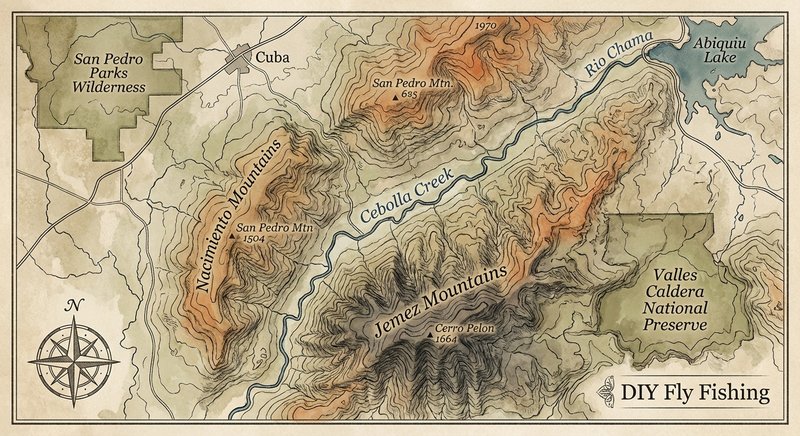
Cebolla Creek
Fly fishing in New Mexico · Advanced · Best seasons: Summer, Fall
Target Species
Cutthroat Trout
About This Water
Small stream with native Rio Grande cutthroat trout. Technical fishing in pristine setting.
Fishing Recommendations
Welcome to one of New Mexico’s true high-country gems. As your guide, I’m excited to walk you through Cebolla Creek. Tucked away in the Jemez Mountains within the Santa Fe National Forest, the Cebolla (Spanish for "onion") is a quintessential small-stream fly fishing destination.
🎣 Location Overview
Cebolla Creek is a high-elevation spring-fed and snowmelt stream that meanders through lush mountain meadows and tight volcanic canyons. What makes it special is its intimacy; this isn't a place for long casts, but rather for stealth and precision.
The water characteristics vary from "meadow-style" s-curves with deep undercut banks to pocket water sections over cobble and fallen timber. Anglers love it because it offers a classic "blue ribbon" small-stream experience where the scenery—towering ponderosa pines and golden aspens—is as breathtaking as the fish. It is one of the premier locations to find New Mexico’s state fish in a wild, pristine environment.
🐟 Target Species & Behavior
The crown jewel here is the Rio Grande Cutthroat Trout.
- Behavior: These are opportunistic but wary fish. In the meadow sections, they are notorious for hovering under overhanging grasses or tight against undercut banks. In the faster pocket water, they sit in the "soft" spots behind boulders.
- Feeding: They are highly keyed into terrestrial insects (grasshoppers, ants, beetles) during the summer and opportunistic nymph feeders year-round. Because the growing season is short at this altitude, they are generally eager to rise to a well-placed dry fly.
- Size: Expect fish in the 6-10 inch range, with a "trophy" for this water being anything over 12 inches.
📅 Best Times to Fish
Optimal Seasons
- Summer (Late June – August): This is the prime window. The water has receded after the spring runoff, and the terrestrial action is at its peak.
- Fall (September – October): My personal favorite. The aspens turn gold, the air is crisp, and the fish are aggressively feeding to bulk up for winter. The Rio Grande Cutthroat’s colors are most vibrant during the fall.
Best Times of Day
- Mid-Morning to Late Afternoon: Unlike lower-elevation tailwaters, the Cebolla stays cool. You don’t need to be there at the crack of dawn. The best dry fly action usually begins around 10:00 AM once the sun hits the water and wakes up the bugs.
Prime Windows
- Post-Monsoon: In July and August, afternoon thunderstorms are common. Fishing just after a light rain can trigger a feeding frenzy as insects are washed into the creek.
🪰 Recommended Flies & Techniques
Top Fly Patterns
- Dry Flies:
- Stimulators (Size 14-16, Orange or Yellow) – Great for imitating stoneflies or hoppers.
- Parachute Adams (Size 16-20) – The ultimate searcher pattern.
- Amy’s Ant or Fat Angie (Size 14) – Perfect for the meadow reaches.
- Elk Hair Caddis (Size 16-18, Tan).
- Nymphs:
- Bead Head Pheasant Tail (Size 16-18).
- Copper John (Size 18, Red or Copper).
- Zebra Midge (Size 20, Black/Silver).
- Streamers:
- Small Woolly Buggers (Size 10-12, Olive or Black) for the deeper pools.
Effective Techniques
- Dry-Dropper: This is the most effective way to fish the Cebolla. Use a buoyant dry fly (like a Stimulator) and hang a small nymph 12–18 inches below it.
- The Stealth Approach: Because the water is crystal clear and shallow, you must stay low. Approach pools from downstream and avoid casting your shadow over the water.
- Dapping: In the tight, brushy areas, you may not be able to cast. Simply poke your rod tip through the brush and "dap" the fly on the surface.
💡 Pro Tips & Local Knowledge
- Focus on the Meadows: The Seven Springs area and the meadows near the Fenton Lake inlet offer classic meadow fishing. Look for the "dark water" against the banks—that’s where the bigger Cutthroats hide.
- The "Cebolla Crawl": If you see fish rising in the meadows, get on your knees. If you can see them, they have definitely already seen you.
- Check the Flows: Being a small creek, it can get "blown out" by heavy monsoon rains in July. Always check local weather reports for the Jemez Springs area before driving up.
- Gear: Use a light setup. A 2-weight or 3-weight rod (7.5 to 8 feet) is perfect. Use a 5x or 6x fluorocarbon tippet to avoid spooking the fish in the clear water.
⚠️ Important Information
Access
- Access is excellent via NM State Road 126.
- The Seven Springs State Fish Hatchery area provides great public access to the upper reaches.
- The section above Fenton Lake State Park is also very popular and productive.
Regulations & Permits
- License: A valid New Mexico Fishing License and a Habitat Management & Access Validation are required.
- Special Rules: Portions of Cebolla Creek are designated as "Special Trout Water." Check the current NM Department of Game and Fish (NMDGF) proclamation, as some sections may be Catch and Release only or require barbless hooks.
- Respect the Fish: Rio Grande Cutthroats are a sensitive species. Keep them in the water, use wet hands, and release them quickly.
Special Considerations
- Wildlife: This is bear and mountain lion country. Carry bear spray and be aware of your surroundings.
- Altitude: You will be fishing at 8,000+ feet. Stay hydrated and be prepared for rapid weather changes.
Bug Hatches & Matching Flies
| Hatch | Type | Peak months | Time of day | Hook sizes | Matching flies |
|---|---|---|---|---|---|
| Blue-Winged Olive Baetis spp. | mayfly | March, April, September, October | Late Morning/Afternoon | #18-22 | RS2 #18-22, Parachute Adams #18-20, Pheasant Tail Nymph #18-20 |
| Pale Morning Dun Ephemerella excrucians | mayfly | June, July | Late Morning/Early Afternoon | #16-18 | PMD Sparkle Dun #16-18, Hare's Ear Nymph #16, Barr's PMD Emerger #16-18 |
| Caddisflies Hydropsyche & Brachycentrus | caddis | June, July, August | Evening | #14-18 | Elk Hair Caddis #14-18, LaFontaine's Deep Sparkle Pupa #14-16, Caddis God-Slayer #16 |
| Yellow Sally Isoperla spp. | stonefly | June, July | Late Afternoon/Evening | #14-16 | Yellow Sally Stimulator #14-16, Iron Lotus #16, Little Yellow Sloan #16 |
| Grasshoppers Orthoptera | terrestrial | July, August, September | Midday | #10-14 | Parachute Hopper #12-14, Joe's Hopper #10-12, Amy's Ant #12-14 |
| Midges Chironomidae | midge | January, February, March, November, December | All Day | #18-24 | Zebra Midge #18-22, Griffith's Gnat #20-22, Top Secret Midge #20-24 |
| Golden Stonefly Hesperoperla pacifica | stonefly | June | Morning/Evening | #8-12 | Pat's Rubber Legs #8-12, Golden Stimulator #10-12, 20 Incher Stone #10-12 |
| Trico Tricorythodes spp. | mayfly | August, September | Early Morning | #20-24 | Trico Spinner #20-24, WD-40 #20-22, Sunken Trico Spinner #22 |